


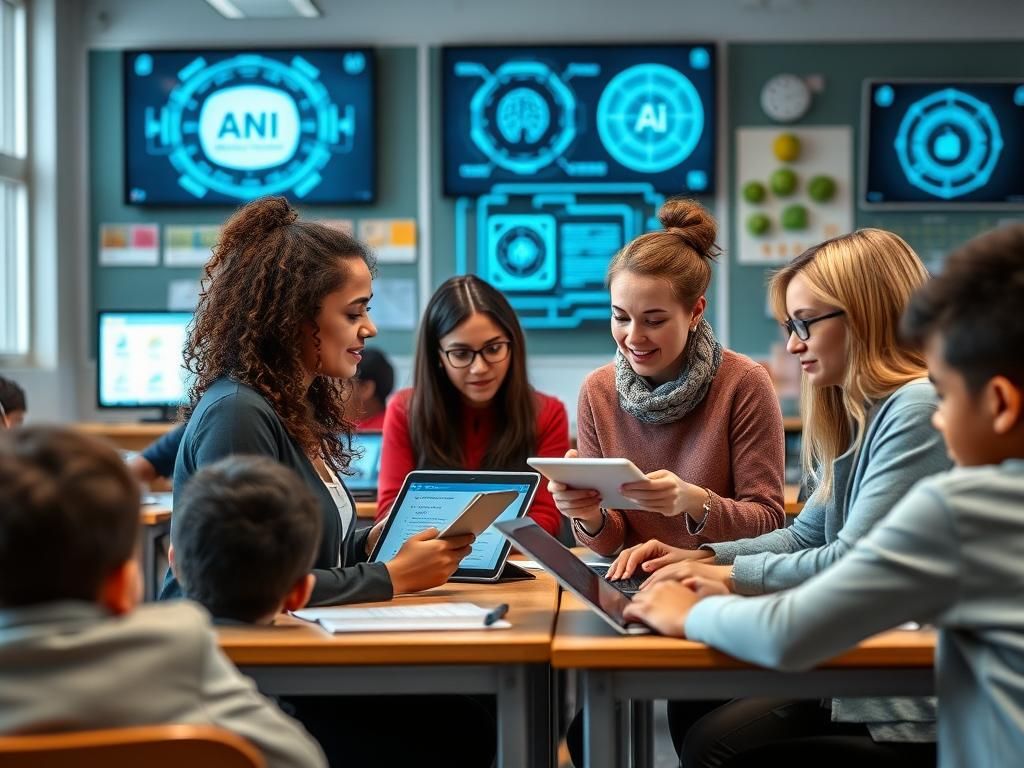
AI in the Classroom: Equipping Educators for the Future
SAN ANTONIO, Texas — On a scorching Saturday in San Antonio, dozens of educators from the city’s largest Northside Independent School District opted for a glimpse into the future rather than a day off. Their mission: to explore how artificial intelligence could revolutionize their classrooms. Teachers marveled as AI instantly graded assignments, transformed traditional lesson plans into engaging podcasts, and crafted online storybooks, prompting one high school English teacher to voice a poignant concern echoing many in the room: “Are we going to be replaced with AI?”
This question looms large for the nation’s 4 million teachers as the education sector faces an unprecedented technological shift. In an unexpected turn, America’s largest teachers unions have forged alliances with some of the world’s most powerful technology companies, aiming to equip educators with AI literacy and guide students in its responsible use. While the two groups haven’t always seen eye-to-eye, they now share a common goal: preparing the future workforce for an AI-integrated world.
A Multi-Million Dollar Investment in Education’s Future
The American Federation of Teachers (AFT), the country’s second-largest teachers union, has secured significant funding from tech giants. Microsoft is contributing $12.5 million over five years, OpenAI is providing $8 million in funding along with $2 million in technical resources, and Anthropic has pledged $500,000. This substantial investment, totaling over $23 million plus additional resources, will enable the AFT to establish an AI training hub in New York City, with plans to open at least two more and train a formidable 400,000 teachers over the next five years.
Randi Weingarten, President of the AFT, acknowledged an initial skepticism in these negotiations but emphasized the critical need for external funding. “There is no one else who is helping us with this. That’s why we felt we needed to work with the largest corporations in the world,” Weingarten stated, clarifying that the unions initiated the outreach to the tech companies.
Similarly, the National Education Association (NEA), representing 3 million educators as the nation’s largest teachers union, announced its own partnership with Microsoft. A $325,000 grant from Microsoft will support the NEA in developing AI “microcredentials” – online training modules designed to reach at least 10,000 members this school year, according to Daaiyah Bilal, NEA’s senior director of education policy. Both unions have stipulated that educators, not the corporate funders, will design and lead these trainings, which will cover safety and privacy alongside practical AI skills, with the intellectual property remaining with the unions.
Tech’s Strategic Play and Government Endorsement
For tech companies, these partnerships represent a strategic opportunity to embed their AI tools within the education system and influence the next generation of users in the competitive “race for AI dominance.” Microsoft, for instance, has committed to a $4 billion initiative for AI training, research, and the distribution of its AI tools to educators and students. This includes the AFT grant and a program offering free access to Microsoft CoPilot tools for all school districts and community colleges in Washington state, its home base. Google is also investing heavily, committing $1 billion to AI education and job training programs, including free access to its Gemini for Education platform for U.S. high schools.
This surge in private investment aligns with federal encouragement. The Trump administration recently established an AI Education Task Force, part of a broader effort to achieve “global dominance in artificial intelligence,” urging tech companies and other organizations to fund these initiatives. To date, over 100 companies have responded to this call.
Balancing Innovation with Caution
Despite the enthusiasm, experts and even tech leaders acknowledge the need for prudence. Recent studies indicate a rapid increase in AI use in schools, yet training and guidance have lagged behind. Robin Lake, director of the Center on Reinventing Public Education, cautioned that while industry resources can quickly scale AI literacy efforts, educators must ensure these partnerships prioritize the best interests of teachers and students. “These are private initiatives, and they are run by companies that have a stake,” Lake noted.
Microsoft CEO Brad Smith echoed this sentiment, advising teachers to maintain a “healthy dose of skepticism.” He highlighted the potential for “unintended consequences,” particularly concerning AI’s impact on critical thinking. “We have to be careful. It’s early days,” Smith stated.
Transformative Tools for the Classroom
Back in San Antonio, the workshop ignited new possibilities for educators. Kathleen Torregrossa, a trainer, encouraged attendees to embrace the inevitable: “We are preparing kids for the future. That is our primary job. And AI, like it or not, is part of our world.”
Teachers experimented with various AI tools, including ChatGPT, Google’s Gemini, Microsoft CoPilot, and specialized educational platforms like Khanmingo and Colorín Colorado. Gabriela Aguirre, a 1st grade dual language teacher, found the tools “amazing” for saving time and adding visual flair. She now plans to use AI to create illustrated flashcards in both English and Spanish, aiming to captivate students who often find traditional lessons “boring.”
Celeste Simone, a middle school teacher for English language learners, declared there’s no going back. AI now enables her to generate pictures alongside vocabulary, create personalized illustrated storybooks with students’ names as characters, translate complex reading passages into languages like Spanish or Pashto, and instantly rewrite texts to match various reading levels. “I can give my students access to things that never existed before,” Simone enthused. “As a teacher, once you’ve used it and see how helpful it is, I don’t think I could go back to the way I did things before.”
As AI increasingly integrates into daily life, these partnerships signify a critical turning point for education, offering both immense potential for innovation and a clear mandate for thoughtful, educator-led implementation to safeguard the learning experience.