

Argentina’s Anti-Corruption President Rocked by Spiraling Graft Scandal
For decades, a cynical adage has permeated Argentinian politics: “Roban, pero hacen” — “They steal, but they get it done.” This fatalistic acceptance of corruption has long colored public perception. Yet, the nation is currently captivated by a spiraling graft scandal that directly challenges the very foundation of President Javier Milei’s administration.
Milei, the self-proclaimed libertarian outsider with the signature wild hair, swept into power in Argentina’s 2023 election by railing against “the caste” – the Peronist-dominated political elite whose lavish spending, he argued, precipitated the country’s profound economic crisis. He promised a radical break from the past, championing extreme fiscal austerity. However, allegations that his most trusted confidante and sister, Karina Milei, the powerful Secretary General of the Presidency, is implicated in a bribery scheme within Argentina’s National Disability Agency have ignited a political firestorm, threatening to tarnish his reputation just weeks before crucial national midterm elections in late October.
Explosive Audio Leaks Point to Kickbacks
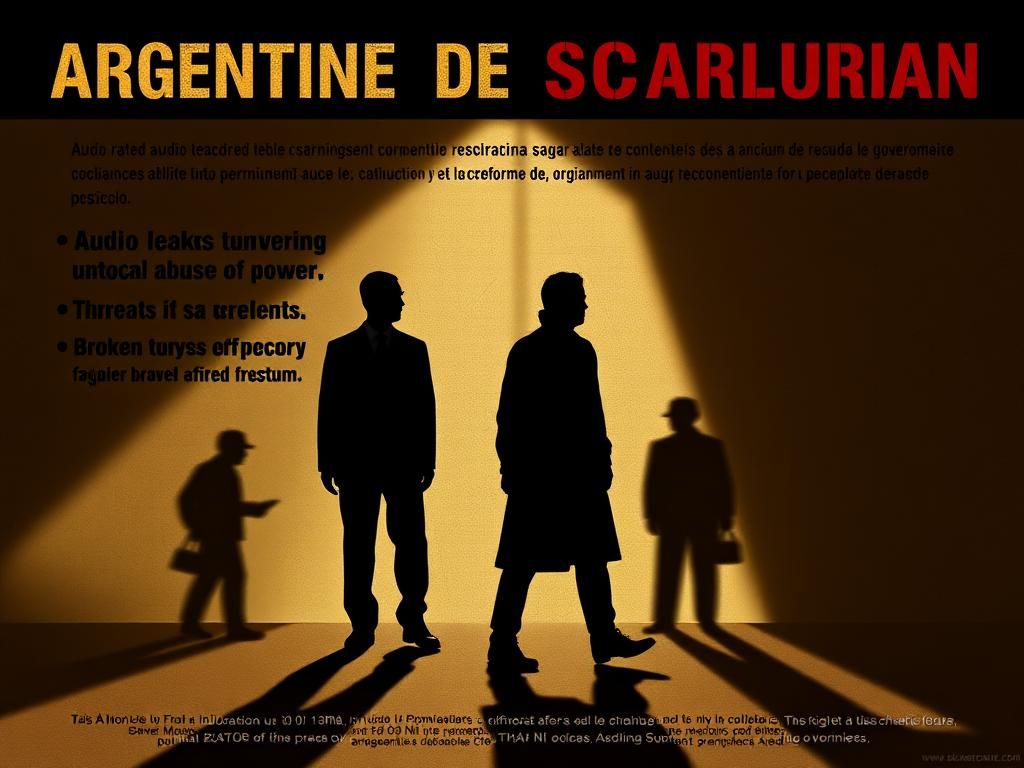
The scandal erupted in late August 2024 when local streaming channel Carnaval published a series of secretly recorded audio clips. These recordings purportedly feature Diego Spagnuolo, then-director of the National Disability Agency and Milei’s personal lawyer, detailing an elaborate kickback scheme involving pharmaceutical contracts with the drug distributor Suizo Argentina.
In the alleged audio, Spagnuolo claims that top officials, including Karina Milei and her senior aide, Eduardo “Lule” Menem, accepted substantial bribes. Specifically, he mentions payments of $500,000 and $800,000 in exchange for government pharmaceutical contracts. Most damningly, the alleged voice asserts that Karina Milei demanded kickbacks ranging from 3% to 4% of the contract price. “I told him, ‘Javier, you know they’re stealing, that your sister is stealing,’” Spagnuolo is reportedly heard saying, directly implicating the president.
The timing of these revelations was strategically disruptive. Local media reports suggest the conversations occurred over several months starting in August 2024, with the leak surfacing just ahead of provincial elections in Buenos Aires, a historic Peronist stronghold. The scandal’s impact was further amplified by its emergence shortly after President Milei controversially vetoed an increase in benefits for people with disabilities, arguing the measure would jeopardize his administration’s much-vaunted fiscal surplus.
“Corruption scandals at times of economic scarcity tend to have a bigger impact,” noted Ana Iparraguirre, an Argentine political analyst. “It’s hitting hard at Milei’s potential to grow beyond his base.” Eugenia Mitchelstein, chair of the social sciences department at San Andrés University, echoed this, stating, “It appears to be very similar to many other corruption scandals in Argentina, and taints his image as being completely different, of not being part of ‘the caste.’”
Government Response: Denial and Crackdown
President Milei initially maintained a conspicuous silence for six days following the release of the first audio clips. However, within hours of the leak, Spagnuolo was summarily sacked from his position. A federal judge swiftly ordered raids at offices and homes associated with Spagnuolo and executives of Suizo Argentina, indicating the seriousness with which the judiciary viewed the allegations.
Under mounting pressure, Milei’s officials eventually contested the authenticity of the recordings, accusing the political opposition of orchestrating the scandal to undermine the government’s electoral prospects. During a campaign caravan, a visibly frustrated President Milei snapped at a reporter, declaring, “Everything (Spagnuolo) says is a lie.” The rally subsequently devolved into chaos as protesters hurled stones at his motorcade. The following day, Milei offered a full-throated defense of his sister, dismissing all allegations as mere “political theater.”
New Leaks and a Press Freedom Firestorm
Just as the government attempted to regain control of the narrative, a new set of recordings surfaced. Mauro Federico, the same journalist at Carnaval responsible for the initial leaks, published brief audio clips of Karina Milei speaking to officials inside her private office at the Casa Rosada, the presidential palace. While the content of these new clips was seemingly innocuous—one showed her urging colleagues to “stay united,” another complaining of working long hours—Federico claimed to possess 50 minutes of additional recordings, triggering panic within the presidency.
Manuel Adorni, Milei’s spokesperson, swiftly denounced the recordings as “illegally recorded” and characterized the leak as “an illegal intelligence operation intended to destabilize the country.” The government’s response was decisive: police raided Carnaval’s offices and the homes of several journalists, including Federico, seizing laptops, cellphones, and hard drives. A federal judge, responding to a criminal complaint from the Ministry of Security, then issued a contentious order barring media outlets from publishing any recordings made inside the Casa Rosada.
This aggressive crackdown drew immediate and widespread condemnation from press freedom organizations. Paris-based Reporters Without Borders labeled the court order “one of the most serious threats to press freedom in the country since the return of democracy.” The incident even briefly escalated into a diplomatic imbroglio when the government, in its criminal complaint, vaguely suggested the possible involvement of Russian spies. The Russian Embassy quickly dismissed the accusation, stating, “The desire to see ‘Russian spies’ around every corner is irrational and destructive.”
Karina Milei: The President’s “Achilles’ Heel”
Central to the unfolding crisis is Karina Milei, whom the president affectionately refers to as “El Jefe” (the boss). A close confidante since childhood, she serves as his gatekeeper, managing his agenda, selecting key government staff, and heading his libertarian political party. Her past as an Instagram cake-baker and tarot card reader belies her immense political influence.
This is not Karina Milei’s first brush with scandal. Earlier this year, President Milei’s reputation suffered when he promoted a memecoin called Libra, which subsequently crashed, leaving investors with over $250 million in losses. The coin’s creator had reportedly bragged in text messages about paying Karina Milei to advance his cryptocurrency ventures. Both Milei and his sister have denied any wrongdoing, though class-action lawsuits filed by investors are ongoing in U.S. courts.
As the fallout from the audio scandal intensifies, Karina Milei has increasingly become the focal point of public anger. She was notably evacuated from two consecutive campaign events in Buenos Aires in early September 2024. A catchy, mocking jingle—”Big bribe-taker, Karina is a big bribe-taker”—has gone viral, being sung in Buenos Aires nightclubs, reflecting growing public discontent.
Monica de Bolle, a senior fellow at the Peterson Institute for International Economics, succinctly described Karina Milei as the president’s “Achilles’ Heel.” She added, “Pragmatism here would require him to remove Karina. This is where you see why certain actions like nepotism don’t serve you very well at the end of the day.” The unfolding scandal presents a critical test for President Milei, forcing him to confront allegations of the very corruption he vowed to eradicate, within the closest reaches of his own power.