Jacqueline Kennedy’s Prescient Warning: Six Decades Later, Kennedy Center Embroiled in Politicization She Feared
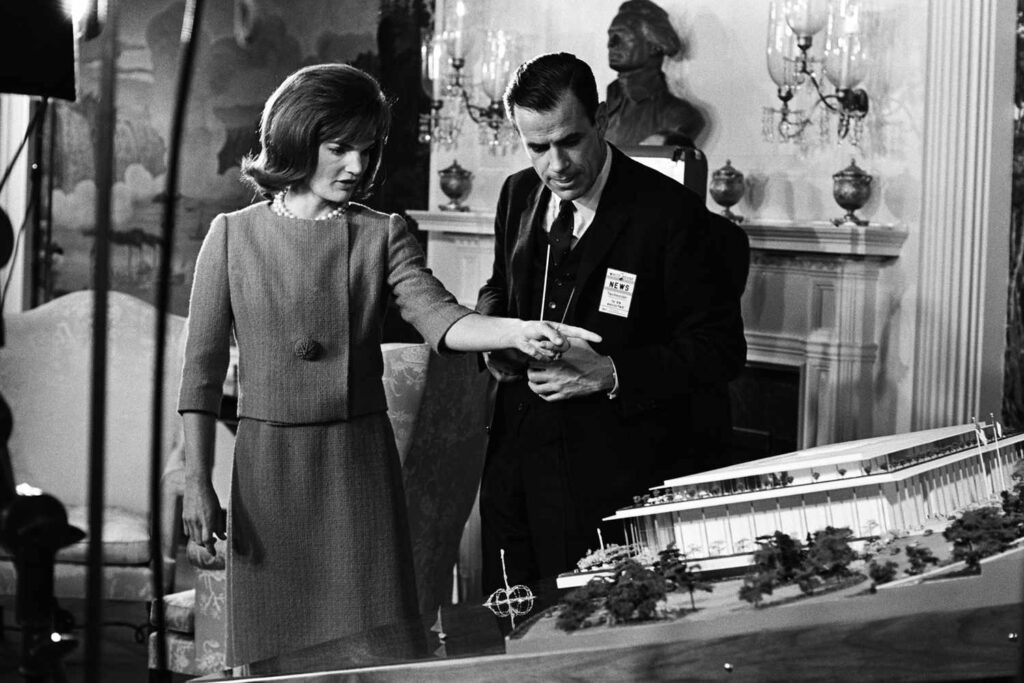
Jacqueline Kennedy’s Prescient Fears Realized: Kennedy Center Faces Politicization and Upheaval
In a stark validation of Jacqueline Kennedy’s deepest fears, the John F. Kennedy Center for the Performing Arts, a national cultural treasure in Washington, D.C., finds itself entangled in a fierce political debate and institutional upheaval. More than 60 years after the former First Lady privately expressed her profound hesitation about naming the center after her late husband, President Donald Trump’s administration has undertaken actions that directly contradict her specific wishes for the institution’s governance and artistic independence.
The genesis of the center, initially conceived as the National Culture Center, saw President John F. Kennedy and his wife actively involved in its planning. Following President Kennedy’s tragic assassination in November 1963, Congress moved swiftly. In a deeply emotional period, they voted to rename the burgeoning arts venue the John F. Kennedy Center for the Performing Arts, designating it a “living memorial” to the 35th president’s fervent advocacy for the arts.

However, Mrs. Kennedy harbored significant reservations. In a candid, four-page private letter penned in 1964 to Roger Stevens, the center’s founding chairman, she articulated her vulnerability and concern. “Last winter, when the decision was made to name it after him, I was not capable of making any decision — and so many people were pressuring me,” she wrote. Mrs. Kennedy believed her husband already had fitting memorials in his grave at Arlington and the forthcoming presidential library. She viewed the center as “a problem he inherited,” and one he would have approached differently had he initiated it.
Her paramount concern was the potential politicization of the institution, fearing that attaching her husband’s name could “spark controversy that distracts from JFK’s legacy” and compromise its artistic mission. She temporarily acquiesced to the naming to allow the project to advance, but issued a clear warning to Stevens: “If, after a fair amount of time, I do not think [the memorial] is what I wish for him, I will ask Congress to change its name — which they will do.” Her ultimate desire was to spare her husband “controversy” and ensure his “right to peace now.”
To mitigate her apprehensions, Mrs. Kennedy outlined a series of stringent requirements for the center’s future. She insisted that the director must be a full-time, dedicated resident of Washington, D.C., commanding the same respect as the heads of institutions like the National Gallery or the Fine Arts Commission. Crucially, she demanded that appointments to the board of trustees be based on a genuine love for the arts, emphatically stating: “The appointment of trustees must never be allowed to fall into the realm of political patronage. If the incumbent president has a friend who is interested in the arts — fine — he should be on the board — as he can help — but someone who is being repaid for past favors … or named in hope of campaign contributions — should not be on it.” Furthermore, she stipulated that a member of the Kennedy family should always maintain a seat on the board, and she herself required a personal representative to serve as a liaison, promising swift responses to inquiries if her conditions were met.

A Modern-Day Echo of Past Fears
Fast forward to February 2025, and Jacqueline Kennedy’s almost prophetic concerns appear to have materialized. President Donald Trump initiated a sweeping takeover of the Kennedy Center, replacing its board of trustees with individuals described as “partisan MAGA loyalists.” Subsequently, this new board voted Trump himself as chairman, granting him extensive authority over the institution’s direction.
Adding to the controversy, Ric Grenell, known for his background in foreign affairs and Republican political consulting, was installed as the interim executive director. This appointment replaced the highly regarded, longtime director and accomplished arts executive Deborah Rutter, and Mr. Grenell now concurrently serves as Trump’s special presidential envoy for special missions at the State Department.
The feared politicization reached a crescendo in December 2025 when the newly constituted board voted to informally rename the landmark. The proposed new designation: “The Donald J. Trump and The John F. Kennedy Memorial Center for the Performing Arts.” This move triggered immediate and widespread condemnation, leading several scheduled artists and entertainers to cancel their performances in protest.
The situation escalated further on Sunday, February 1, 2026, when President Trump announced plans to close the Kennedy Center for a period of two years. He cited intentions for “construction, revitalization and complete rebuilding,” promising a “new and beautiful landmark” upon its reopening.
Family Outcry and Legacy Defense
The Trump administration’s actions have ignited outrage among President Kennedy’s surviving relatives, who view the moves as an attempt to diminish or even erase the 35th president’s legacy. Maria Shriver, President Kennedy’s niece, vehemently denounced the renaming in December.
“The Kennedy Center was named after my uncle, President John F Kennedy. It was named in his honor. He was a man who was interested in the arts, interested in culture, interested in education, language, history,” Shriver stated. She emphasized that “he and my Aunt Jackie amplified the arts, celebrated the arts, stood up for the arts and artists,” declaring, “It is beyond comprehension that this sitting president has sought to rename this great memorial dedicated to President Kennedy. It is beyond wild that he would think adding his name in front of President Kennedy’s name is acceptable. It is not.”
Echoing his aunt’s sentiments, Jack Schlossberg, the grandson of JFK and Jackie Kennedy, issued a forceful statement on X following the closure announcement. “Trump can take the Kennedy Center for himself. He can change the name, shut the doors, and demolish the building,” Schlossberg wrote. “He can try to kill JFK. But JFK is kept alive by us now rising up to remove Donald Trump, bring him to justice, and restore the freedoms generations fought for.”
Jacqueline Kennedy’s 1964 letter stands as a poignant testament to her deep understanding of the delicate balance required to safeguard artistic institutions from political maneuvering. Six decades later, her foresight serves as a guiding light amidst a contentious battle for the soul and legacy of one of America’s most significant cultural landmarks.