


Ford’s Monumental $2 Billion Bet: Louisville Assembly Plant Shifts to Electric Future
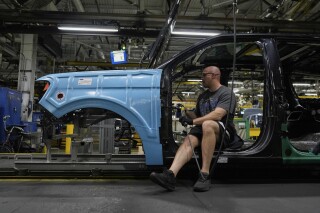
LOUISVILLE, Ky. — Ford Motor Co. is making a monumental stride into the future of automotive manufacturing, announcing a nearly $2 billion investment to retool its Louisville Assembly Plant in Kentucky. This significant commitment marks a pivotal shift for the facility, which has spent seven decades producing gasoline-powered vehicles, as it prepares to spearhead the production of a new generation of electric vehicles (EVs).
Driving Towards Affordable & Profitable EVs
Ford CEO Jim Farley unveiled the ambitious strategy on Monday, emphasizing the company’s goal to produce EVs that are not only more affordable for consumers but also more profitable for the automaker to build, ultimately aiming to outcompete rival models in the rapidly evolving market. “We took a radical approach to solve a very hard challenge: Create affordable vehicles that are breakthrough in every way that matters — design, technology, performance, space and cost of ownership — and do it with American workers,” Farley stated in a press release.
The First Electric Offering: A Midsize Pickup
The first electric vehicle slated to roll off the revamped Louisville assembly line is a midsize, four-door electric pickup truck, projected for release in 2027. This vehicle is intended for both domestic and international markets, underscoring Ford’s global EV ambitions. Powering these new trucks will be lower-cost batteries produced at a new Ford factory in Michigan, an initiative backed by a previously announced $3 billion investment by the Detroit automaker.
A “Model T Moment” for EV Production
Ford likens this transformative period to a “Model T moment” for its EV business, drawing a parallel to the mass-produced vehicle that revolutionized personal transportation over a century ago. This analogy highlights not just the shift to electric, but a fundamentally different approach to vehicle construction. The company plans to utilize a universal platform and a groundbreaking production system for its EVs, a foundational architecture that can be adapted across a diverse range of vehicle types, from sedans to SUVs.
Innovating Assembly for Efficiency
The Louisville factory’s retooling is designed for unparalleled efficiency, aiming to drastically cut production costs and accelerate assembly times. Ford projects:
- 20% reduction in parts compared to a typical vehicle
- 25% fewer fasteners
- Remarkable 40% reduction in workstations from dock-to-dock
These innovations are expected to result in a 15% faster assembly time. The traditional linear assembly line will be transformed into an “assembly tree,” where three distinct sub-assembly lines operate simultaneously before converging, streamlining the manufacturing process.
“Nobody wants to see another good college try by a Detroit automaker to make an affordable vehicle that ends up with idled plants, layoffs and uncertainty,” Farley commented. “So, this has to be a good business. From Day 1, we knew there was no incremental path to success. … We reinvented the moving assembly line.” The midsize electric truck is targeted to have a starting price of approximately $30,000, though further specifications, including its reveal date, EPA-estimated battery range, battery sizes, and charge times, will be announced at a later date.
Securing Jobs and Boosting Kentucky’s Economy
Economically, Ford’s investment in the Louisville plant is set to secure 2,200 existing hourly jobs, providing stability to the local workforce. Kentucky Governor Andy Beshear hailed the announcement, emphasizing its role in strengthening the more than century-old partnership between Ford and the Bluegrass State. “This announcement not only represents one of the largest investments on record in our state, it also boosts Kentucky’s position at the center of EV-related innovation and solidifies Louisville Assembly Plant as an important part of Ford’s future,” Beshear stated.
A Broader Impact Amidst Challenges
Collectively, Ford’s approximate $5 billion investment across the Kentucky assembly plant and the Michigan battery plant is anticipated to create or secure nearly 4,000 direct jobs. This massive investment is also poised to bolster the domestic supply chain, fostering the growth of dozens of new U.S.-based suppliers.
This strategic pivot comes even as the political landscape presents challenges, with former President Donald Trump’s administration unwinding incentives for automakers to transition to electric vehicles, including the impending removal of a federal tax credit that could save buyers up to $7,500 on a new electric car. Despite these policy shifts, Farley and other top auto industry executives remain steadfast, asserting that electric vehicles are the undisputed future of the automotive sector.
Internally, Ford’s Model e electric vehicle business reported a full-year loss of $5.08 billion for 2024, with revenue declining by 35% to $3.9 billion. This substantial loss underscores the financial challenges and investments inherent in the EV transition. Furthermore, Ford is navigating an increasingly competitive global market, particularly with the rapid expansion of Chinese automakers offering comparatively affordable electric vehicles. Addressing this competition, Farley affirmed, “We’re not in a race to build the most electric cars. We’re in a race to have a sustainable electric business that’s profitable, that customers love.” He confidently added that the new vehicle produced in Louisville, Kentucky, “is going to be a much better solution to anything that anyone can buy from China.”