


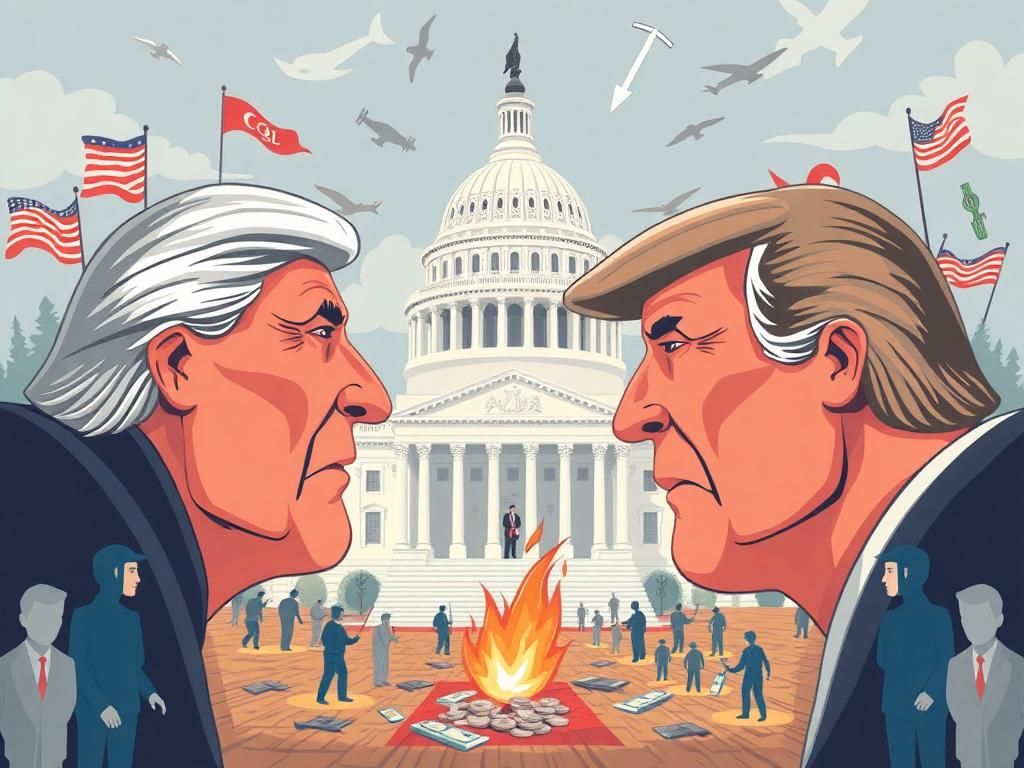
Government Shutdown Deepens Amidst Political Stalemate and Economic Concerns
WASHINGTON (AP) — The federal government’s partial shutdown has entered its fifth day, with Republican and Democratic lawmakers showing few signs of progress in resolving a deepening budget impasse. As hundreds of thousands of federal employees face furloughs or work without pay, and the unprecedented threat of permanent job cuts looms, Washington remains locked in a bitter political struggle.
Democrats and Republicans at Loggerheads Over Healthcare and Budget
Democrats are steadfast in their demand to renew critical subsidies that help millions of households afford health insurance under the Affordable Care Act. They argue that a failure to restore these funds would plunge these families into a “crisis” of unaffordable care.
Conversely, President Donald Trump and his Republican allies insist on preserving existing spending levels and have threatened to permanently terminate the employment of thousands of federal workers if the shutdown persists—a tactic unprecedented in U.S. history. Trump, who rose to fame with the catchphrase “You’re fired” on “The Apprentice,” has unequivocally laid the blame for potential layoffs at the feet of Democrats, stating, “Anybody laid off that’s because of the Democrats.”
Economic Headwinds and Fiscal Challenges
This budgetary showdown unfolds against a backdrop of troubling economic signals. While the U.S. economy has continued its growth trajectory this year, recent data indicates a slowdown in hiring and persistently elevated inflation. Furthermore, the administration’s import taxes have created significant disruptions for businesses and eroded confidence in economic leadership.
Compounding the fiscal anxieties is the nation’s nearly $2 trillion annual budget deficit, a figure recognized as financially unsustainable, yet without bipartisan consensus on the necessary tax increases or spending cuts to rein in borrowing.
Stalled Negotiations and Accusations
Direct negotiations between the two parties appear to have stalled. House Democratic leader Hakeem Jeffries reported no talks with Republican leadership since a White House meeting earlier in the week, lamenting that Republicans, including President Trump, have since gone “radio silent.” Jeffries criticized this as “negotiation through deepfake videos” and noted Trump’s presence on the golf course, deeming it “not responsible behavior.” When asked about the shutdown talks via text message by CNN, Trump offered a succinct, confident response: “We are winning and cutting costs big time.”
The administration’s assertive approach includes leveraging the shutdown to gain greater budgetary control, with officials signaling a readiness to impose permanent job cuts on thousands of furloughed federal workers. This strategy, never before employed, aims to save money, even as Republicans claim they would take no pleasure in such actions. House Speaker Mike Johnson acknowledged the situation as “regrettable” but insisted it was not the president’s desire. White House National Economic Council Director Kevin Hassett urged Democrats to agree to a “clean, continuing resolution” for seven more weeks of funding, asserting that Republicans, being in control, hold “a lot more power over the outcome.”
Democratic Concerns: Protecting Healthcare and Assurances
Democrats, however, remain wary. Senator Adam Schiff of California not only defended his party’s commitment to protecting health care affordability but also pointed to the Trump administration’s practice of “pocket rescissions.” These actions involve withholding congressionally approved spending—roughly $4.9 billion in foreign aid in a recent instance—effectively undermining the sanctity of future budget compromises. “We need both to address the health care crisis and we need some written assurance in the law—I won’t take a promise—that they’re not going to renege on any deal we make,” Schiff stated.
Contentious Rhetoric and Legislative Gridlock
The fraught atmosphere is further exacerbated by contentious political rhetoric. Vice President JD Vance dismissed a controversial video depicting Jeffries in a sombrero and thick mustache as “simply a joke,” despite its perceived mocking of Mexican descent and Republican claims that Democratic demands would fund healthcare for undocumented immigrants. Democrats vigorously dispute this, highlighting that immigrants in the U.S. illegally are not eligible for federal health care programs like the Affordable Care Act or Medicaid, though hospitals do receive Medicaid reimbursements for emergency care to eligible individuals regardless of immigration status.
Legislative efforts to end the shutdown have also faltered. A Republican bill to reopen the government failed in the Senate on Friday, unable to secure the necessary 60 votes to overcome a filibuster. Compounding the deadlock, Speaker Johnson announced that the House would close for legislative business next week, a move Senate Democratic leader Chuck Schumer criticized as demonstrating a lack of seriousness: “He sent all his congressmen home last week and home this week. How are you going to negotiate?” Senate Majority Leader John Thune reiterated that the shutdown would persist as long as Democrats withhold their votes, expressing hope for a “change of heart” among them on Monday.
The current political landscape suggests a prolonged stalemate, with both parties entrenched in their positions and seemingly prioritizing public messaging over direct, productive engagement.