


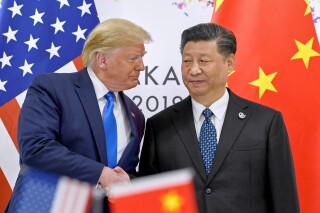
Trump Escalates Trade War: 100% Tariff on Chinese Imports Announced Amid Rare Earth Dispute
WASHINGTON (AP) — In a dramatic escalation of trade tensions, former President Donald Trump announced on Friday an impending 100% additional tariff on Chinese imports. This formidable new tax, slated to commence on November 1, 2025, or potentially sooner, is a direct response to Beijing’s recent imposition of export controls on crucial rare earth elements. The move threatens to plunge the global economy into a renewed trade war, echoing—and potentially surpassing—the market instability witnessed in April when similar tariff threats sparked fears of a steep recession.
A Fractured Détente
The declaration, made via his social media platform, Truth Social, represents a significant rupture in the fragile détente that has characterized U.S.-China trade relations since earlier this year. Both nations had previously engaged in a fraught trade war, initiated by Trump’s administration, which saw tariffs on Chinese goods soar to 145% and retaliatory taxes on American products reach 125%. These prohibitive rates effectively halted trade, prompting negotiations that eventually lowered U.S. tariffs to 30% and Chinese tariffs to 10%, allowing for continued dialogue. However, underlying tensions persisted, particularly regarding America’s access to China’s vital rare earth resources and Beijing’s ability to acquire advanced U.S. computer chips.
China’s Rare Earth Lever: A Critical Standoff
Trump’s announcement explicitly links the new 100% tariff to China’s decision to restrict access to rare earth elements, materials indispensable for modern technology and military applications. Just one day prior, on Thursday, the Chinese government unveiled new regulations requiring foreign companies to obtain special approval for shipping these metallic elements and related technologies — including those used in mining, smelting, and recycling — out of the country. Notably, any export requests for products destined for military use would be outright rejected.
Rare earth elements are a group of 17 chemically similar metallic elements that are critical components in a vast array of high-tech products. They are essential for manufacturing everyday electronics like smartphones and electric vehicles, as well as sophisticated military hardware such as jet engines, missile guidance systems, and lasers. China currently dominates the global supply chain, controlling an estimated 70% of rare earth mining and 93% of the production of permanent magnets derived from them, giving Beijing immense leverage.
Wider Economic Confrontation and Market Fallout
Beyond the tariffs, Trump also threatened to impose U.S. export controls ‘on any and all critical software’ from American firms, further widening the scope of the economic confrontation. Adding a layer of diplomatic uncertainty, the President suggested he saw ‘no reason’ to meet with Chinese leader Xi Jinping during an upcoming trip to South Korea for the Asia-Pacific Economic Cooperation (APEC) summit, a meeting previously seen as a critical opportunity for de-escalation.
The financial markets reacted swiftly and negatively to the news. The S&P 500 tumbled 2.7% on Friday, marking its worst day since April, a stark indicator of investor anxiety regarding renewed trade hostilities between the world’s two largest economies. Analysts warn that the proposed tariffs, piled on top of existing rates, could cause a severe breakdown in trade, potentially leading to a worldwide economic slowdown. Domestically, such aggressive import taxes could exacerbate inflation and further strain a fragile U.S. job market, particularly as the effects of a government shutdown begin to manifest in federal worker layoffs. This has led some investors to engage in the ‘TACO’ (Trump Always Chickens Out) trade, betting on the President eventually rescinding his threats, yet the immediate impact remains significant.
Trump’s assertion that China is ‘becoming very hostile’ and holding the world ‘captive’ underscores the deep mistrust defining the bilateral relationship. He even speculated, without providing evidence, that China’s timing of the rare earth restrictions was intentionally disruptive, perhaps to overshadow his role in a recently announced ceasefire between Israel and Hamas.
Expert Insights on a Volatile Situation
- Sun Yun, director of the China program at the Stimson Center, described Beijing’s rare earth restrictions as a ‘disproportional reaction’ to recent U.S. sanctions on Chinese companies and upcoming port fees. However, she noted that China believes de-escalation must be mutual, suggesting ‘there is room for maneuver, especially on the implementation’ of these measures.
- Gracelin Baskaran, director of the Critical Minerals Security Program at the Center for Strategic and International Studies, highlighted China’s formidable leverage as the dominant player in the rare earth market, emphasizing that these restrictions are both a negotiating tool and a threat to the U.S. industrial and military base.
- Cole McFaul, a research fellow at Georgetown University’s Center for Security and Emerging Technology, suggested that Trump’s post might be a strategic move ahead of talks, but cautioned that Beijing historically perceives itself as gaining concessions in such negotiations.
- Craig Singleton, senior director of the China program at the Foundation for Defense of Democracies, warned that Trump’s latest pronouncements could ‘mark the beginning of the end of the tariff truce,’ signaling a dangerous phase where both economic superpowers simultaneously deploy their economic weapons, neither willing to yield.
The Prospect of Mutually Assured Disruption
The exact implementation of Trump’s threats and China’s subsequent response remain uncertain, but the risk of ‘mutually assured disruption’ is now undeniably elevated. As global economies brace for impact, the latest escalation signals a precarious new chapter in the complex and often contentious relationship between the United States and China.