


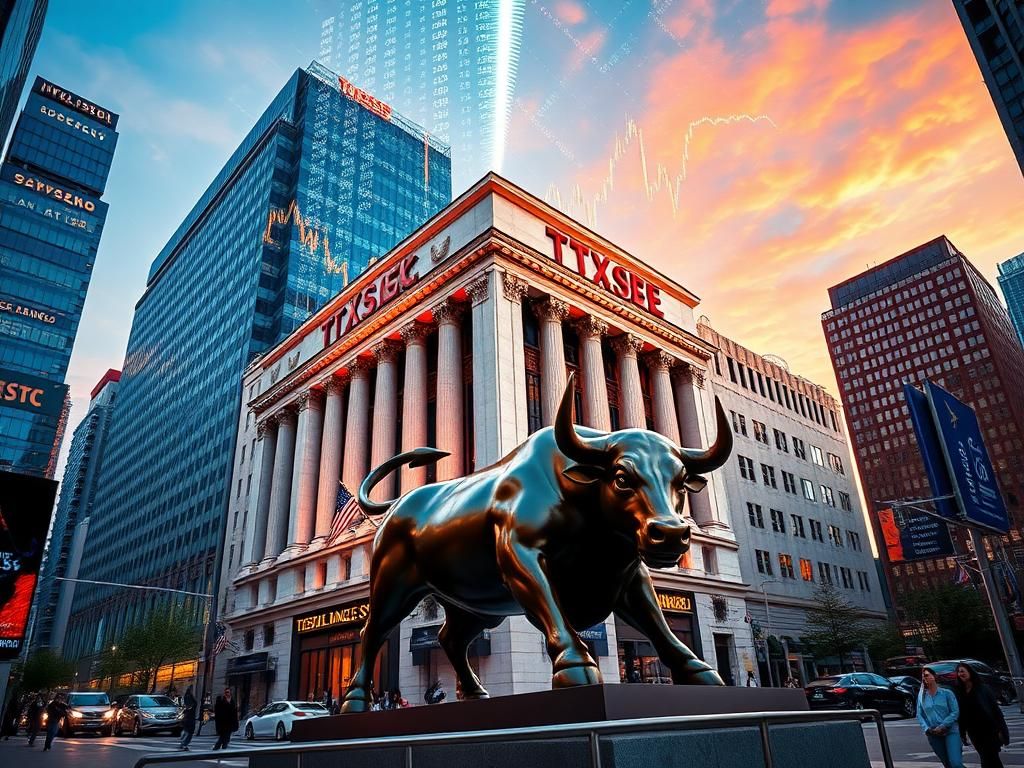
Texas Stock Exchange Gets SEC Nod, Challenging Wall Street Duopoly
DALLAS, Texas – The financial landscape of the United States is on the brink of a significant transformation, as the Texas Stock Exchange (TXSE) officially received approval from the U.S. Securities and Exchange Commission (SEC) on September 30. This landmark decision paves the way for the Dallas-based startup to emerge as a direct national competitor to the established dominance of the New York Stock Exchange (NYSE) and Nasdaq, a duopoly that has held sway over American equity markets for decades.
The SEC’s green light has been met with enthusiastic support from Texas lawmakers, including Governor Greg Abbott, who confidently declared, “Texas is swiftly becoming America’s financial hub.” This sentiment is underpinned by the TXSE’s robust foundation, which includes a formidable $120 million in funding secured in June 2024 from prominent investment firms such as BlackRock and Citadel Securities. This significant capital injection makes the TXSE one of the most well-funded attempts at a new national exchange in generations, signaling serious intent to disrupt the status quo.
The Lone Star State’s Growing Economic Clout
TXSE officials emphasize that the exchange’s emergence is a natural extension of Texas’s remarkable economic expansion. The state has rapidly ascended as a corporate powerhouse, now hosting the headquarters of the second-highest number of Fortune 500 companies in the nation, trailing only California and surpassing New York. This corporate influx has been largely driven by Texas’s attractive regulatory environment and favorable taxation policies.
Nicole Chambers, Global Managing Director of Listings for TXSE, articulated this strategic positioning at a recent gathering of Dallas business leaders. “Texas is a major player in the U.S. regardless of the exchange landscape, but it ultimately makes sense as the 7th largest economy in the world,” Chambers stated, underscoring the state’s global economic footprint. She further highlighted that 45 countries, each smaller than Texas in economic output, maintain their own stock exchanges, reinforcing the logical imperative for a Texas-based exchange. “Texas has really become a leader in where you can do business,” Chambers added during a panel discussion at the University of Texas Austin campus. “We couldn’t do this in Oregon or in Nebraska.”
“Y’all Street” and the Wall Street Response
The anticipation around the TXSE, pronounced “Tex-ee,” has already sent ripples through the financial industry. In a clear response to TXSE’s stated intentions, both the NYSE and Nasdaq have announced strategic moves into the Dallas market. The NYSE declared in February its plan to reincorporate its Chicago electronic exchange and relocate it to Dallas, rebranding it as NYSE Texas. Not to be outdone, Nasdaq followed in March with its own announcement to establish a regional headquarters in Dallas.
Bill Bailey, TXSE’s managing director of market intelligence, views these developments as direct reactions to the TXSE’s creation. These moves promise to test Dallas’s burgeoning reputation as a financial services hub, a transformation that has earned the city the fitting nickname, “Y’all Street.”
A New Challenger to a Long-Standing Duopoly
For over a decade, since the NYSE acquired the American Stock Exchange in 2008, the U.S. equities market has been effectively controlled by a duopoly of the NYSE and Nasdaq. Historically, attempts by regional exchanges like those in Boston, Philadelphia, and Chicago to challenge this dominance have ultimately failed, either being absorbed by the larger entities or ceasing operations. University of Texas at Arlington associate professor of finance Sriram Villupuram notes that a new, dominant national exchange has proven elusive.
TXSE leadership, however, believes this time will be different. While stock transactions are now predominantly digital, the exchange will maintain a physical presence in Dallas. TXSE plans to emulate the ceremonial bell-ringing traditions of its New York rivals, infusing them with a distinctive “Texas flair.” More critically, the TXSE aims to differentiate itself by offering a state-of-the-art digital trading platform, featuring fewer requirements for the composition of company boards of directors compared to existing exchanges. The new exchange also seeks to attract companies frustrated by rising listing fees, evolving rules, and stringent share price benchmarks imposed by Nasdaq and NYSE.
The Path to Success: Patience and Momentum
The success of the TXSE will largely hinge on the patience of its deep-pocketed investors and its ability to rapidly onboard companies. As Villupuram explains, attracting the first 50 to 100 companies will be crucial in building momentum, creating a snowball effect as more prospective listings gain confidence. “It gives those that are thinking about listing an idea about what it takes to get on the exchange, and it could snowball from there,” Villupuram commented.
Beyond strategic incentives, the TXSE’s trajectory is inextricably linked to the ongoing health of the Texas economy. Continued economic growth and corporate relocation to the state will provide a fertile ground for the exchange to recruit new listings. While trading itself is automated, Villupuram stresses the enduring importance of a physical presence. “With stocks, the demand, the trading has become automated, electronic, whatever you want to call it, but the supply, the courting of companies to come get listed with us, that is still very much human to human,” he noted.
Dallas: A Financial Powerhouse on the Rise
Dallas’s emergence as a financial center is no accident. Historically, its central location in the Sun Belt made it a natural hub for communications, transportation, and finance as Texas industrialized. This trend has accelerated, with Dallas-Fort Worth International Airport becoming a national travel nexus and Texas-based corporations expanding significantly. Ray Perryman, president of Waco-based economic research firm The Perryman Group, affirms, “Dallas is the natural location for a financial center to emerge in this region.”
Evidence of this shift is abundant. Major investment banks, including JPMorgan Chase and Goldman Sachs, now boast tens of thousands of employees in the region and continue to expand. Goldman Sachs is currently constructing a $500 million tower in downtown Dallas, slated to house over 5,000 employees, establishing it as the bank’s largest hub outside of New York. Charles Schwab famously relocated its headquarters from California to Dallas in 2020.
The numbers further illustrate Texas’s ascent: over the past two decades, New York has seen a 16% growth in investment and securities sector employment, while Texas has experienced a staggering 111% expansion in the same period. This growth, coupled with a lower cost of living compared to the Northeast, is attracting top talent. Sasha Stratton, head of risk for Selby Jennings in Dallas, a financial services recruitment firm, moved from New York five years ago, drawn by the prospect of homeownership and a higher quality of life for less money. She observes that firms are now “prioritizing hiring in Dallas over hiring in New York in a lot of instances… it’s actually a smart, strategic decision to take advantage of how booming the economy is.”
The confluence of TXSE’s launch, the expansion of established exchanges, and the robust economic momentum of Texas creates a powerful feedback loop. It promises easier access to capital for growing Texas companies, fueling further expansion and job creation. As Perryman concludes, “New York will likely remain the primary center of equity markets for the time being, but the landscape is changing.”