


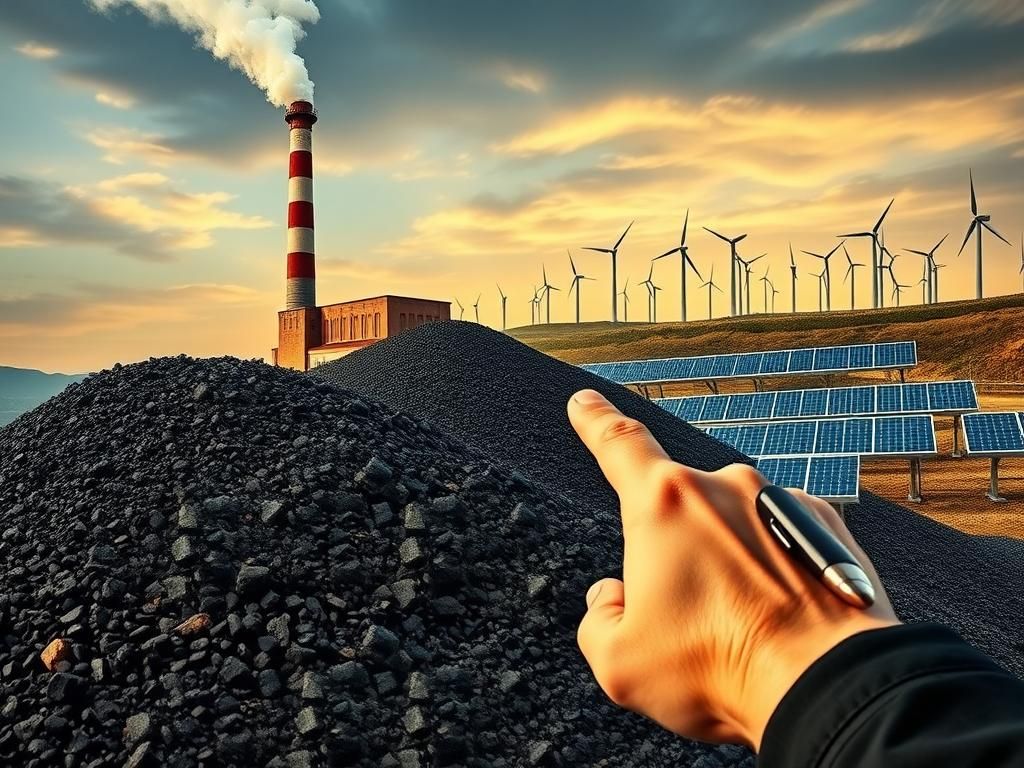
Trump’s Coal Revival Faces Harsh Market Reality Amid Plummeting Demand
The Trump administration is aggressively pursuing a resurgence of the U.S. coal industry, greenlighting the largest federal coal sales in over a decade. Yet, this ambitious push is colliding with an undeniable market reality: a significant decline in demand, with most power plants slated to stop burning coal within the next decade, according to an Associated Press data analysis.
In the coming days, U.S. officials are set to offer approximately 600 million tons of coal from publicly owned reserves adjacent to existing strip mines in Montana and Wyoming. These sales are a cornerstone of President Donald Trump’s broader agenda to boost domestic coal production and consumption for electricity generation. However, the AP’s analysis, utilizing data from the U.S. Energy Information Administration and Global Energy Monitor, reveals a stark contradiction: a majority of the power plants currently supplied by these very mines are planning to cease coal-burning operations entirely within the next ten years. Furthermore, three other mines slated for expansion or new leases under the Trump administration are also grappling with diminishing demand as power plants reduce their coal usage or shut down altogether. This raises a fundamental question for the administration’s strategy to revive a heavily polluting industry: who will ultimately purchase this vast quantity of coal?
This critical question casts a long shadow over the administration’s enthusiastic endorsement of coal, a primary driver of climate change. It underscores the inherent uncertainty when political policies, no matter how fervent, attempt to re-engineer energy markets driven by long-term economic and environmental decisions, profoundly impacting not only the viability of energy producers but also the future of the planet in a rapidly evolving political and environmental landscape.
Rushing Ahead Despite Declining Markets and Climate Concerns
The upcoming lease sales are concentrated in the Powder River Basin of Montana and Wyoming, historically the most productive coal fields in the U.S. Despite a recent government shutdown, officials confirmed that these sales would proceed, having exempted workers involved in fossil fuel permits and leases from furloughs. This move directly counters actions taken by the Biden administration, which last year moved to block future coal leases in the region, citing their significant potential to exacerbate climate change. The Department of Energy estimates that burning the coal from just these two upcoming leases would release over 1 billion tons of planet-warming carbon dioxide into the atmosphere.
President Trump has consistently dismissed climate change as a “con job,” a stance at odds with the overwhelming consensus of the scientific community. During a September 23 speech to the U.N. General Assembly, he lauded coal as “beautiful” and highlighted the abundance of U.S. reserves, while simultaneously criticizing solar and wind power. Further emphasizing this direction, administration officials announced Wednesday the cancellation of $8 billion in grants previously allocated for clean energy projects across 16 states, all of which were won by Democrat Kamala Harris in the 2024 presidential election.
Following a directive from Trump on his first day in office in January, numerous coal lease sales that had been postponed or stalled were swiftly revived and expedited for approval, often with minimal consideration of their greenhouse gas emissions. The administration has also advanced coal mine expansions and lease sales in Utah, North Dakota, Tennessee, and Alabama, in addition to those in Montana and Wyoming. Interior Secretary Doug Burgum announced on Monday the opening of over 20,000 square miles (approximately 52,000 square kilometers) of federal lands to mining—an area larger than New Hampshire and Vermont combined.
Beyond lease sales, the administration has dramatically reduced royalty rates for coal extracted from federal lands. It has also mandated a coal-fired power plant in Michigan to remain operational beyond its scheduled retirement date and pledged $625 million to recommission or modernize existing coal plants, citing growing electricity demand driven by artificial intelligence and data centers. “We’re putting American miners back to work,” Burgum stated, flanked by miners and Republican politicians. “We’ve got a demand curve coming at us in terms of the demand for electricity that is literally going through the roof.”
The Plunge in Coal Demand and Skepticism from Experts
The Associated Press’s findings regarding the reduced coal consumption by power plants served by public land mines reflect a systemic, industry-wide decline that initiated in 2007. Energy experts and economists contacted for this report were not surprised, expressing deep skepticism that coal could ever regain its former dominance in the power sector. While the Interior Department did not address inquiries about future coal demand from public lands, experts acknowledge that Trump’s policies could provide a temporary boost to the coal industry as new natural gas and solar projects take time to come online. “Eventually coal will get pushed out of the market,” predicted Umed Paliwal, an electricity markets expert at the University of California, Berkeley. “The economics will just eat the coal generation over time.”
Illustrating the market shift, the upcoming coal sales in Montana and Wyoming were requested by the Navajo Nation-owned Navajo Transitional Energy Co. (NTEC), which acquired several major Powder River Basin mines in a 2019 bankruptcy auction, becoming one of the largest industry players. These mines supply 34 power plants across 19 states. Critically, 21 of these plants are projected to cease burning coal within the next decade, including all five plants that utilize coal from NTEC’s Spring Creek mine in Montana.
In regulatory filings, NTEC assessed the fair market value of 167 million tons of federal coal adjacent to its Spring Creek mine at just over $126,000. This equates to less than one-tenth of a penny per ton – a stark contrast to the $35 million bid for an equivalent 167 million tons in 2013, a bid federal officials then deemed too low. NTEC justified its low valuation by referencing previous government assessments that forecast fewer buyers for coal, arguing that taxpayers would still benefit from future royalties on any coal eventually mined. The company explicitly stated, “The market for coal will decline significantly over the next two decades. There are fewer coal mines expanding their reserves, there are fewer buyers of thermal coal and there are more regulatory constraints.”
Further reinforcing this trend, on Wednesday, the government plans to sell 440 million tons of coal next to NTEC’s Antelope Mine in central Wyoming. Over half of the 29 power plants supplied by this mine are scheduled to stop burning coal by 2035. An example is the Rawhide plant in northern Colorado, which is slated to phase out coal by 2029, transitioning to natural gas and 30 megawatts of solar power for its electricity generation.
Aging Infrastructure and the “Comeback Mode” Dilemma
Despite these challenging market indicators, Peabody Energy, the largest U.S. coal company, maintains a more optimistic outlook. In September, Peabody suggested that U.S. coal demand could surge by 250 million tons annually—nearly a 50% increase from current volumes—based on the premise that existing power plants could burn more coal due to delays in new nuclear and gas plant constructions. “U.S. coal is clearly in comeback mode,” declared James Grech, Peabody’s president, during a recent conference call with analysts, emphasizing the nation’s vast coal reserves as its leading energy source.
However, the reality of the existing infrastructure presents a significant hurdle. No large coal power plants have been brought online in the U.S. since 2013, and most operational plants are 40 years old or older. Energy consulting group GridLab’s Nikhil Kumar noted that the administration’s $625 million pledge for refurbishment would be insufficient, given that a single boiler component replacement at a plant can cost upwards of $25 million. This discrepancy between the administration’s goals and market dynamics brings the core question back into sharp focus: “I don’t see where you get all this coal consumed at remaining facilities,” Kumar concluded, highlighting the fundamental challenge facing the administration’s ambitious coal revival.