


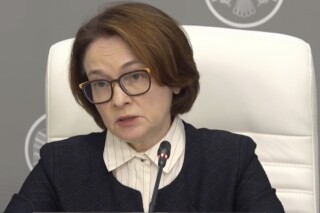
Russia’s Central Bank Cuts Key Interest Rate Amid Economic Balancing Act
MOSCOW – Russia’s central bank, in a significant policy shift, announced Friday a reduction of its benchmark interest rate by one percentage point, bringing it down to 17%. This decision marks a strategic retreat from previous aggressive hikes, including an emergency surge to 21% shortly after the full-scale invasion of Ukraine, designed to stabilize the ruble and curb rampant inflation. The current cut signals a delicate balancing act by authorities attempting to bolster a wartime economy that is showing signs of slowing growth while grappling with persistent inflationary forces.
Monetary Policy and Persistent Inflation
The central bank’s monetary policy has been a critical lever in managing the economic fallout of the conflict, now stretching into its third year. Initial rate hikes were aimed at preventing a currency collapse and controlling soaring prices. While the bank noted a modest easing of inflation in July and August, the annual rate remains elevated at 8.2%, significantly above target. Critically, the bank warned that “inflation expectations have not changed considerably in recent months” and “remain elevated,” posing a continued challenge to sustainable price deceleration.
This apparent contradiction – cutting rates while acknowledging high inflation – underscores the deep frictions within Russia’s economic framework. On one side, the central bank is mandated to maintain price stability. On the other, the finance ministry is actively injecting substantial funds into the economy through escalating defense orders and lucrative military recruitment bonuses. This fiscal stimulus, a direct consequence of the protracted war against Ukraine, has successfully spurred growth and wage increases, particularly in poorer regions, but simultaneously fuels inflationary pressures.
Mixed Economic Data and Budgetary Pressures
The economic data paints a mixed picture. Annual growth slowed to 1.1% in the second quarter, down from 1.4% in the first quarter and a robust 4.5% at the end of the previous year. More alarmingly, a quarter-over-quarter analysis revealed a negative 0.6% contraction in the second quarter, suggesting a more recent deceleration in economic activity.
Compounding these challenges is a burgeoning budget deficit. For the January-July period, the deficit surged to 4.9 trillion rubles ($58 billion), a dramatic increase from 1.1 trillion rubles recorded in the same period last year. Analysis by the Kyiv School of Economics indicates that government spending reached 129% of its planned amount, largely driven by military expenditures. Simultaneously, crucial oil and gas revenues, vital for state coffers, experienced a 19% decline compared to the previous year, partly due to fluctuating global oil prices and the impact of Western sanctions.
Surprising Resilience Amidst Sanctions
Despite the comprehensive sanctions imposed by Western nations, which have largely cut Russia off from foreign investment in key industries and significantly reduced its natural gas sales to Europe, the Russian economy has displayed surprising resilience. Unemployment rates are at historic lows, and household incomes are reportedly rising, buoyed by the substantial government spending related to the war effort. Oil shipments, a cornerstone of Russia’s economy, have remained relatively stable, adapting to new markets despite price volatility.
Funding Mechanisms and Future Trajectory
The government has managed to finance its deficit largely by issuing ruble-denominated bonds to domestic banks. These financial institutions, anticipating further interest rate cuts, have shown a willingness to absorb these bonds, providing a crucial funding mechanism for the state’s increasing fiscal needs. However, this reliance on domestic financing, coupled with inflationary pressures and a slowing growth rate, highlights the complex and potentially unsustainable trajectory of Russia’s wartime economy. The central bank’s latest rate cut is a gamble, aiming to prevent a deeper economic slump without losing control over inflation in an environment profoundly shaped by ongoing geopolitical conflict.