


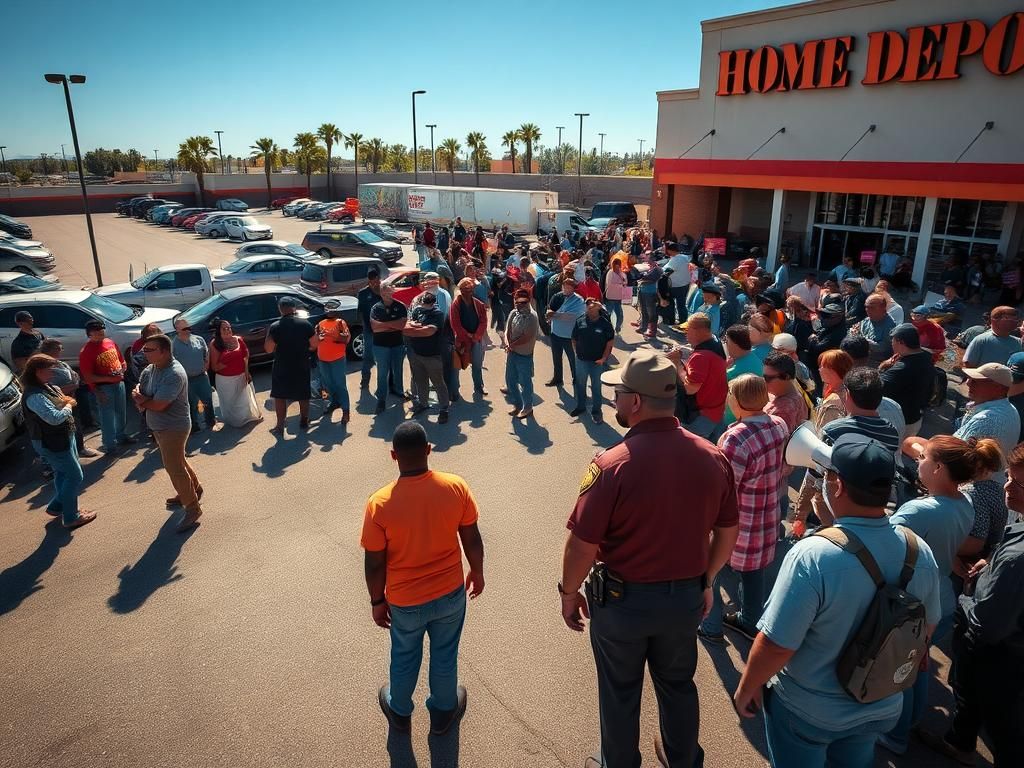
Southern California Home Depots Become Epicenter of Immigration Crackdown
LOS ANGELES, Calif. – The bustling parking lots of Home Depot stores across Southern California, long-established informal hubs for day laborers seeking landscaping and construction jobs, have become flashpoints in the Trump administration’s intensified immigration crackdown. Federal agents are conducting sweeping operations, leading to a climate of fear, desperate escapes, and a tragic fatality, even as community activists and local officials push back through organized alerts and legal challenges.
Decades-Old Hubs Now Prime Targets
For decades, these retail giants have served as de facto employment centers where workers, many from Mexico and El Salvador, gather daily. This summer, however, these locations transformed into prime targets for federal immigration enforcement. The Van Nuys Home Depot, a sprawling 108,000 square-foot store, has been raided at least five times, with agents rounding up immigrants and sending others scrambling for safety. Across Southern California, at least a dozen Home Depot stores have faced similar repeated operations. The focus on these sites reportedly stems from discussions within the White House, with Stephen Miller, a key architect of President Donald Trump’s immigration policies, reportedly identifying them as targets earlier this year.
Fear, Flight, and Fatalities: The Human Cost
The constant threat of raids has spurred an organized response from the day laborers and their allies. In Van Nuys, a man on a bicycle patrols the parking lot, his megaphone ready to blast warnings of approaching federal agents. Workers themselves carry whistles to sound the alarm, while activists use two-way radios to track suspicious vehicles. Javier, a 52-year-old Mexican immigrant who has lived in the U.S. for three decades, recounted narrowly escaping three raids at the Van Nuys store by hiding under a truck, driving away swiftly, or blending in with shoppers inside. He now contemplates returning to Mexico, citing the heightened enforcement. Another laborer, Luis, 37, a legal resident from Mexico, described the agents’ tactics as “just fishing” for undocumented individuals. The human cost of these operations became stark last month in Monrovia, where a man fleeing immigration authorities ran onto a nearby freeway and was struck and killed by a vehicle.
Legal Battles and Local Pushback
Immigrant advocates have launched legal challenges against these raids, but on a recent Monday, the Supreme Court cleared the way for federal agents to continue their operations in Los Angeles for now. This ruling marked the latest victory for the Trump administration at the high court, with Homeland Security Secretary Kristi Noem hailing it as “a win” for the rule of law. However, advocates swiftly condemned the decision. Pablo Alvarado, co-executive director of the National Day Laborer Organizing Network, argued at a press conference near a Home Depot that “When you undermine the civil rights of those who are more vulnerable, you undermine the civil rights of everyone else.” Locally, Los Angeles Mayor Karen Bass has expressed support for the litigation and has trained city workers on how to respond to immigration enforcement on city-owned properties. City councilperson Ysabel Jurado has even voiced opposition to a proposed new Home Depot in her district, criticizing the company for not doing enough to combat the raids. Chris Newman, legal director for the National Day Laborer Organizing Network, advocates for these locations to receive the same city protection as public libraries.
Home Depot’s Unintended Role and Business Impact
The Atlanta-based home improvement giant, boasting nearly $160 billion in annual sales, has a complex relationship with this labor pool. Contractors and professionals account for approximately half of Home Depot’s business, a significantly higher proportion than its competitor Lowe’s, which relies on contractors for only about 30% of its sales. Neil Saunders, managing director of GlobalData Retail, suggests that Home Depot’s business model, attracting a high volume of contractors, inadvertently makes it a more appealing target for immigration enforcement. While the raids haven’t impacted the company’s overall sales, they have demonstrably affected local foot traffic. Data from Placer.ai, an analytics firm, shows a 10.7% decline in foot traffic at Los Angeles-area Home Depot stores in June compared to the previous year, and a 10% decline in July. This contrasts with a milder nationwide decline of 3.8% and 2.7% for the same months.
Company Stance Amidst the Turmoil
Home Depot, which operates roughly 2,300 stores, maintains it is not involved in immigration enforcement and is not alerted to impending raids. Company spokesperson Beth Marlowe stated, “We tell associates to report any suspected immigration enforcement activity immediately and not engage with the activity for their safety,” adding that employees feeling uneasy can go home with pay. Eyewitnesses in Van Nuys have reported instances where local managers have attempted to bar agents by closing the store’s automated glass doors.
Evolution of Day Labor and Enduring Community
The phenomenon of day laborers congregating at Home Depot parking lots evolved with the rise of big-box home improvement stores, which allowed contractors to directly price shop for materials. Nik Theodore, a professor of urban planning and policy at the University of Illinois in Chicago, explained that this shift increasingly tied a contractor’s bid success to labor costs. “Home Depot is not an innocent bystander in all of this. Their sources of success were instrumental in catalyzing this change,” Theodore said. Recognizing these challenges, Los Angeles passed an ordinance in 2008 requiring similar retailers to provide amenities like seating areas, bathrooms, and trash facilities. At the Van Nuys location, a non-profit operates a labor center, logging workers’ names and tracking employers who fail to pay, offering a crucial layer of support. Despite the dangers, workers continue to return to these familiar spots. “Here, all of us together, we’ve become friends,” Javier noted, highlighting the enduring sense of community amidst the uncertainty.