


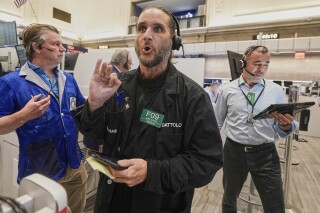
Wall Street Hits New Records Amidst Tech Surge and Mixed Economic Signals
NEW YORK — Wall Street celebrated another day of milestones on Thursday, with major indices pushing further into record territory. Technology and communication services sectors led the charge, underscoring investor confidence in areas benefiting from significant capital expenditure cycles, particularly in artificial intelligence. However, the broader market presented a mixed picture, with many companies facing headwinds from a challenging retail landscape and ongoing economic adjustments.
Market Indices Reach New Heights
The benchmark S&P 500 index climbed 0.3%, adding 20.46 points to close at 6,501.86, marking its second consecutive record high. The Dow Jones Industrial Average, after an initial dip, recovered to gain 0.2%, or 71.67 points, reaching a new record of 45,636.90, surpassing its previous peak set last Friday. The tech-heavy Nasdaq composite also saw a strong finish, rising 0.5% to 21,705.16, narrowly missing its all-time high achieved just two weeks prior.
Tech and AI Drive Gains, Nvidia Sees Slight Dip
Driving these gains were robust performances from key tech players. Broadcom surged 2.8%, Amazon added 1.1%, and Google parent Alphabet climbed 2%. This resilience in technology and communication services sectors reflects a consistent theme observed throughout the year. Bill Northey, senior investment director at U.S. Bank Asset Management, highlighted that these sectors are “really the areas that are surrounding this incredible capital expenditure cycle,” positioning them as primary beneficiaries of current market dynamics.
Despite the sector’s overall strength, chip giant Nvidia experienced a slight dip of 0.8% after reporting quarterly earnings and revenue that, while exceeding analyst forecasts, revealed a slower-than-anticipated growth rate in its artificial intelligence chipset sales. Nvidia is widely regarded as a barometer for the AI boom, and its performance often signals broader trends in the technology sector.
Retail Sector Grapples with Headwinds
In contrast to the tech sector’s ascent, several retailers reported disappointing results or outlooks. Best Buy saw its shares fall 3.7% as its second-quarter snapshot was overshadowed by an uncertain outlook, partly due to U.S. tariffs on trading partners. Urban Outfitters likewise slid 10.7%, despite better-than-expected quarterly results, as the company warned that tariffs would increase pressure on its gross margins in the latter half of the year. Dick’s Sporting Goods also fell 4.8% despite beating expectations, while Victoria’s Secret & Co. closed 0.5% lower. Bucking the trend, Burlington Stores climbed 5.3% following strong earnings.
Hormel Foods Leads S&P 500 Declines
Elsewhere, Spam maker Hormel Foods suffered a significant decline of 13.1%, making it the largest decliner among S&P 500 companies, after its earnings fell short of Wall Street’s forecasts and the company lowered its full-year outlook.
Mixed Economic Data and Fed Outlook
Traders also digested a mixed bag of economic data. The Labor Department reported a decrease in applications for unemployment benefits last week, signaling that employers are largely retaining their workforce, even as the overall pace of hiring has slowed sharply since the spring. Meanwhile, the Commerce Department announced that the U.S. gross domestic product (GDP) expanded at a 3.3% annual rate in the April-June quarter. This growth follows a 0.5% contraction in the first three months of the year, a period heavily influenced by the fallout from the Trump administration’s trade policies. Northey noted that the GDP print “reinforces the fact that this continues to be an economy, domestically, that is continuing to show a great deal of resilience.”
The sluggishness in the job market remains a key factor influencing the Federal Reserve. Fed Chair Jerome Powell signaled last week that the central bank might cut its key interest rate at its upcoming September meeting. Traders are now pricing in an 85.3% chance of a quarter-percentage-point rate cut, according to data from CME Group. While lower rates can stimulate investment and economic activity by making borrowing cheaper, they also carry the risk of exacerbating inflation.
Looking Ahead: Inflation Data on Deck
Looking ahead, investors await Friday’s release of the U.S. personal consumption expenditures (PCE) index, a key inflation gauge. Economists anticipate it will show inflation holding steady at approximately 2.6% year-over-year in July, against a backdrop of businesses continuing to warn consumers about higher costs and prices stemming from tariffs.
Bond Market Update
In the bond market, Treasury yields were mixed. The yield on the 10-year Treasury note dipped to 4.21% from 4.24% on Wednesday, while the two-year Treasury yield, which is more sensitive to Federal Reserve policy expectations, rose to 3.63% from 3.62%.