

Brazil Launches Counter-Offensive Amid Escalating US Trade and Diplomatic Tensions
SAO PAULO (AP) — The Brazilian government has launched a robust economic and diplomatic counter-offensive in response to escalating tensions with the United States, marked by a 50% tariff imposed by former U.S. President Donald Trump on several Brazilian exports. On Wednesday, President Luiz Inácio Lula da Silva unveiled the “Sovereign Brazil” plan, a comprehensive package designed to bolster local companies affected by these duties, providing a credit lifeline of 30 billion reais (approximately $5.5 billion).
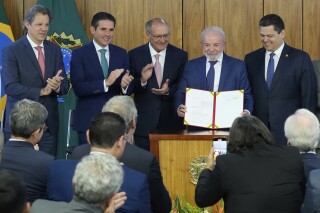
The announcement, made at the presidential palace in Brasilia and attended by top congressional leaders—a rare show of unified political support for Lula in recent months—underscores the gravity of the trade dispute. Hours later, however, the diplomatic friction intensified as U.S. Secretary of State Marco Rubio announced new sanctions targeting at least two Brazilian officials, linking them to a controversial Cuban medical program.
Brazil’s Economic Shield: The “Sovereign Brazil” Plan
President Lula da Silva described the “Sovereign Brazil” initiative, which includes a bill slated for congressional review, as a vital first step to protect the nation’s export sector. The leftist leader, whose approval ratings have seen a notable increase since the U.S. tariffs were announced, reiterated his claim that he and Trump have never engaged in direct dialogue, asserting the former American president’s unwillingness to negotiate.
Key Measures to Mitigate Impact
Key measures within the plan aim to mitigate the financial impact on Brazilian businesses. These include:
- Tax Postponement: Allowing companies directly affected by the U.S. tariffs to defer their tax charges.
- Tax Credits: Providing 5 billion reais (approximately $917 million, based on the prevalent exchange rate) in tax credits specifically for small- and medium-sized enterprises (SMEs) until the end of 2026.
- Insurance Expansion: Broadening access to insurance mechanisms designed to protect companies against losses from cancelled international orders.
- Public Procurement Incentives: Encouraging public sector purchases of goods that would have otherwise been exported to the U.S., thereby creating a domestic market for these products.
- “Drawback” Extension: Granting a one-year extension of tax credits for companies that import components to produce goods for export, a mechanism known as “drawback,” providing crucial relief for manufacturers.
“We cannot be scared, nervous and anxious when there is a crisis. A crisis is for us to create new things,” Lula declared, emphasizing national resilience. He further criticized the U.S. rationale for the tariffs, stating, “In this case, what is unpleasant is that the reasons given to impose sanctions against Brazil do not exist.”
Ricardo Alban, chairman of the Brazilian Industry Confederation, voiced a cautious endorsement of the plan. While acknowledging its necessity, he described it as “palliative,” expressing hope that it would be a temporary measure. “Nothing justifies us being on the lowest of tariffs to going to the highest of tariffs,” Alban stated, reflecting widespread industry concern over the sudden 50% increase in duties. For context, the U.S. tariff on specific Brazilian exports, such as frozen açaí pulp, was previously negligible before Trump’s imposition.
The Political Undercurrent: Bolsonaro and Judicial Independence
The trade dispute is deeply intertwined with political narratives, particularly concerning the judicial situation of former Brazilian President Jair Bolsonaro. Trump has echoed claims from Bolsonaro’s allies, alleging that the former president’s prosecution for attempting to overturn his 2022 election loss represents a “deliberate breakdown in the rule of law” and “politically motivated intimidation” by the Brazilian government, including accusations of “human rights abuses.” Bolsonaro is currently under house arrest as part of an ongoing investigation into his alleged role in inciting the January 8th, 2023, riots in Brasilia, which saw his supporters storm government buildings in a manner reminiscent of the U.S. Capitol attack. His trial is anticipated to reach a sentencing phase between September and October.
Lula vehemently rejected these accusations, asserting the absolute independence of Brazil’s judiciary. “Our American friends, every time they decide to fight with someone, they try to create an image of a devil against the people they want to fight with,” he remarked, vowing to seek alternative international markets for Brazilian goods displaced from the U.S. market.
Reinforcing the judiciary’s autonomy, Lula stated that the executive branch has no influence over the Supreme Court justices, who have consistently maintained their impartiality. He drew a direct parallel to U.S. events: “If what happened at the Capitol (the U.S. riots on Jan. 6, 2021) had happened in Brazil, he (Trump) would be on trial here too.”
Further highlighting the strained relationship, Supreme Court Justice Alexandre de Moraes, who is overseeing the case against Bolsonaro, was sanctioned earlier in August under the U.S. Magnitsky Act. This act, typically used to target serious human rights offenders, was applied despite de Moraes’s consistent argument that all defendants in the case have been afforded full due process.
Rubio’s Retaliation: Targeting the “More Doctors” Program
Hours after Brazil’s “Sovereign Brazil” plan was announced, U.S. Secretary of State Marco Rubio declared that the U.S. would “restrict visa issuance to Cuban and complicit third-country government officials and individuals responsible for Cuba’s exploitative labor export program.”
Rubio specifically cited Brazil’s “More Doctors” program, launched in 2013, as “an unconscionable diplomatic scam of foreign ‘medical missions.’” This initiative previously brought thousands of Cuban doctors to serve in underserved areas across Brazil. Although the current Brazilian government stated that the program now involves almost 25,000 medical professionals nationwide, it did not specify how many are still Cuban.
Brazil’s Health Minister Alexandre Padilha, who was instrumental in founding the program, fiercely defended it, asserting its resilience against “unjustifiable attacks.” “This program saves lives and it is approved by those who matter most: the Brazilian people,” Padilha stated. He then specifically named Mozart Sales and Alberto Kleiman, two key figures from his first tenure as health minister, whose U.S. visas were reportedly revoked, linking these actions to opposition against vaccines, research, and science.
The U.S. actions drew praise from some Brazilian political figures. Lawmaker Eduardo Bolsonaro, son of the former president and a vocal proponent for amnesty for those implicated in the alleged coup plot, commented, “This measure is a clear message: neither ministers, nor lower-tier bureaucrats nor their family members are immune. Sooner or later, everyone who contributed to support those (autocratic) regimes will answer for what they did — and there will be no place to hide.”
However, Brazil’s Finance Minister Fernando Haddad countered, stating, “My country is being sanctioned for being more democratic than its aggressor.” He concluded, “We will face, as we have, many difficult situations and we shall overcome. This one comes from the outside, but unfortunately it has the support of radicalized sections of Brazil’s society.”