


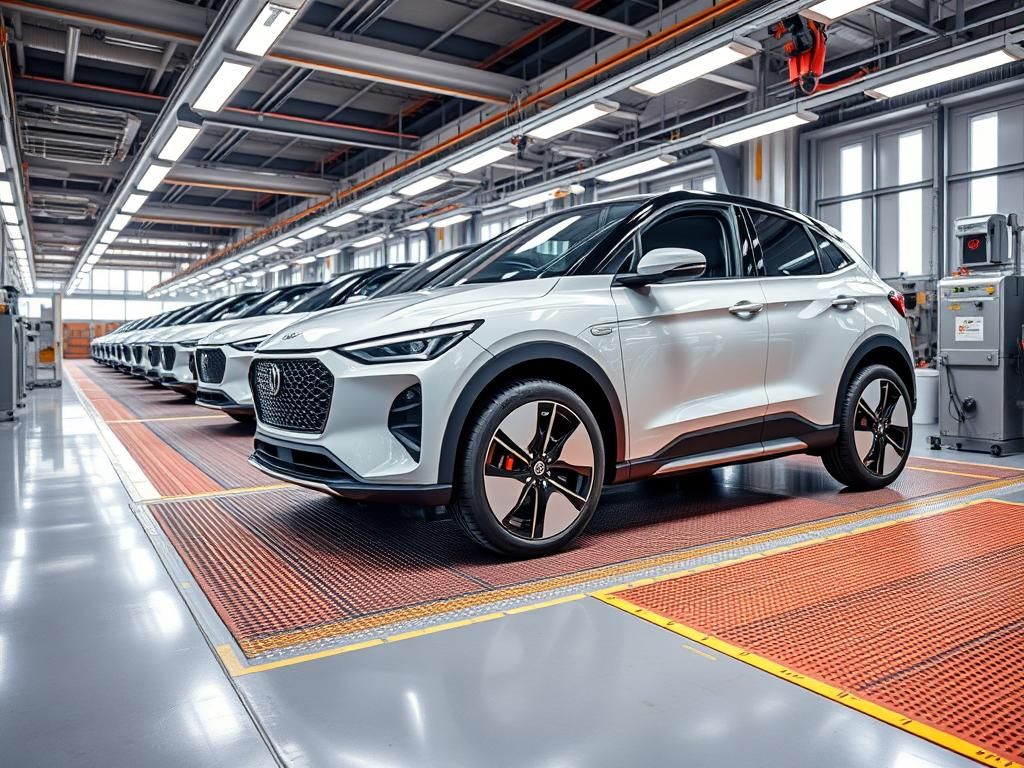
VinFast Electrifies India: Vietnamese Automaker Inaugurates $500 Million EV Plant
THOOTHUKUDI, India – Vietnamese automaker VinFast officially commenced production at its new $500 million electric vehicle (EV) manufacturing facility in Thoothukudi, Tamil Nadu, on Monday. This significant milestone marks a pivotal step in the company’s ambitious $2 billion investment strategy for India and its broader expansion across the booming Asian market.
A Strategic Foothold in India’s Automotive Hub
The state-of-the-art factory, strategically located in southern India’s highly industrialized Tamil Nadu state, is initially poised to produce 50,000 electric vehicles annually. However, its design allows for a rapid tripling of output to an impressive 150,000 cars, positioning it as a vital hub for future exports to the wider region. VinFast anticipates the plant will create over 3,000 local jobs, providing a significant boost to the local economy.
The choice of Tamil Nadu followed an extensive scouting mission across 15 locations in six Indian states. T.R.B. Raaja, Tamil Nadu’s Industries Minister, highlighted the state’s robust manufacturing ecosystem, skilled workforce, well-developed infrastructure, and reliable supply chain as key deciding factors. Raaja emphasized, “This investment will lead to an entirely new industrial cluster in south Tamil Nadu, and more clusters is what India needs to emerge as a global manufacturing hub.”
Pivot to Asia: A New Horizon for VinFast
VinFast’s aggressive entry into the Indian market signals a strategic recalibration after facing challenges in gaining significant traction in the more established U.S. and European markets. The company is now firmly focused on capitalizing on the burgeoning demand for EVs in Asia.
This regional pivot is further underscored by its groundbreaking last year on a $200 million EV assembly plant in Indonesia, also targeting an annual production of 50,000 vehicles. VinFast is concurrently expanding its presence in Thailand and the Philippines. Despite selling nearly 97,000 vehicles in 2024—a threefold increase from the previous year—only about 10% of these sales occurred outside Vietnam. The new Indian factory is envisioned as a crucial base for exports not only to South Asian nations like Nepal and Sri Lanka but also to burgeoning markets in the Middle East and Africa.
India’s Electric Revolution: A Market Ripe for Disruption
As the world’s third-largest car market by volume, India presents an enticing landscape for EV manufacturers. It offers a unique confluence of a rapidly expanding economy, increasing EV adoption rates, supportive government policies, and a nascent EV market that has yet to see a dominant player emerge. “It is a market that no automaker in the world can ignore,” asserted Ishan Raghav, managing editor of the Indian car magazine autoX.
The growth of EVs in India has been primarily propelled by two and three-wheelers, which accounted for a significant 86% of the over six million EVs sold last year. While four-wheel passenger EV sales constituted a modest 2.5% of total car sales in India last year, this segment is experiencing explosive growth, surging from a mere 1,841 units in 2019 to over 110,000 in 2024. The Indian government aims for EVs to comprise one-third of all passenger vehicle sales by 2030. Charith Konda, an energy specialist at the Institute for Energy Economics and Financial Analysis (IEEFA), attributes this rapid expansion to newer models offering improved batteries, quicker charging capabilities, and extended driving ranges. VinFast plans to introduce its VF6 and VF7 SUV models, specifically designed for the Indian market, later this year.
Navigating the Indian Landscape: VinFast’s Advantages and Challenges
Unlike several Chinese EV brands that have encountered hurdles in India following border clashes in 2020—which led to restrictions on companies like BYD building their own factories—VinFast enters the market without such geopolitical baggage. Chinese giant SAIC, owner of MG Motor, circumvented these restrictions by partnering with India’s JSW Group. Their MG Windsor, a five-seater SUV, successfully sold 30,000 units in just nine months, chipping away at Tata Motors’ once-dominant 70% EV market share, bringing it down to approximately 50%. Tata Motors pioneered the mass-market EV segment in India with its electric Nexon SUV launch in 2020, achieving significant success.
VinFast stands to benefit from India’s “Make in India” policy, which offers incentives such as lower land prices and tax breaks for local manufacturing, while simultaneously imposing high import duties to discourage fully built imports. This policy poses challenges even for global players like Tesla, whose Model Y, launched last month, carries a price tag of nearly $80,000 in India, significantly higher than its approximately $44,990 U.S. price (excluding federal tax credit). Konda reiterated India’s firm stance: “India’s stand is very clear. We do not want to import manufactured cars, even Teslas. Whether it’s Tesla or Chinese cars, they are taxed heavily.”
Despite these advantages, the road ahead for VinFast is formidable. India’s EV market is competitive, featuring established players like Tata Motors and Mahindra dominating the affordable segments, alongside Hyundai, MG Motors, and luxury brands such as Mercedes-Benz and Audi in higher price points. Indian consumers typically purchase EVs as secondary vehicles for urban commuting, citing unreliable charging infrastructure outside major cities.
Vivek Gulia, co-founder of JMK Research, emphasizes that VinFast must gain the trust of India’s cost-sensitive and conservative drivers by ensuring battery quality, robust services, and competitive pricing. “Initially, people will be apprehensive,” Gulia noted. VinFast’s strategy includes establishing showrooms and service centers across India, collaborating with local companies for charging and repairs, and aiming for cost efficiencies by recycling batteries and localizing key components like powertrains and battery packs.
Achieving scale is paramount. While VinFast has signed agreements for 32 dealerships across 27 Indian cities, it faces a significant gap compared to entrenched players like Hyundai, which boasts 1,300 sales points. Building brand recognition and trust in India is a long game, as exemplified by Hyundai’s decades-long effort, aided by endorsements from Bollywood stars like Shah Rukh Khan. Gulia concludes that if VinFast can strike the right balance on pricing and cultivate customer trust, “Then they can actually do really good.”