


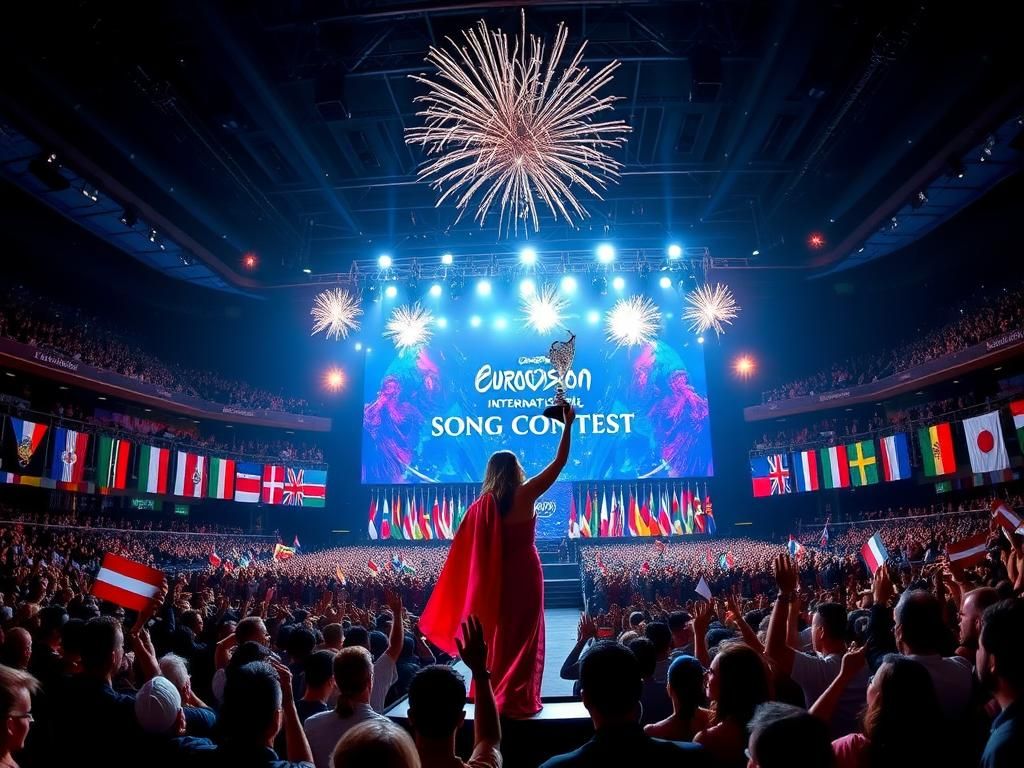
Intervision: Russia’s New Song Contest – A Blend of Glitter and Geopolitics
Moscow, Russia — In a spectacular display of vocal prowess and dazzling pyrotechnics at the Live Arena on Saturday night, Vietnamese singer Duc Phuc was crowned the inaugural winner of Intervision, Russia’s ambitious new international song contest. His electrifying performance of “Phu Dong Thien Vuong,” a dynamic fusion of pop, rap, and dubstep, secured him the coveted crystal cup trophy and a grand prize of 30 million rubles, equivalent to approximately $360,000 USD. Kyrgyzstan claimed second place in the high-stakes final.
The contest, however, proved to be about more than just music, as geopolitical tensions simmered beneath the surface of the glittering spectacle. The night was marked by unexpected twists, particularly concerning the United States’ representation. Moments before her scheduled performance, Australian-born Vassy, the U.S. entrant, was abruptly announced as unable to perform due to “political pressure” from the Australian government. This followed an earlier withdrawal by singer-songwriter Brandon Howard, originally slated to perform for the U.S., just three days prior to the final, citing “unforeseen family circumstances.” Vassy declined to comment on the incident when contacted by The Associated Press.
Adding to the evening’s dramatic narrative, Russian singer Shaman, known for his ultra-patriotic anthems, concluded his act with a fervent plea to the international jury. He requested that Russia’s performance not be judged, declaring, “Russia has already won by inviting so many countries to join us.” His statement underscored the contest’s undeniable role as a platform for projecting Russia’s global standing.
Glitter and Geopolitics: Russia’s Cultural Counter-Offensive
For decades, the Eurovision Song Contest has stood as Europe’s premier international music competition, a continent-spanning celebration of unity through song. Intervision openly seeks to challenge that supremacy. Much like its European counterpart, the contest features artists performing under their national flags before a live audience and an international jury, vying for votes and glory.
Yet, the foundations of Intervision are deeply entwined with geopolitics. The contest was brought to life by a special presidential decree in February 2025, just three years after Moscow was indefinitely barred from Eurovision following its full-scale invasion of Ukraine in February 2022. This ban left Russia seeking a new avenue to re-establish its presence on the global cultural stage.
Despite persistent denials from Kremlin officials, who insist Intervision is “diametrically opposite to the attempts to use sports, art, and any other human activities for political gains,” the contest’s political undercurrents are undeniable. President Vladimir Putin himself discussed Intervision during a state visit to China in September and delivered a special video message at the start of the show. Foreign Minister Sergey Lavrov also made an appearance, conducting an interview between the initial and subsequent acts. Lawmaker Leonid Slutsky explicitly articulated the contest’s strategic importance, telling Russian state news agency Tass, “Eurovision pales in comparison to Intervision. (It) destroys the myth of Russian isolation.” The message was clear: Intervision aims to showcase a Russia that is embraced, not ostracized, by a significant portion of the world, despite the ongoing conflict in Ukraine.
A Revival with a Political Pulse
The new Intervision draws inspiration from a socialist-era contest of the same name, which ran intermittently in Czechoslovakia (1965-1968) and Poland (1977-1980). Historian Dean Vuletic, author of “Postwar Europe and the Eurovision Song Contest,” notes that while the original Intervision aimed to “bridge between East and West” and attract Western media attention—even famously featuring Boney M in 1979—it never garnered significant interest in Soviet Russia. The 2025 revival, however, appears to serve a more direct geopolitical purpose.
The lineup for the inaugural Intervision featured 23 acts, predominantly from countries maintaining a neutral or friendly stance towards Russia’s actions in Ukraine. Participants included nations such as China, South Africa, Brazil, the UAE, India, Cuba, Ethiopia, and Venezuela, making the U.S. entry by Vassy a notable outlier. Transparency in the artist selection process remained opaque; Intervision rules allow “co-organizers”—ranging from national broadcasters to individuals—to nominate acts, but no public list confirms these entities. This lack of clarity contributed to an uneven playing field regarding cultural influence, with “national stars” like Russia’s Shaman enjoying significant domestic promotion, while others, such as Egypt’s Moustafa Saad, a soloist at the Alexandria Opera House, held a comparatively niche profile.
The Missing Element: A Global Fanbase
For Intervision to cultivate a lasting legacy, it must transcend political directives and win over a genuine fanbase. While content creators like Henrik Larsson have posted reaction videos, acknowledging “fantastic” songs and a broader global perspective, the vast majority of established Eurovision fan communities have largely dismissed or condemned the contest. Comments on popular forums reflected sentiments such as, “Let the dictators and war criminals have their own little party where they can spout their propaganda and call it a contest,” highlighting deep-seated skepticism and political opposition.
A significant point of divergence from the inclusive spirit of Eurovision, a contest widely embraced by the LGBTQ+ community, is Intervision’s public commitment to “traditional universal and family values.” This stance is a direct affront to many potential fans. Notably, information regarding U.S. entrant Vassy’s role as an ambassador for the NOH8 Campaign, a nonprofit advocating for LGBTQ+ rights and gender equality, briefly vanished from her Wikipedia page following the announcement of her participation in Intervision, though it was later restored.
The contest’s genuine public appeal within Russia also remains questionable. Reports from The Associated Press found online casting advertisements offering small payments to individuals willing to join the Intervision crowd, suggesting an artificial inflation of audience engagement.
An Uncertain Future, A Clear Agenda
Historian Dean Vuletic cautions that without a robust fanbase or a central organizing body driving it forward, Intervision’s future hinges precariously on political will. Both the Czechoslovak and Polish iterations of Intervision ultimately faltered due to social upheaval and shifting political priorities.
As the 2025 show concluded, organizers announced that the next edition of Intervision would be held in Saudi Arabia in 2026. For now, the Kremlin’s enthusiasm for the competition’s role in shaping Russia’s international image remains undimmed. Foreign Minister Lavrov reiterated, “In Soviet times, the party and government made decisions to promote a positive image of Russia abroad. Today, we must advance an objective portrayal. Indeed, some of our perceived shortcomings provoke envy among many foreign counterparts.” Intervision, it seems, is not merely a song contest, but a crucial instrument in Russia’s broader diplomatic and cultural strategy.