

Trump’s Economy Faces Headwinds: Job Growth Slows, Inflation Rises
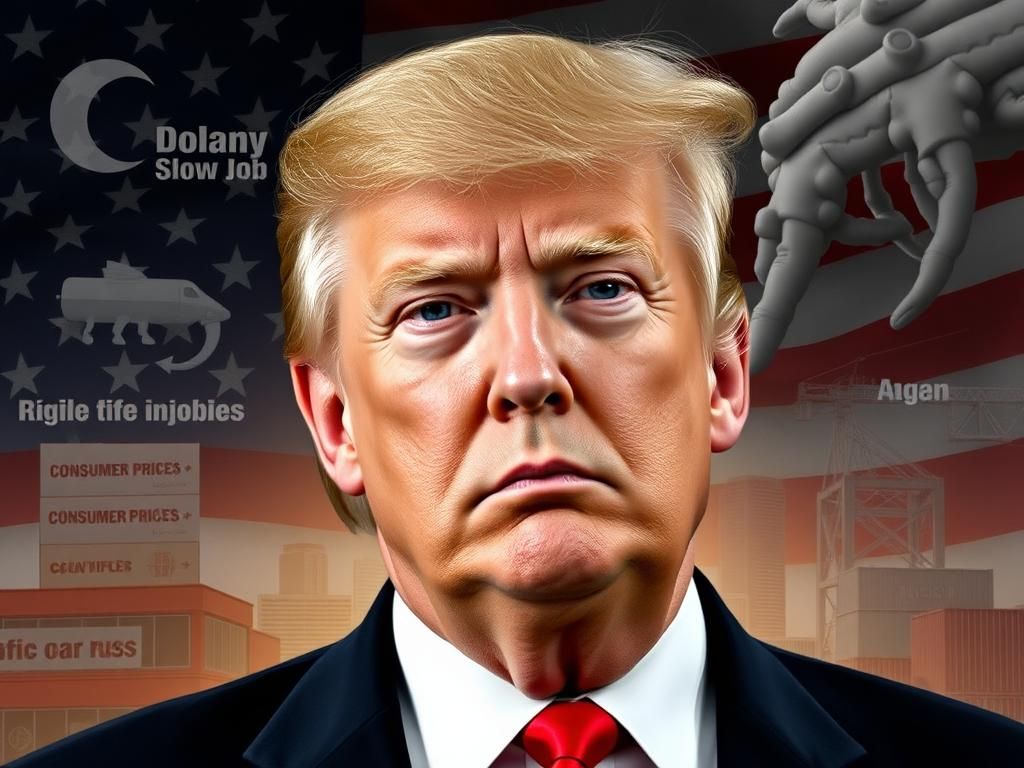
WASHINGTON (AP) – Seven months into his second term, President Donald Trump faces a faltering U.S. job market, marked by a sharp slowdown in hiring and a notable uptick in inflation. The economic landscape contrasts sharply with the “booming economy” he promised, as his administration’s policies, including significant tariffs, begin to take a measurable toll.
The Alarming August Jobs Report
The latest jobs report, released Friday, delivered stark figures: employers added a mere 22,000 jobs in August. This figure represents a significant slowdown, falling far short of the estimated 150,000 to 200,000 new jobs typically needed each month to keep pace with population growth and maintain a healthy labor market. The national unemployment rate edged up to 4.3%.
Adding to the concern, revisions revealed that the economy actually lost 13,000 jobs in June, marking the first monthly decline in employment since December 2020, amidst the height of the COVID-19 pandemic. Key sectors, often indicators of economic strength, have also shown signs of contraction: factories have shed 42,000 manufacturing jobs, and construction firms have cut 8,000 workers since April.
Trump’s Call for Patience Amid Declining Approval
In the face of these disheartening numbers, President Trump, known for his rapid-fire approach, is now asking for patience. “We’re going to win like you’ve never seen,” Trump declared on Friday, adding, “Wait until these factories start to open up that are being built all over the country, you’re going to see things happen in this country that nobody expects.” He suggested that more robust job numbers might still be a year away.
However, this plea has done little to assuage public anxiety. Economic approval for Trump, which stood at a robust 56% in early 2020 during his first term, has plummeted to 38% in July of this year, according to polling data from The Associated Press-NORC Center for Public Affairs Research. This marks a persistent weakness for an issue that was once a core strength for the former president.
Blame Game and Policy Clashes
The White House has been quick to deflect responsibility, with President Trump laying blame on Federal Reserve Chair Jerome Powell. Trump asserted that the economy would be adding more jobs if Powell had aggressively slashed benchmark interest rates, despite warnings from many economists that such drastic cuts could further ignite inflation. Investors, anticipating a weakening economy, now widely expect a rate cut from the Fed at its upcoming September meeting.
Democrats, however, point the finger squarely at the administration’s policies. Senate Minority Leader Chuck Schumer, D-N.Y., stated, “This is a blaring red light warning to the entire country that Donald Trump is squeezing the life out of our economy.” Schumer specifically cited Trump’s tariffs and his administration’s often “freewheeling policies” as the root causes of the economic downturn.
Promises Versus Reality: A Factual Reckoning
A review of President Trump’s past economic pledges reveals a widening gap between his rhetoric and current performance:
- “Black Jobs” (2024 Campaign): Trump vowed that deporting undocumented immigrants would protect “Black jobs.” Yet, the Black unemployment rate has climbed to 7.5%, its highest level since October 2021, coinciding with aggressive immigration crackdowns by his administration.
- “Factories Roaring Back” (April 2025 Tariffs Announcement): At a ceremony announcing new tariffs, Trump declared, “Jobs and factories will come roaring back into our country and you see it happening already.” Since that announcement in April, manufacturers have cut 42,000 jobs, and builders have downsized their workforces by 8,000.
- “Liquid Gold” Energy Wealth (Inaugural Address): Trump promised that the nation’s “liquid gold” of oil would lead to widespread wealth as he pivoted the economy towards fossil fuels. However, the logging and mining sectors, which include oil and natural gas, have shed 12,000 jobs since January. Furthermore, the Energy Information Administration in August projected that U.S. crude oil production, a key source of the promised wealth, would fall next year by an average of 100,000 barrels a day.
- “End Inflation on Day One” & Halving Electricity Prices (2024 Rallies): During his 2024 campaign, Trump repeatedly pledged to “end” inflation on his “day one” and to halve electricity prices within 12 months. Far from ending, consumer prices have climbed from a 2.3% annual increase in April to 2.7% in July, while electricity costs have risen by 4.6% so far this year.
White House Optimism Meets Expert Skepticism
Despite the challenging data, the Trump White House maintains an optimistic outlook. Kevin Hassett, director of the White House National Economic Council, characterized Friday’s jobs report as an “outlier.” He highlighted that the Atlanta Federal Reserve is still projecting an annualized economic growth of 3% this quarter, a figure he argued would be more consistent with monthly job gains closer to 100,000. Hassett also asserted that inflation remains low, income growth is “solid,” and new investments in infrastructure and equipment will ultimately boost hiring. At a recent Thursday night dinner with tech giants including Apple, Google, Microsoft, OpenAI, and Meta, Trump reiterated his belief that artificial intelligence facilities currently under construction would deliver “jobs numbers like our country has never seen before,” albeit “a year from now.”
However, this future-oriented optimism often conflicts with the President’s past accusations. Michael Strain, director of economic policy studies at the American Enterprise Institute, noted the inherent contradiction in Trump’s dual narrative. “The president clearly stated that the data were not trustworthy and that the weakness in the data was the product of anti-Trump manipulation,” Strain commented. “And if that’s true, what are we being patient about?” Strain’s remarks highlight the confusion created by the President’s previous decision to fire the head of the Bureau of Labor Statistics last month following significant downward revisions in the July jobs report, which Trump branded as “faked” to embarrass him.
Echoing concerns about the broad economic picture, Daniel Hornung, who served as deputy director of the National Economic Council in the Biden White House, observed a “pretty broad based weakening” in the August jobs data. He specifically called out the “decline over three months in goods producing sectors like construction and manufacturing” as particularly notable, suggesting that “tariffs are likely exacerbating challenges.”
Conversely, Stephen Moore, an economics fellow at the conservative Heritage Foundation and a strong supporter of the President, acknowledged that the labor market is “definitely softening,” though he also echoed Trump’s skepticism regarding the reliability of the jobs numbers. Moore framed the economic adjustments as a response to Trump’s policies of higher tariffs and reduced immigration, suggesting that the primary issue going forward would be a “shortage of workers, not a shortage of jobs”—a problem he described as “good to have.”
Political Outlook: The Road to 2026
For now, the economic performance will undoubtedly cast a long shadow over the upcoming political cycle. Political consultant and pollster Frank Luntz offered a contrarian view, suggesting that the August jobs report, while poor, might not be the ultimate determinant of President Trump’s political fortunes. Luntz argued that voters are more attuned to the issues of inflation and overall affordability. “That’s what the public is watching, that’s what the public cares about,” Luntz said, adding, “Everyone who wants a job has a job, for the most part.”
Luntz emphasized that Trump still has roughly a year to demonstrate significant progress on improving affordability. He projected that voters would generally “lock in their opinions about the economy by Labor Day before the midterm elections next year.” Therefore, the “deciding point will come Labor Day of 2026,” suggesting that despite the current headwinds, President Trump still has a window to change the economic narrative before voters head to the polls.