


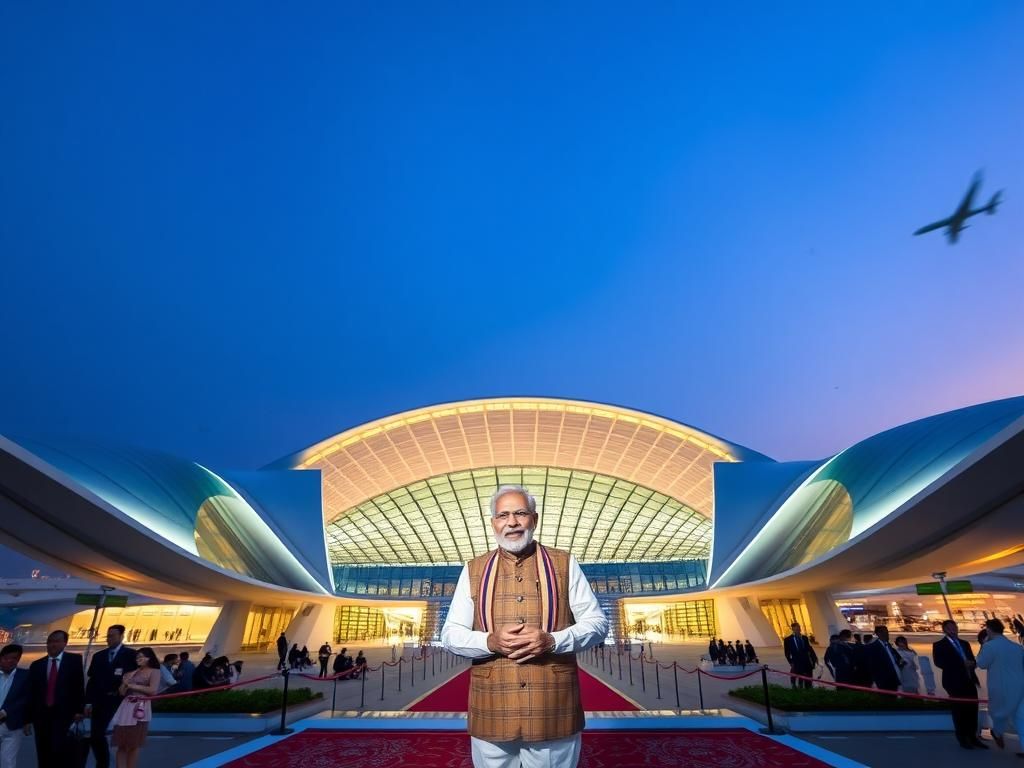
India’s Aviation Boom Takes Flight: Navi Mumbai International Airport Inaugurated
NEW DELHI – In a significant stride for India’s rapidly expanding aviation sector, Prime Minister Narendra Modi on Wednesday inaugurated the first phase of the Navi Mumbai International Airport. This sprawling new international gateway is poised to redefine air travel in the nation’s financial capital.
Developed by the Adani Group with an estimated investment of $2.2 billion for its initial phase, the airport is slated to begin operations in December. It promises substantial relief to the heavily congested Chhatrapati Shivaji Maharaj International Airport and will serve as a pivotal passenger and cargo hub for Asia. This makes Mumbai the only metropolitan city in India to boast a second international airport, underscoring its growing economic and strategic importance.
Propelling India’s Infrastructure Vision
The ambitious project is a cornerstone of India’s broader national agenda to modernize its infrastructure and enhance air connectivity, a vision actively championed by the Modi government. Over the past decade, the country has witnessed a remarkable transformation in its aviation landscape, with the number of operational airports more than doubling from 74 in 2014 to 160 today.
This aggressive expansion aims to bridge smaller cities, streamline cargo movement, and position air travel as a key catalyst for economic development across the diverse nation. “It’s a reflection of a nation that is growing,” Prime Minister Modi affirmed during the inauguration speech, highlighting the airport as a symbol of India’s progress.
Solidifying India’s Global Aviation Standing
India has cemented its position as the world’s third-largest air transport market in terms of departing passenger traffic, trailing only the United States and China. In 2024 alone, approximately 174 million passengers embarked on air journeys from and within India, accounting for a notable 4.2% of the global total. The new Navi Mumbai facility is strategically designed to accommodate this surging demand.
Pioneering Capacity and Connectivity
Upon completion of its first phase, the airport will have an annual capacity for up to 20 million passengers. Looking ahead, the Adani Group projects a formidable expansion to handle up to 90 million passengers annually once all four planned terminals become fully operational.
Beyond its impressive capacity, the Navi Mumbai International Airport is set to be a pioneer in connectivity, becoming India’s first airport to integrate water taxis into its transport network. This innovative approach complements robust links via high-speed rail, underground metro trains, and an extensive network of roads and highways, ensuring seamless access for travelers and cargo alike.
A Symbol of India’s Global Aspirations
The inauguration of Navi Mumbai International Airport is more than just the opening of a new transport hub; it represents a bold declaration of India’s economic ascent and its commitment to building world-class infrastructure that can support its aspirations on the global stage.