


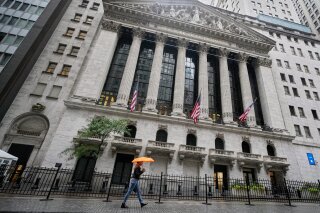
Wall Street Recovers from Tumultuous Week with Strong Finish
NEW YORK (AP) – By STAN CHOE – October 16, 2024 – Wall Street concluded a tumultuous yet ultimately winning week on Friday, with major indexes posting their best performance in two months. A late-week rally, fueled by stabilizing bank stocks and renewed optimism over U.S.-China trade relations, helped investors shrug off earlier jitters.
Market Snapshot: A Week of Swings
The S&P 500, a broad measure of market performance, advanced 0.5% on Friday, bringing its final weekly gain to its highest point since early August. The Dow Jones Industrial Average added 238.37 points, a 0.5% increase, to close at 46,190.61, while the tech-heavy Nasdaq composite climbed 117.44 points, also up 0.5%, to finish at 22,679.97. Despite Friday’s calm, the week was marked by jarring swings as investors grappled with twin concerns: the financial health of small and mid-sized banks and the escalating trade dispute between the United States and China.
Bank Stocks Stabilize, Alleviating Fears
A significant driver of Friday’s market recovery was the stabilization of bank stocks. Several regional lenders, including Truist Financial, Fifth Third Bancorp, and Huntington Bancshares, reported stronger-than-anticipated quarterly profits. These positive earnings helped to allay fears that had caused a sharp downturn in the banking sector just a day earlier, sparked by worries over potentially problematic loans.
Spotlight on Troubled Lenders
Two banks that had been at the epicenter of Thursday’s concerns saw notable recoveries. Zions Bancorp, which disclosed it was charging off $50 million in loans due to “apparent misrepresentations and contractual defaults” by borrowers, surged 5.8% on Friday, trimming its previous day’s 13.1% loss. Similarly, Western Alliance Bancorp, currently engaged in a lawsuit against a borrower over fraud allegations, rose 3.1% after a 10.8% plunge on Thursday. These incidents underscore a growing scrutiny on the quality of loans extended by banks and other financial institutions, a trend exacerbated by last month’s Chapter 11 bankruptcy filing of First Brands Group, a prominent supplier of aftermarket auto parts.
The ripple effects of the First Brands Group bankruptcy extended to investment firms, with Jefferies Financial Group, a firm potentially exposed to losses from the bankruptcy, climbing 5.9% on Friday. This gain followed a considerable decline of approximately 30% for Jefferies since mid-September. The broader market grapples with a pivotal question: are these isolated incidents of loan defaults, or do they signal a larger, systemic threat to the financial industry, particularly after an extended period of low interest rates encouraged riskier lending?
“Cockroaches” or Isolated Incidents?
JPMorgan CEO Jamie Dimon weighed in on this debate during an earnings conference call earlier in the week, cautioning, “When you see one cockroach, there are probably more.” However, not all analysts share the same level of alarm. Brian Jacobsen, chief economist at Annex Wealth Management, offered a more reassuring perspective: “But banks make loan loss provisions and typically have plenty of capital to keep the cockroaches from causing structural damage. Based on earnings and data so far, it looks like this isn’t an infestation.”
U.S.-China Trade Tensions Ease
Compounding the week’s earlier volatility were heightened U.S.-China trade tensions. However, these concerns eased considerably on Friday after President Donald Trump indicated that the “very high tariffs” he had threatened to impose on Chinese imports were “not sustainable.” Further calming investor nerves, Trump informed Fox News Channel’s “Sunday Morning Futures” that he planned to meet with Chinese leader Xi Jinping at an upcoming conference in South Korea, a sharp reversal from an earlier social media post where he had dismissed such a meeting as having “no reason.”
Bond Market Stabilizes, Gold Pulls Back from Highs
In the bond market, Treasury yields stabilized after a significant rush into safer assets on Thursday. The yield on the benchmark 10-year Treasury note edged up slightly to 4.00% from 3.99% late Thursday. Gold, often seen as a safe-haven asset, also pulled back from its recent record highs, falling 2.1% to $4,213.30 per ounce. Despite this Friday dip, gold prices have soared by roughly 60% this year, driven by a confluence of factors including trade war anxieties, expectations of future interest rate cuts by the Federal Reserve, and ongoing concerns about the massive national debts accumulating globally.
Global Markets Reflect Early Weakness
Internationally, stock markets largely reflected Wall Street’s earlier weakness before its Friday rebound. Germany’s DAX index lost 1.8%, and Hong Kong’s Hang Seng index sank 2.5%, indicating a broader global apprehension earlier in the week.
Conclusion: Cautious Resilience Prevails
The market’s ability to recover from a volatile start and end the week on a positive note suggests a cautious resilience, as investors carefully balance lingering concerns over loan quality and geopolitical tensions with signs of economic stability and diplomatic overtures.