


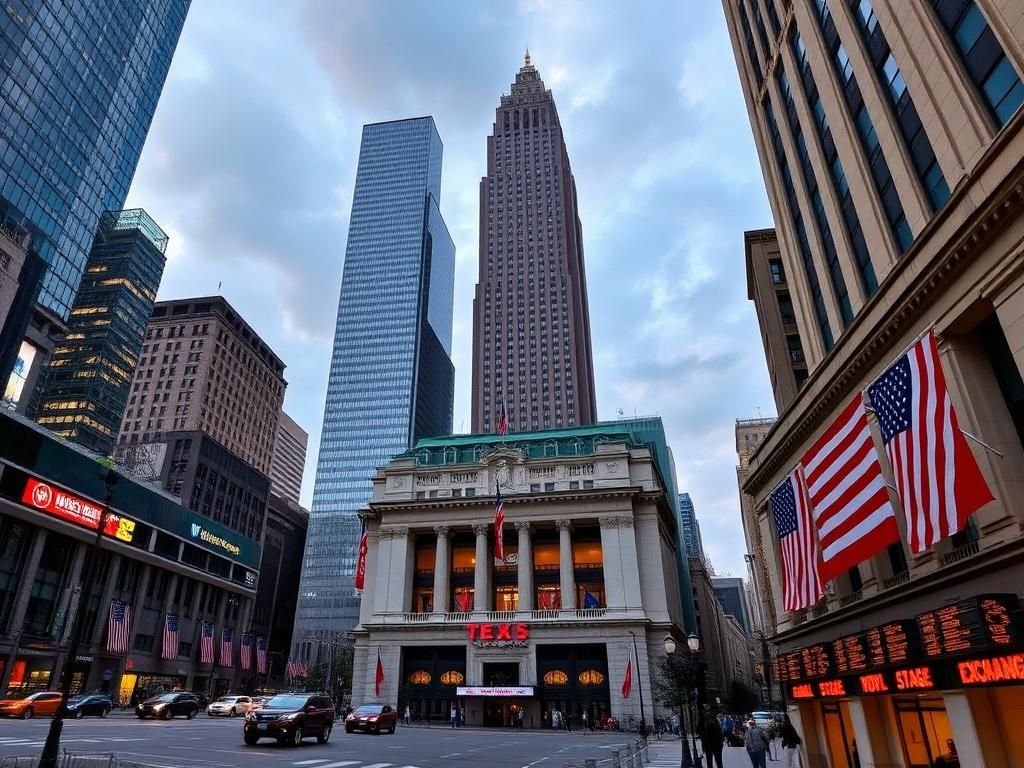
Texas Stock Exchange Approved: ‘Y’all Street’ Set to Challenge NYSE and Nasdaq
Dallas, TX – The financial landscape of the United States is poised for a significant shift following the U.S. Securities and Exchange Commission’s (SEC) recent approval of the Texas Stock Exchange (TXSE) to operate as a national exchange. Announced on September 30, 2025, this landmark decision clears the path for the Dallas-based startup to emerge as a direct competitor to the long-standing duopoly of the New York Stock Exchange (NYSE) and Nasdaq.
The SEC’s green light was met with fervent enthusiasm across Texas, particularly from state officials like Governor Greg Abbott, who confidently proclaimed, “Texas is swiftly becoming America’s financial hub.” This sentiment reflects a growing recognition of the state’s burgeoning economic influence and its increasing appeal to major corporations and financial institutions.
A $120 Million Bet Against the Duopoly
The TXSE, often referred to as “Tex-ee,” has been building considerable momentum since its initial announcement in June 2024. The exchange revealed then that it had secured an impressive $120 million in backing from influential investment firms, including global giants BlackRock and Citadel Securities. This substantial financial commitment positions TXSE as one of the most robustly funded attempts at launching a new national exchange in decades, signaling serious intent to disrupt the established order.
For years, the U.S. equities market has been dominated by the NYSE and Nasdaq. Following the NYSE’s acquisition of the American Stock Exchange in 2008, numerous regional exchanges, such as those in Boston, Philadelphia, and Chicago, were either absorbed or shut down. Past efforts to establish a third dominant national exchange have largely faltered, struggling to attract a critical mass of companies willing to list. TXSE leadership, however, believes this time will be different.
The Lone Star State’s Economic Lure
TXSE officials attribute the feasibility of their venture to the robust and continuously expanding Texas economy. The state has witnessed a significant influx of Fortune 500 companies, drawn by its favorable regulatory environment and attractive taxation policies. Currently, Texas boasts the second-highest number of Fortune 500 company headquarters in the nation, trailing only California and surpassing New York.
Nicole Chambers, Global Managing Director of Listings at TXSE, highlighted Texas’s global economic standing in a September gathering of Dallas business leaders. “Texas is a major player in the U.S. regardless of the exchange landscape, but it ultimately makes sense as the 7th largest economy in the world,” Chambers stated, emphasizing that “45 countries smaller than Texas have their own stock exchanges.” She further asserted, “Texas has really become a leader in where you can do business… We couldn’t do this in Oregon or in Nebraska.”
‘Y’all Street’: A New Financial Capital Emerges
The emergence of TXSE has not gone unnoticed by the established players. In a clear reaction to TXSE’s ambitions, the New York Stock Exchange announced in February 2025 its plan to reincorporate its Chicago electronic exchange and relocate it to Dallas, rebranding it as NYSE Texas. Nasdaq followed suit in March 2025, revealing its intention to establish a regional headquarters in Dallas. Bill Bailey, Managing Director of Market Intelligence at TXSE, views these moves as direct responses to TXSE’s creation, underscoring the perceived threat to their dominance.
These developments underscore Dallas’s rapid transformation into a burgeoning financial services hub, earning the city the playful moniker “Y’all Street.” The long-term impact of these competitive maneuvers will test whether Dallas’s recent growth is substantial enough to sustain multiple major exchange presences.
TXSE’s Strategic Advantage and Path Forward
Scheduled to launch in Fall 2026, the TXSE plans to operate as an entirely digital exchange, though it will maintain a physical presence in Dallas. It intends to adopt many of the traditional ceremonials of its rivals, including bell-ringing events, infused with a distinct “Texas flair.”
With its substantial $120 million investment, the digital infrastructure is expected to be state-of-the-art. Critically, TXSE aims to differentiate itself by offering fewer requirements for the composition of company boards of directors compared to existing exchanges. This strategy, coupled with capitalizing on potential discontent over rising fees, new rules, and share price benchmarks at Nasdaq and NYSE, forms a core part of its appeal to potential listings.
The success of TXSE will heavily depend on investor patience and its ability to rapidly attract companies. Sriram Villupuram, an associate professor of finance at the University of Texas at Arlington, emphasizes that persuading the first 50 to 100 companies to list will be crucial for building momentum. “It gives those that are thinking about listing an idea about what it takes to get on the exchange, and it could snowball from there,” Villupuram noted. He also highlighted that while stock trading is largely automated, the “courting of companies to come get listed with us, that is still very much human to human,” making a physical presence near major corporations vital.
Dallas: The New Center of Gravity for Finance
Historically, Dallas has served as a critical trading hub in the Sun Belt due to its central location, fostering growth in communications, transportation, and finance. This trend has intensified, with Dallas-Fort Worth International Airport becoming a national travel nexus and Texas-based corporations expanding significantly.
Major investment banks like JPMorgan Chase and Goldman Sachs now employ tens of thousands in the region. Goldman Sachs is currently constructing a $500 million tower in downtown Dallas, slated to house over 5,000 employees and become its largest hub outside of New York. Charles Schwab, another financial titan, notably relocated its headquarters from California to Dallas in 2020.
Economist Ray Perryman, president of The Perryman Group, points to stark contrasting employment growth figures: New York’s investment and securities sector has seen only a 16% growth over the past two decades, while Texas has experienced an astounding 111% expansion in the same period. Furthermore, the lower cost of living in Texas, compared to the Northeast, makes it an attractive location for talent, as attested by Sasha Stratton, head of risk for Selby Jennings in Dallas. Firms are increasingly prioritizing hiring in Dallas, viewing it as a “smart, strategic decision.”
The combined force of TXSE’s launch, coupled with the expansion of NYSE and Nasdaq into the region, is expected to create a virtuous cycle. This will facilitate easier access to capital for growing Texas companies, spurring further expansion and job creation, and reinforcing the symbiotic relationship between the exchanges and the state’s booming economy. While New York is likely to retain its status as the primary equity market center for the foreseeable future, Perryman concludes, “the landscape is changing.”