


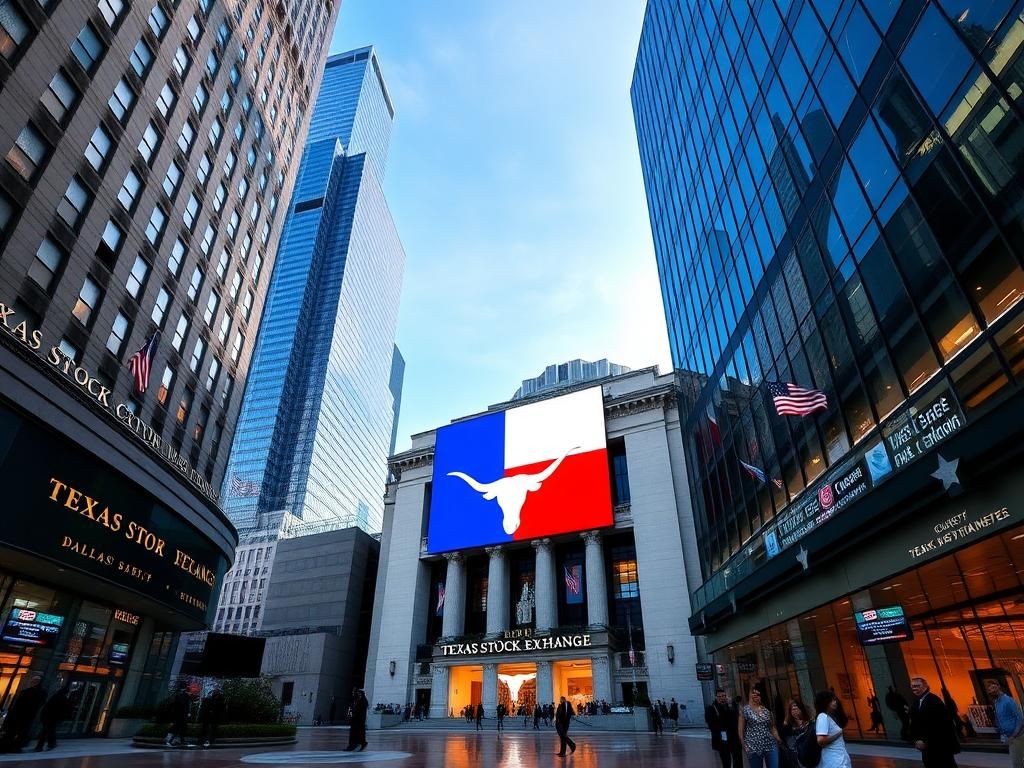
Texas Stock Exchange Approved, Poised to Challenge New York's Financial Giants
By PAUL COBLER/The Texas Tribune
DALLAS, Texas — The financial landscape of the United States is poised for a significant shift as the U.S. Securities and Exchange Commission (SEC) has officially approved the Texas Stock Exchange (TXSE) to operate as a national exchange. Announced on September 30, this milestone positions the Dallas-based startup as a formidable challenger to the longstanding dominance of New York's financial titans, the New York Stock Exchange (NYSE) and Nasdaq.
The TXSE, pronounced “Tex-ee,” is not just another regional player; it represents one of the most ambitious and well-funded attempts at a new national exchange in decades. Its launch, anticipated for Fall 2025, comes backed by a substantial $120 million in funding from leading investment firms, including global asset manager BlackRock and high-frequency trading giant Citadel Securities.
Texas lawmakers have enthusiastically embraced the news, with Governor Greg Abbott proclaiming, “Texas is swiftly becoming America’s financial hub.” This sentiment echoes a broader narrative of economic migration and growth that has seen numerous Fortune 500 companies relocate or expand within the state, drawn by its favorable regulatory environment and taxation policies. Currently, Texas boasts the second-highest number of Fortune 500 headquarters in the nation, surpassing New York and trailing only California. Globally, the Texas economy stands as the 7th largest, a compelling statistic cited by TXSE's Global Managing Director of Listings, Nicole Chambers, who noted that “45 countries smaller than Texas have their own stock exchanges.”
A New Home for Capital
The allure of Texas's robust economy is undeniable. “Texas has really become a leader in where you can do business,” Chambers remarked at a panel discussion at the University of Texas Austin, emphasizing the unique conditions that make such an exchange viable: “We couldn’t do this in Oregon or in Nebraska.”
Indeed, the burgeoning financial ecosystem in Dallas has earned it the moniker “Y'all Street.” Major players like JPMorgan Chase and Goldman Sachs have significantly expanded their presence. Goldman Sachs, for instance, is currently constructing a $500 million tower in downtown Dallas, slated to house over 5,000 employees, making it the bank's largest hub outside of New York. Charles Schwab also moved its headquarters from California to Dallas in 2020. This influx has fueled a staggering 111% growth in the investment and securities sector workforce in Texas over the last two decades, dramatically outpacing New York's 16% growth during the same period.
Even the established exchanges have taken note. Following TXSE's initial announcement in June 2024, the NYSE declared in February its intent to reincorporate its Chicago electronic exchange and move it to Dallas, rebranding it NYSE Texas. Nasdaq followed suit in March, announcing a new regional headquarters in the city. Bill Bailey, TXSE's Managing Director of Market Intelligence, views these moves as direct reactions to the emerging Texas competitor.
Challenging the Duopoly
For years, the U.S. stock market has been largely dominated by a duopoly formed by the NYSE and Nasdaq, particularly since the NYSE acquired the American Stock Exchange in 2008. Attempts to establish a significant third national exchange have historically struggled to gain traction, with many regional exchanges either being absorbed or shuttering.
TXSE leadership believes their approach will be different. While trading has become largely automated and electronic, the exchange will maintain a physical presence in Dallas, promising bell-ringing ceremonies imbued with a distinct “Texas flair.” Beyond the pomp and circumstance, TXSE aims to differentiate itself with a state-of-the-art digital platform and fewer stringent requirements for the composition of company boards of directors. Crucially, the exchange hopes to attract listings by appealing to companies reportedly discontented with rising fees, new regulatory rules, and share price benchmarks imposed by the incumbent exchanges.
According to Sriram Villupuram, an associate professor of finance at the University of Texas at Arlington, the success of TXSE will heavily depend on the patience of its investors and its ability to rapidly secure an initial cohort of 50 to 100 listings. “It gives those that are thinking about listing an idea about what it takes to get on the exchange, and it could snowball from there,” Villupuram explained.
TXSE officials also underscore the symbiotic relationship between the exchange's success and Texas's continued economic prosperity. A growing state economy will naturally attract more large corporations and financial firms, providing a fertile ground for recruitment to the new exchange.
Ray Perryman, president of The Perryman Group, an economic research company, encapsulates the shifting tides: “New York will likely remain the primary center of equity markets for the time being, but the landscape is changing.” The convergence of TXSE's innovative model, deep financial backing, and the dynamic growth of the Texas economy promises to reshape how capital is raised and traded in the United States, cementing Dallas's place as a pivotal financial hub.