


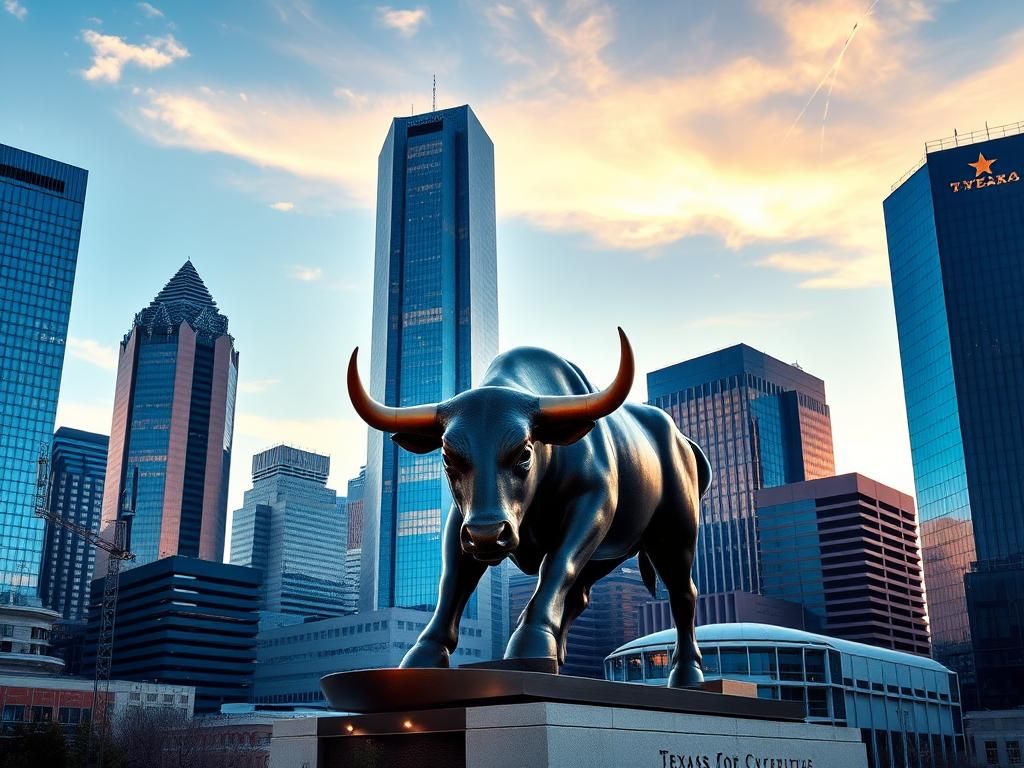
Texas Stock Exchange Approved, Challenging Wall Street’s Dominance
Dallas, Texas – The financial landscape of the United States is poised for a significant shift as the U.S. Securities and Exchange Commission (SEC) granted approval on September 30, 2025, for the Dallas-based Texas Stock Exchange (TXSE) to operate as a national exchange. This pivotal decision marks the latest, and perhaps most formidable, challenge to the long-standing dominance of the New York Stock Exchange (NYSE) and Nasdaq, igniting celebrations among Texas leaders and sparking a palpable buzz throughout the financial world.
Governor Greg Abbott heralded the news, declaring, “Texas is swiftly becoming America’s financial hub.” This sentiment underscores the ambitious vision behind TXSE, pronounced “Tex-ee,” which has been making headlines since June 2024 when it announced securing a staggering $120 million in backing from influential investment firms such as BlackRock and Citadel Securities. This substantial initial funding positions TXSE as one of the most well-capitalized new national exchange ventures in decades.
A New Contender Emerges from the Lone Star State
The impetus for TXSE’s creation is deeply rooted in Texas’s burgeoning economic prowess. State officials and TXSE leadership point to the state’s rapid growth and business-friendly environment, characterized by favorable regulatory and taxation policies. Texas currently boasts the headquarters of the second-highest number of Fortune 500 companies in the nation, closely trailing California and significantly surpassing New York. Globally, Texas stands as the 7th largest economy, a compelling statistic that Global Managing Director of Listings Nicole Chambers highlighted at a Dallas business gathering in September 2025. “Texas is a major player in the U.S. regardless of the exchange landscape, but it ultimately makes sense as the 7th largest economy in the world,” Chambers stated, noting that “45 countries smaller than Texas have their own stock exchanges.” She emphasized, “Texas has really become a leader in where you can do business… We couldn’t do this in Oregon or in Nebraska.”
Wall Street Takes Notice: The Rise of “Y’all Street”
The emergence of TXSE has not gone unnoticed by the established giants. In what many perceive as a direct response to TXSE’s plans, the NYSE announced in February 2025 its decision to reincorporate its Chicago electronic exchange and relocate it to Dallas, rebranding it as NYSE Texas. Not to be outdone, Nasdaq followed suit in March 2025 with plans to open a regional headquarters in Dallas.
Bill Bailey, Managing Director of Market Intelligence at TXSE, views these moves as affirmations of Texas’s growing financial gravity. These competitive shifts underscore Dallas’s transformation into a significant financial services hub, earning it the moniker: “Y’all Street.”
Breaking the Duopoly: TXSE’s Strategy for Disruption
Historically, the U.S. equities market has been dominated by a duopoly. Following the NYSE’s acquisition of the American Stock Exchange in 2008, it, alongside Nasdaq, has largely controlled the national exchange landscape. Regional exchanges like those in Boston, Philadelphia, and Chicago have either been absorbed or ceased operations, while previous attempts to launch a successful third national exchange have largely faltered, struggling to attract a critical mass of companies.
TXSE leadership believes this time will be different. While the exchange will operate as an entirely digital platform, it plans to maintain a physical presence in Dallas, complete with bell-ringing ceremonies and traditional fanfare, albeit with a distinct Texas flavor. With its robust $120 million backing, TXSE promises a state-of-the-art digital infrastructure. Crucially, the exchange intends to offer fewer stringent requirements for the composition of company boards of directors and aims to capitalize on what it perceives as growing discontent among companies regarding new rules, escalating fees, and rising share price benchmarks at NYSE and Nasdaq.
University of Texas at Arlington associate professor of finance Sriram Villupuram notes that TXSE’s success will heavily depend on the patience of its investors and its ability to build momentum. Attracting the first 50 to 100 companies will be vital, creating a snowball effect as more companies consider listing. The exchange is expected to launch in Fall 2026.
Dallas: A Burgeoning Financial Powerhouse
Dallas’s historical role as a trading hub in the Sun Belt, driven by its central location and robust transportation and communication infrastructure, has evolved significantly. Today, it’s a magnet for major financial institutions. Investment banking titans like JPMorgan Chase and Goldman Sachs have tens of thousands of employees in the region and are expanding further. Goldman Sachs is constructing a $500 million tower in downtown Dallas, slated to house over 5,000 employees, making it the bank’s largest operational hub outside of New York. In 2020, Charles Schwab notably relocated its headquarters from California to Dallas.
This migration isn’t just about corporate strategy; it’s also about talent. Ray Perryman, president of the Waco-based economic research company The Perryman Group, highlights a striking contrast: over the last 20 years, New York has seen only a 16% growth in investment and securities sector employment, while Texas has experienced a remarkable 111% expansion. Sasha Stratton, head of risk for Selby Jennings in Dallas, a recruitment firm for financial services, attributes this to the state’s lower cost of living, which attracts professionals seeking a higher quality of life. “Firms are prioritizing hiring in Dallas over hiring in New York in a lot of instances… it’s actually a smart, strategic decision to take advantage of how booming the economy is,” Stratton observed.
A Shifting Landscape for U.S. Equity Markets
The convergence of economic activity in the South and the substantial financial backing for TXSE positions the new exchange as a formidable competitor. Perryman suggests that while New York will likely retain its status as the primary center for equity markets for the foreseeable future, “the landscape is changing.”
The launch of TXSE, coupled with the expansion of NYSE and Nasdaq operations in Dallas, promises to create a more dynamic and accessible capital market for growing Texas companies. This increased access to capital is expected to fuel further expansion and job creation, creating a virtuous cycle that benefits both the burgeoning exchanges and the Texas economy as a whole. The “Y’all Street” phenomenon is not just a catchy nickname; it represents a tangible shift in power and influence within the fiercely competitive world of American finance.
This story was originally published by The Texas Tribune and distributed through a partnership with The Associated Press.