


The Battery Paradox: Crucial for Green Energy, Challenged by Local Safety Concerns
In a rapidly evolving energy landscape, large arrays of lithium-ion batteries are becoming an indispensable component of electrical grids across the United States. These Battery Energy Storage Systems (BESS), designed to store surplus power and dispatch it during peak demand, are critical for integrating intermittent renewable energy sources like wind and solar, promising greater grid reliability and fewer blackouts. However, their burgeoning deployment is increasingly encountering significant local resistance, fueled by profound safety concerns over the potential for catastrophic fires.
The Critical Role and Rapid Expansion of Battery Storage
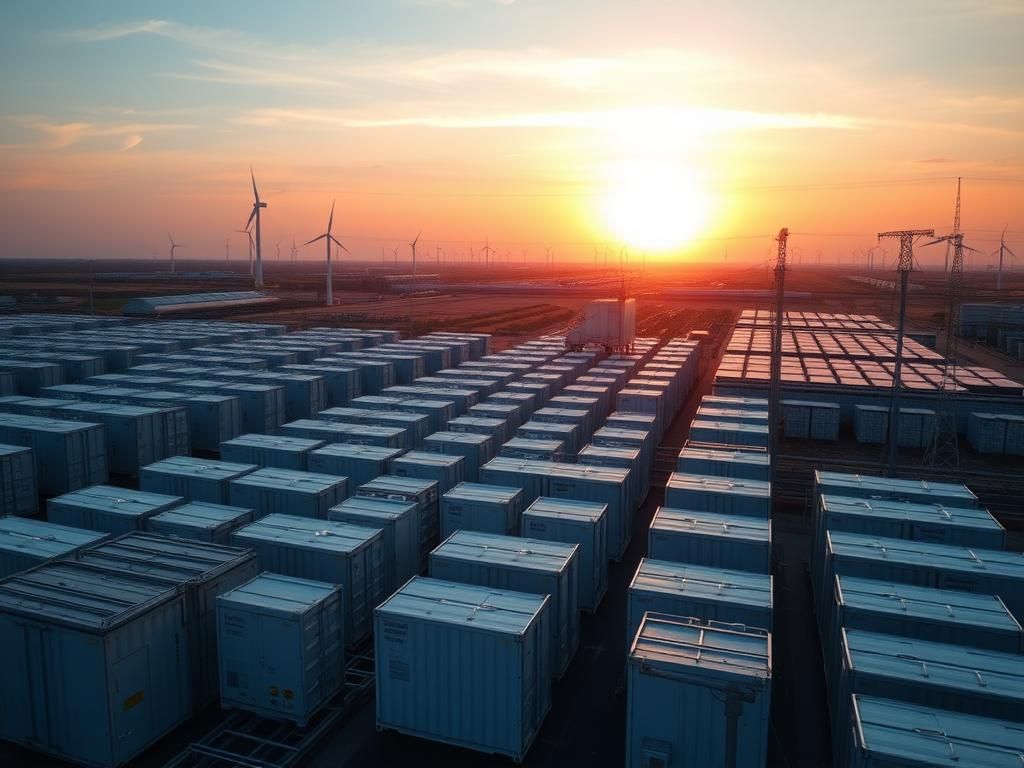
BESS units, often appearing as rows of shipping containers filled with hundreds of thousands of battery cells in fenced lots, are lauded for their ability to stabilize electrical grids and make them more resilient. They efficiently absorb cheaper power during low-demand periods and release it profitably when demand — and prices — are high.
Globally, China and the United States are leading the charge in rapidly expanding battery storage capacity. Since 2024, other nations including Saudi Arabia, South Africa, Australia, the Netherlands, Chile, Canada, and the U.K. have also commissioned or initiated construction on substantial projects, according to BloombergNEF research.
Within the U.S., California and Texas have historically led in battery storage adoption, but other states are quickly catching up with privately developed systems. Despite some historical federal skepticism towards renewable energy, crucial tax credits for energy storage projects were notably maintained in the recently approved federal budget, applicable to qualified projects commencing construction within the next eight years.
The sector is experiencing explosive growth. In the second quarter of 2025 alone, developers added an impressive 4,908 megawatts of battery storage capacity. A report from the American Clean Power Association, an industry group, indicates that Arizona, California, and Texas collectively accounted for approximately three-quarters of this new capacity, which is enough to power nearly 1.7 million households. New York State, for instance, has set an ambitious target to install 6,000 megawatts of energy storage by 2030, with half of that slated for large-scale systems.
Igniting Fears: The Specter of Thermal Runaway
Despite the undeniable benefits, opposition to these systems typically crystallizes around the risk of thermal runaway — an uncontrolled chain reaction of heating that can escalate into a fire or explosion. Local communities often pose a critical question: “What if that happens in my neighborhood?”
Such fears are not unfounded. A significant incident in January saw a massive battery storage facility in Moss Landing, California, ignite. The fire sent plumes of potentially toxic smoke into the atmosphere and necessitated the evacuation of approximately 1,500 people, underscoring the real-world hazards associated with these large-scale installations.
Ofodike Ezekoye, a combustion expert and professor of mechanical engineering at The University of Texas at Austin, acknowledges the inherent risks. While noting that failures are “relatively infrequent,” he cautions that “no engineered system is 100% foolproof.” Ezekoye characterizes BESS as a “relatively immature technology that is maturing quickly,” highlighting ongoing efforts by “thoughtful researchers and other stakeholders who are trying to improve the overall safety of these systems.”
Proponents counter that battery system safety has advanced significantly. For example, New York has adopted stringent fire codes requiring a “modular enclosure design with required minimum spacing to keep fires from spreading,” a measure intended to prevent the kind of indoor fire seen at Moss Landing.
Local Communities Push Back with Moratoriums
Despite reassurances, residents living near proposed BESS sites are often far from convinced, leading to a surge in local moratoriums. According to a presentation by the Pacific Northwest National Laboratory, the number of localities imposing temporary bans began rising notably in 2023 and 2024, mirroring the increased pace of battery storage deployment, with a significant cluster emerging in New York.
In Island Park, New York, Mayor Michael McGinty articulated the strong sentiment behind a moratorium passed in July after a storage system was proposed near the village line: “We’re not guinea pigs for anybody… we are not going to experiment, we’re not going to take risk.”
Long Island has become a particular hotbed of activism, attracting national attention. Former Environmental Protection Agency Administrator Lee Zeldin visited New York in August to voice criticisms, alleging the state was hastily approving sites to meet “delusional” green power objectives – a claim state officials firmly deny. This region is especially pertinent as its power grid is set to receive a boost from incoming offshore wind farms in the coming years.
Further afield, the city of Maple Valley, Washington, approved a six-month moratorium in July. City Manager Laura Philpot explained the decision as a means “to protect us until we know more.” In Halstead, Kansas, Mayor Dennis Travis reports that voters will decide on Election Day whether to prohibit larger battery storage systems within city limits. While Travis hopes the city might eventually host a safely designed system, he notes local opponents tend to “wrongly fixate on the California fire.”
Meanwhile, in the Town of Ulster, New York, Winnie Sokolowski is among residents actively opposing a proposed 250-megawatt lithium-ion storage system, arguing its proximity to schools and homes is unacceptable. “They’re banking on nothing happening, but I don’t think you can place it where they’re proposing and assume nothing’s going to happen,” Sokolowski stated. “It’s just too risky if it does.” The developer, Terra-Gen, maintains that its design will prevent fire spread and poses “no credible, scientific-based threat to neighbors, the public or the environment.”
State Officials Champion Safety and Progress
Doreen Harris, President of the New York State Energy Research and Development Authority, expresses confidence in the state’s robust safety regulations. She affirms that scaling up battery storage systems is essential to “strengthen and modernize our grid,” drawing a parallel to initial local concerns over solar farms that have since demonstrated their benefits. The ongoing challenge for policymakers and developers alike is to balance the urgent need for a modernized, green energy infrastructure with the imperative of ensuring public trust and safety in an era of rapid technological change.