

Dr. Jane Goodall, Revolutionary Primatologist and Conservation Icon, Dies at 90
By HALLIE GOLDEN and TAMMY WEBBER
London, England – Dr. Jane Goodall, the iconic primatologist whose groundbreaking work with chimpanzees revolutionized our understanding of animal behavior and whose relentless advocacy inspired a global conservation movement, has died at the age of 90. Goodall passed away peacefully this week in California while on an extensive U.S. speaking tour, according to the Jane Goodall Institute. Her death marks the end of a remarkable life dedicated to protecting wild animals and fostering hope for the natural world.
Goodall’s passing elicited heartfelt tributes from around the globe. Former President Joe Biden, who honored her with the Presidential Medal of Freedom shortly before leaving office, remarked that her messages of hope “mobilized a global movement to protect the planet.”
A Childhood Dream Ignites a Scientific Revolution
Born Valerie Jane Morris-Goodall in London, England, in 1934, her fascination with animals began in early childhood, famously sparked by a toy chimpanzee named Jubilee. At the age of 10, after reading Edgar Rice Burroughs’ “Tarzan of the Apes,” Goodall’s path was set: she dreamed of traveling to Africa and living among its wild creatures. This childhood fantasy, once considered improbable for a young woman in the mid-20th century, became her life’s calling, though initially without aspirations of becoming a scientist. She envisioned herself as a naturalist, documenting the animal kingdom through her writing.
In 1957, at 23 years old, Goodall arrived in Africa, securing an entry-level position as an assistant secretary at a natural history museum in Nairobi. It was there that she met the renowned anthropologist and paleontologist Louis Leakey, who, impressed by her tenacity, invited her to join him and his wife on a fossil expedition at the Olduvai Gorge. Recognizing her unique observational skills and “open mind,” Leakey ultimately offered her the opportunity that would define her life: to study chimpanzees in the Gombe Stream Game Reserve (now Gombe Stream National Park) in what is now Tanzania.
The Groundbreaking Gombe Discoveries
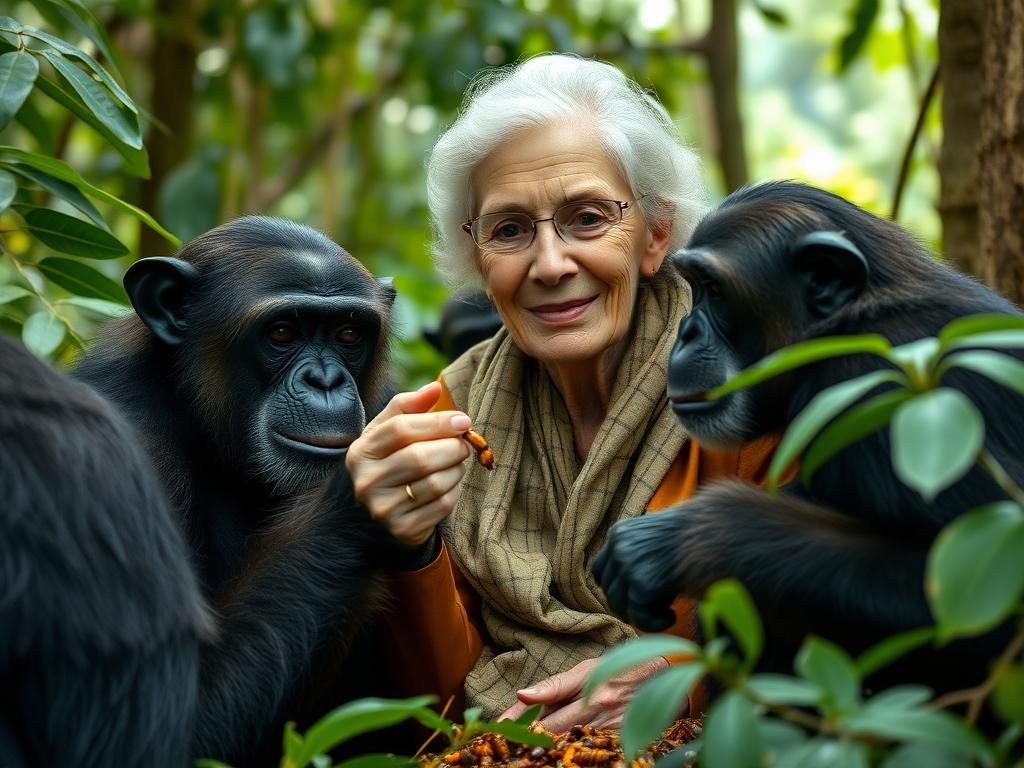
Goodall began her pioneering research in 1960, initially without a college degree. Her unconventional approach quickly set her apart from traditional scientific methods. Rather than maintaining detached observation and assigning numbers to her subjects, Goodall immersed herself in the chimpanzees’ lives. She spent countless hours observing them, patiently earning their trust, giving them names like David Greybeard and Fifi, and even feeding them. This deeply personal engagement, while initially criticized by some in the scientific community for a perceived lack of objectivity, yielded unprecedented insights.
Within months, Goodall made a discovery that would rewrite textbooks and challenge the very definition of humanity: she observed David Greybeard using a stripped blade of grass to extract termites from a mound, demonstrating tool-making and tool-use in non-human primates. This revelation, along with subsequent observations of chimps eating meat and exhibiting complex social behaviors, shattered the long-held belief that humans were the sole users and makers of tools, prompting Leakey to famously quip, “Now we must redefine ‘man,’ redefine ‘tool,’ or accept chimpanzees as humans.” Goodall eventually earned her Ph.D. in ethology from the University of Cambridge in 1966, one of only a handful of individuals admitted without an undergraduate degree.
Her research at Gombe also unveiled the darker aspects of chimpanzee behavior. Goodall documented instances of extreme aggression and even a four-year conflict, later dubbed the “Gombe Chimpanzee War” (1974-1978), where a larger group systematically hunted and killed all members of a smaller community. “It was a shock to find that they could show such brutal behavior,” she recalled in 2003, acknowledging, “That made them seem even more like us than I thought before.”
From Observer to Global Advocate
A pivotal moment in Goodall’s journey from researcher to impassioned advocate came in 1986 during a conference in Chicago. Watching a disturbing film about experiments on laboratory animals, she realized her mission had to expand beyond Gombe. “I knew I had to do something,” she later stated. “It was payback time.”
From that point, Goodall dedicated her life to global conservation and humanitarian efforts. She founded the Jane Goodall Institute (JGI) in 1977 to support her research at Gombe and expand conservation programs worldwide. In 1991, she launched Roots & Shoots, a global environmental and humanitarian youth program that now operates in over 60 countries, empowering millions of young people to become changemakers in their communities.
Until her death, Goodall maintained an incredibly active schedule, traveling almost 300 days a year to lecture, raise awareness, and inspire action. When the COVID-19 pandemic curtailed her travels, she quickly adapted, launching the “Jane Goodall Hopecast” podcast from her childhood home in England, engaging with influential guests like U.S. Senator Cory Booker and author Margaret Atwood. Her final public appearance was scheduled to be with students and teachers in Los Angeles for a tree-planting initiative in wildfire burn zones.
A Lasting Legacy of Hope and Inspiration
Goodall’s impact extends far beyond scientific discovery. She became a beacon of hope, particularly for women and girls aspiring to careers in science and conservation. Jeffrey Flocken, Chief International Officer of Humane World for Animals, recounted how Goodall once spent two hours captivating his young daughter with stories of her “adventures with animals and the challenges of being a young woman pioneering biological research in the field when conservation was still an emerging profession.” He emphasized, “Jane cared about all animals passionately. And she was able to use that passion to inspire others — children in particular.”
Primatologist Catherine Hobaiter of the University of St. Andrews, who studies chimpanzee communication, shared that Goodall transformed her view of science. “It was the first time… that I got to hear that it was okay to feel something,” Hobaiter remarked, highlighting Goodall’s profound influence on fostering empathy within scientific pursuits.
Jane Goodall’s legacy is etched not only in the annals of primatology but also in the hearts of countless individuals she inspired to protect the delicate balance of our planet. Her life stands as a testament to the power of observation, perseverance, and unwavering hope in the face of daunting environmental challenges.