


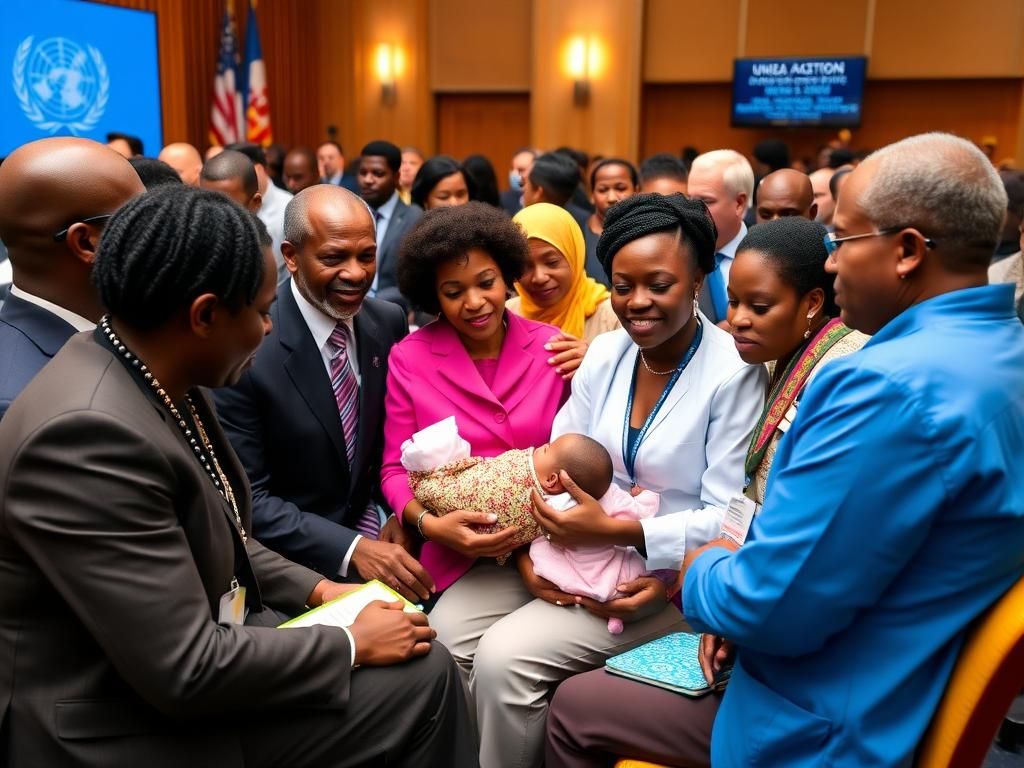
UNGA Sidelines: A New Era of Global Humanitarian Action Driven by Non-State Actors
A Moment of Urgency Ignites Action
NEW YORK — Amidst the flurry of conferences held alongside the United Nations General Assembly’s annual high-level meetings this past week, a brief but profound hallway conversation illuminated an immediate path toward urgent humanitarian relief. An executive from a global antipoverty nonprofit, fresh from Zambia, recounted a stark reality: a hospital struggling to care for approximately fifty newborns daily possessed only a single incubator, one warmer, and one resuscitator.
What could have merely drawn sympathy quickly spurred action. Leaders of a corporate-nonprofit alliance, dedicated to providing medical equipment to underserved communities, overheard the plea. Susana Eshleman, President of Children International, confirmed that assistance for the Zambian hospital could materialize before the year’s end. “It’s very encouraging and inspiring to be here,” Eshleman remarked, highlighting a renewed sense of purpose. “It feels like a shot in the arm sometimes when the work that we’re doing is hard and the global situation, given all the recent developments, is particularly hard.”
The New Reality: Facing Foreign Aid Pullbacks
This pivotal exchange vividly illustrates the increasingly vital role played by foundations, nonprofits, corporations, and international actors converging during what attendees refer to as “UNGA week.” Their gatherings in Manhattan’s ballrooms and intimate townhouse dinners are solidifying crucial relationships and accelerating coordination, especially in a year marked by significant foreign aid pullbacks from the U.S. and other wealthy nations. These cuts have left organizations like the International Rescue Committee (IRC) facing substantial deficits, with CEO David Miliband reporting a loss of $600 million in U.S. grants. Similarly, the United Nations Children’s Fund (UNICEF) anticipates at least a 20% cut in revenue next year, necessitating staff reductions and aggressive cost-saving measures.
A Pragmatic and Galvanizing Tone
In this challenging environment, discussions during UNGA week have adopted a more pragmatic, focused, and galvanizing tone. Former President Bill Clinton, opening the Clinton Global Initiative (CGI) annual meeting, acknowledged a list of pressing global issues but concluded with a powerful call to action: “Be caught trying.” This sentiment resonated throughout the various forums, where a greater emphasis was placed on the indispensable roles companies and philanthropies must assume in shaping an uncertain future.
The Rise of Non-Governmental Partnerships
The shift towards non-governmental partnerships was underscored by major announcements from prominent philanthropists. At his global forum, billionaire businessman Michael Bloomberg unveiled a groundbreaking partnership with the African Development Bank Group, designed to channel more investment into the continent. “There’s certainly no shortage of challenges to discuss over there,” Bloomberg stated, referring to the U.N. headquarters. “But the truth is, in a world that’s more interconnected and fast-moving than ever, the biggest problems can’t be solved by national governments alone.”
The Clinton Global Initiative, which reimagined its meeting this year to focus on interactive working groups, saw hundreds of frontline workers, policy experts, foundation donors, and NGO representatives engage in collaborative problem-solving across the New York Hilton Midtown ballrooms. These groups, typically divided into ten-person discussions, led to numerous new initiatives. Among them were a social enterprise fund launched by Kiva Microfunds in collaboration with corporate foundations, and the establishment of a new Global Network for National Service.
Significant Philanthropic Pledges and Global Health Advancements
Further cementing the philanthropic sector’s heightened commitment, the Rockefeller Foundation pledged $50 million to strengthen international development systems. President Rajiv Shah highlighted that this significant investment includes upgrading a critical famine early warning system, originally developed by the U.S. Agency for International Development (USAID). Crucially, the initiative aims to diversify the system’s financing, insulating it from the whims of any single political party.
In global health, significant advancements were also announced. The Clinton Health Access Initiative (CHAI) forged a partnership with Dr. Reddy’s Laboratories, Unitaid, and Wits RHI to distribute Gilead Sciences’ HIV prevention drug, lenacapavir, across 120 low- and middle-income countries. The Gates Foundation followed suit with a similar agreement with Indian pharmaceutical giant Hetero Labs. Bill Gates himself further committed a substantial $912 million pledge to the Global Fund’s replenishment campaign, dedicated to combating AIDS, malaria, and tuberculosis.
Acknowledging Limitations, Urging Innovation
Despite these considerable philanthropic contributions, leaders acknowledged their limitations. Mark Suzman, CEO of the Gates Foundation, emphasized that no combination of private philanthropies could fully compensate for government aid cuts. “There is no possible way any philanthropy, any combination of philanthropies, can fill the gap,” Suzman asserted. David Miliband of the International Rescue Committee echoed this, urging the sector to embrace innovation, enhance the efficiency of assistance delivery through new technologies, and actively seek alternative financing streams. He specifically called upon “newly wealthy countries — like those in the Gulf” and local philanthropies in aid-recipient nations to step up.
A Collective Spirit in Challenging Times
Nonprofit leaders arriving in Manhattan reported a palpable shift in the atmosphere compared to previous years. The customary scramble for attention at concurrent events was replaced by a stronger spirit of collective action, as organizations facing funding setbacks in health, climate, and migration realized the necessity of coordinated goals. Concerns about obtaining visas had led some groups to travel with fewer staff, and there was “real worry that ‘we wouldn’t have UNGA'” at all, according to Suzanne Ehlers, Executive Director of USA for UNHCR, who nonetheless announced a $15 million campaign for refugee women’s scholarships. Charity Wallace, whose consulting firm Wallace Global Impact focuses on cross-sector solutions, noted that many now recognize “they have to step up in a different way” in this new reality. Matt Freeman, Executive Director of Stronger Foundations for Nutrition, found the increased spirit of collaboration “heartwarming,” a contrast to the “sharper elbows” one might expect in times of scarcity. Kitty van der Heijden, Deputy Executive Director of Partnerships at UNICEF, despite facing significant revenue cuts, expressed a defiant optimism: “I have no time for depression. I only have time to build more partnerships, to be out there, to deliver, because I know that we can. And we cannot do it alone.”
Conclusion: Reshaping International Development
The annual UNGA sidelines, traditionally a forum for global dialogue, have evolved into a critical nexus where non-governmental forces are actively reshaping the landscape of international development. In the face of shrinking state-sponsored aid, the urgency of collective action and innovative partnerships has never been more apparent, transforming challenges into a renewed impetus for global engagement.