


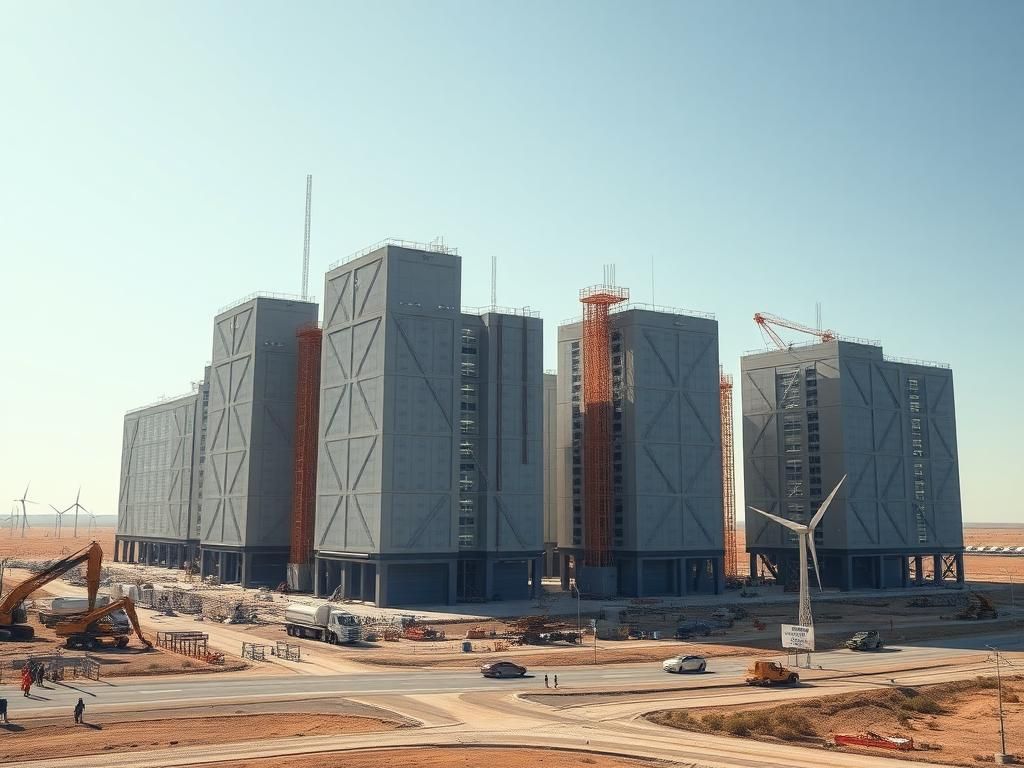
OpenAI’s ‘Stargate’ Initiative Expands: A $500 Billion Bet on AI Infrastructure
Abilene, Texas — In a bold move signaling an unprecedented scale-up in artificial intelligence infrastructure, OpenAI, the creator of the popular ChatGPT, has announced plans to expand its “Stargate” AI data center initiative beyond its flagship complex in Abilene, Texas. The company, in partnership with Oracle and Softbank, will establish five additional massive data centers across the U.S., driving towards an ambitious $500 billion infrastructure investment championed earlier this year by President Donald Trump.
The announcement was made during a visit by OpenAI CEO Sam Altman and Oracle co-CEO Clay Magouyrk to the sprawling Stargate complex in Abilene, where the Texas sun prompted Altman to shed his signature crewneck for a T-shirt. This visit underscored the monumental scale of the project, which aims to transform how AI models like ChatGPT are built and operated.
A Nationwide Network for AI Dominance
While Abilene serves as the proving ground, the Stargate joint venture is rapidly spreading its footprint. Two more data center complexes are slated for Texas – one northeast of Abilene in Shackelford County and another in Milam County. Further expansion includes a facility in Doña Ana County, New Mexico, another in Lordstown, Ohio, and a fifth location yet to be disclosed in the Midwest. This strategic dispersal aims to solidify OpenAI’s computational backbone, crucial for the ever-increasing demands of advanced AI development.
For OpenAI, this expansion signifies a strategic pivot from its previous reliance on Microsoft as an exclusive computing partner. Altman candidly stated that the company has been “severely limited for the value we can offer to people,” acknowledging current shortcomings like ChatGPT’s speed and intelligence. “We have many other ideas and products we want to build,” he added, indicating a future of heightened innovation enabled by this infrastructure boom. The partnership also includes a significant $300 billion deal for OpenAI to purchase computing capacity from Oracle, marking a colossal bet for the San Francisco-based AI pioneer.
Abilene: The Heart of the AI Supercluster
The Abilene complex, which local Mayor Weldon Hurt described as revitalizing an “old railroad town,” is on track to become the world’s largest AI supercluster. This eight-building campus, characterized by its distinctive H-shaped structures, is designed to house hundreds of thousands of cutting-edge AI computer chips. One building is already operational, with a second nearing completion. Each server rack within these facilities will be packed with 72 of Nvidia’s powerful GB200 chips, specifically engineered for the most intensive AI workloads, with each building ultimately expected to deploy approximately 60,000 such units.
The economic ripple effect in Abilene is substantial, with over 6,000 workers commuting daily for the massive construction effort. Once fully operational, Oracle anticipates nearly 1,700 direct onsite jobs and thousands more indirect employment opportunities, a significant boon for the regional economy. Hand-painted signs promising “huge discounts” on “move-in-ready homes” for “AI workers” are now a common sight along roads leading to the facility, illustrating the local impact.
Balancing Innovation with Environmental Responsibility
However, the rapid development of such energy-intensive infrastructure in a drought-prone region like West Texas has not been without its challenges and concerns. Abilene, currently under a two-day-a-week outdoor watering schedule due to chronically stressed reservoirs at roughly half-capacity, faces delicate trade-offs.
Oracle executives have emphasized their commitment to minimizing the environmental footprint, particularly concerning water usage. The data center’s closed-loop cooling system requires an initial fill of one million gallons from the municipal water system, but subsequent needs are projected at a remarkably low 12,000 gallons per building annually, preventing evaporation. “These data centers are designed to not use water,” Magouyrk asserted, calling it “a better solution” for the environment.
Despite these measures, experts like Shaolei Ren, a professor at the University of California, Riverside, who studies AI’s environmental toll, note the nuanced reality. While a closed-loop system is commendable for local water conservation, it often demands more electricity, leading to higher indirect water usage through power generation. Indeed, the Abilene complex requires a substantial 900 megawatts of electricity and includes a new gas-fired power plant, utilizing natural gas turbines for backup power – a system Oracle claims is superior to traditional diesel generators. Most of the power originates from the local grid, drawing from a mix of natural gas, wind, and solar farms prevalent in the region.
Ren also raised concerns about the “health impacts of essentially turning the data center site into a power plant” for nearby communities, urging further study. Local residents like Arlene and Fred Mendler, whose 33-year peaceful existence near the site has been shattered, echo these sentiments. They lament the loss of 1,200 acres of mesquite shrubland, once home to wildlife, now scraped to bare dirt, replaced by constant construction noise and bright lights.
A Ground Zero for AI
U.S. Senator Ted Cruz, a Texas Republican, toured the site, proclaiming Texas “ground zero for AI” due to its “abundant, low-cost energy.” This sentiment highlights the significant role that states with robust energy resources are playing in the ongoing AI revolution.
As OpenAI pushes the boundaries of artificial intelligence, the Stargate initiative represents a monumental investment not just in technology, but in the physical infrastructure necessary to power the next generation of AI capabilities. The project navigates a complex landscape of economic opportunity, technological advancement, and environmental stewardship, setting a precedent for the future of AI development worldwide.