


Trump Administration Intervenes in Enbridge Line 5 Dispute, Citing Federal Authority
WASHINGTON D.C. / LANSING, MICHIGAN — The ongoing legal saga surrounding Enbridge’s Line 5 pipeline beneath Michigan’s Straits of Mackinac has escalated with the intervention of the Trump administration. The U.S. Justice Department has filed a brief arguing that Michigan Governor Gretchen Whitmer’s 2020 order to shut down the aging pipeline interferes with federal foreign policy and national security interests, pitting state environmental protection against international energy concerns.
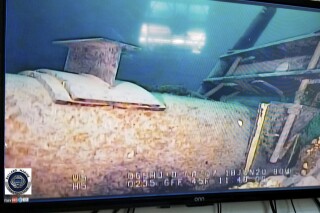
Line 5, a crucial piece of energy infrastructure, has transported crude oil between Superior, Wisconsin, and Sarnia, Ontario, since its construction in 1953. A particularly vulnerable 4.5-mile (6.4-kilometer) segment traverses the environmentally sensitive Straits of Mackinac, connecting Lake Michigan and Lake Huron. This segment has been a flashpoint for environmental advocates and state officials who fear a catastrophic rupture could devastate the Great Lakes ecosystem.
Concerns about the pipeline’s integrity mounted significantly after Enbridge revealed in 2017 that its engineers had been aware of gaps in the pipeline’s protective coating since as early as 2014. These fears were further amplified in 2018 when a boat anchor damaged the underwater segment, highlighting the tangible risks associated with its continued operation.
In November 2020, Governor Whitmer, a Democrat, took decisive action, ordering her state regulators to revoke the easement that permitted the pipeline to operate beneath the Straits. Enbridge swiftly responded by filing a federal lawsuit to invalidate her order. The pipeline has continued to operate throughout the ensuing litigation.
Federal Government Asserts Foreign Policy and Treaty Authority
Although not an original party to the lawsuit, the Trump administration’s Justice Department filed a brief on September 12, forcefully asserting that Whitmer’s order represents an overreach of state authority. Attorneys argued that Michigan’s action amounted to an attempt to “globalize” its regulatory power, directly clashing with the federal government’s objective of ensuring a stable flow of energy between the U.S. and Canada.
The brief emphasized that shutting down Line 5 could disrupt the North American energy supply chain, potentially leading to increased domestic prices and bolstering the economic and political leverage of “malign foreign actors worldwide.” These outcomes, the administration contended, directly conflict with U.S. foreign policy goals, echoing executive orders issued by President Donald Trump declaring that a reliable energy supply is paramount to national security.
Furthermore, the federal attorneys cited a 1977 treaty between the U.S. and Canada, which they argue prohibits either nation’s authorities from impeding the flow of energy through cross-border pipelines. They also asserted that pipeline safety regulation falls exclusively under federal purview, warning that allowing states to impose their own standards would create an “untenable patchwork of regulations.”
Michigan Defends State Sovereignty
Michigan Attorney General Dana Nessel, whose office is defending the governor’s revocation order, plans to file a formal response in October. A spokesperson for Nessel, Danny Wimmer, reiterated the state’s position, stating that the revocation is a legitimate pipeline routing decision, not an attempt to impose new safety regulations, and thus falls within state authority under the public trust doctrine. This legal principle posits that natural resources belong to the public, and the state has a duty to protect them. Michigan also argues that private entities like Enbridge cannot leverage an international treaty to initiate a federal lawsuit.
Enbridge, for its part, has consistently aligned with the federal government’s stance, with company spokesperson Michael Barnes pointing to the 1977 treaty provisions as precluding states and judges from unilaterally halting the pipeline’s operations.
U.S. District Judge Robert Jonker is scheduled to hear Enbridge’s motion for summary judgment on November 12, a pivotal moment that could significantly influence the pipeline’s future.
Enbridge’s Proposed Tunnel and Other Legal Battles
As the legal battles unfold, Enbridge has put forth a proposal to encase the Straits segment of Line 5 in a protective concrete tunnel, an undertaking estimated to cost at least $500 million. While the U.S. Army Corps of Engineers acknowledges that this project would destroy wetlands and bat habitats, it also states that the tunnel would effectively eliminate the risk of another anchor strike damaging the pipeline.
Michigan regulators granted permits for the tunnel in December 2023. Enbridge now awaits final approval from the Army Corps of Engineers, which fast-tracked the permit review in April following the Trump administration’s identification of the tunnel for expedited emergency permitting. However, environmental groups and Native American tribes have challenged these state permits, arguing that the Michigan Public Service Commission failed to adequately consider the overall necessity of the pipeline when granting approval. The Michigan Supreme Court recently announced it would hear this case.
Adding to the complex legal landscape, Attorney General Nessel filed a separate lawsuit in 2019 seeking to nullify the Straits easement altogether. The U.S. Supreme Court is currently deliberating whether this case should be heard in federal or state court.
Line 5 also faces challenges in Wisconsin, where a federal judge in Madison last summer ordered Enbridge to shut down a segment of the pipeline crossing the Bad River Band of Lake Superior Chippewa’s reservation within three years. Enbridge has proposed rerouting this section around the reservation and has appealed the shutdown order to the 7th U.S. Circuit Court of Appeals. Environmental groups and the Bad River Band have also separately challenged the state permits for the reroute, with hearings scheduled to continue through October.
The multi-faceted legal and political struggle over Line 5 underscores the deep divisions between economic interests, energy security, and environmental stewardship, with the fate of a critical piece of infrastructure and a pristine natural resource hanging in the balance.