

“Our Brand Is Crisis”: Trump Administration’s Media Confrontations Escalate Amid UK Visit
London, UK — Amidst President Donald Trump’s diplomatic visit to the United Kingdom, which included meetings with U.K. Prime Minister Keir Starmer and King Charles, a candid remark by White House Staff Secretary Will Scharf has inadvertently highlighted the escalating tensions between the Trump administration and major American media outlets. Scharf’s comparison of real-world events to the 2015 political drama “Our Brand Is Crisis” emerged as a microcosm of a broader narrative unfolding across the Atlantic, where prominent late-night shows have faced abrupt cancellations and the President has intensified his critique of news organizations.

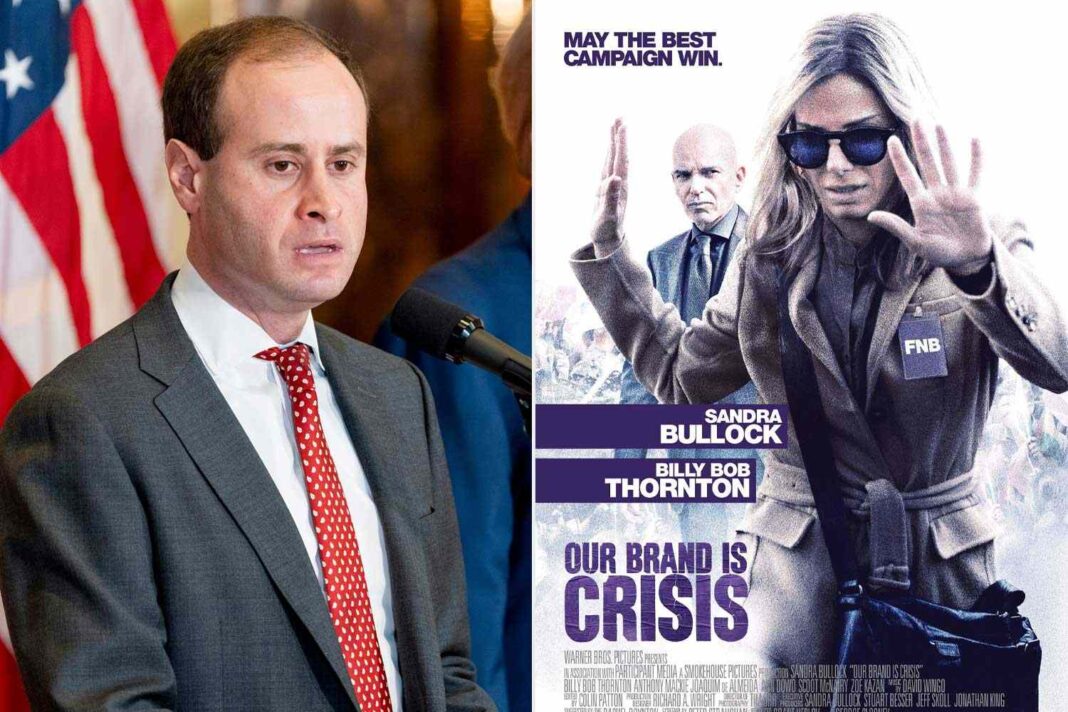
On Thursday, September 18, 39-year-old Will Scharf was present at a business reception between President Trump and Prime Minister Starmer at the historic Chequers Court, the Prime Minister’s country residence in England. Caught on a hot mic, Scharf offered a seemingly innocuous pleasantry, stating, “Wonderful.” However, he quickly added an unexpected, poignant observation, as reported by SkyNews: “Our Brand Is Crisis. That was a Sandra Bullock movie that’s a bit too true to life sometimes.” The film, released in 2015, stars Sandra Bullock as a seasoned American political consultant tasked with re-electing a controversial president in Bolivia, a narrative loosely inspired by the 2005 documentary detailing how American political campaign tactics helped elect Gonzalo Sánchez de Lozada as Bolivia’s president in 2002. Scharf’s comment, delivered during a high-stakes international visit, has since resonated with observers noting the administration’s ongoing confrontations with the media.

Late-Night TV Under Fire: Cancellations and FCC Warnings
Domestically, the past week has been marked by significant upheaval in the television landscape. On Wednesday, September 17, ABC announced the “indefinite” pulling of “Jimmy Kimmel Live!” from its network. This drastic decision came just two days after the show’s host, 57-year-old Jimmy Kimmel, referenced the late right-wing activist Charlie Kirk in his monologue. Kirk, 31, had been tragically shot and killed during a speaking event at Utah Valley University on September 10. The network’s move was made mere hours after Brendan Carr, Chairman of the Federal Communications Commission (FCC) and a Trump appointee, publicly condemned Kimmel’s statements as “some of the sickest conduct possible” and urged Disney, ABC’s parent company, to take action, according to Deadline. The following day, Carr further defended his stance in an X post, warning that his agency was “not done yet” with implementing changes to the “media ecosystem.”
Adding to the controversy, President Trump himself made remarks aboard Air Force One on Thursday, September 18, asserting that many networks are “97% against” him and consistently provide “wholly bad publicity.” He provocatively suggested, “I mean they’re getting a license. I would think maybe their license should be taken away.” The President continued, expressing his frustration with evening shows that “all they do is hit Trump,” implying a lack of conservative representation for years. This recent escalation of his long-standing feud with Kimmel had been foreshadowed by Trump, who previously suggested “Jimmy Kimmel Live!” would be the next late-night casualty following another high-profile cancellation.
Colbert’s Cancellation and Corporate Mergers
Indeed, Kimmel’s show was not the first to be impacted. In mid-July, CBS announced the cancellation of “The Late Show with Stephen Colbert.” The decision regarding 61-year-old Colbert’s program followed his on-air criticism of CBS’s parent company, Paramount, during his July 14 episode. Colbert had taken issue with Paramount’s $16 million settlement with President Trump on July 3, which stemmed from the President’s allegations that CBS News’ “60 Minutes” deceptively edited an interview with former Vice President Kamala Harris. Significantly, Paramount was then in the process of finalizing a merger with entertainment company Skydance, a deal that required approval from the Trump administration and was ultimately granted on July 24.
Direct Threats and a Polarized Media Landscape
The underlying tension was palpable even before Kimmel’s show was pulled. Just a day prior, ABC News’ Jonathan Karl questioned President Trump, 79, about Attorney General Pam Bondi’s stated intentions to “go after hate speech.” Trump’s response was direct and pointed: “I’d probably go after people like you, because you treat me so unfairly. It’s hate. You have a lot of hate in your heart. Maybe I’ll come after ABC.”
As President Trump concludes his UK visit, which was also marked by protests from British activists over his controversial friendship with Jeffrey Epstein, the confluence of his White House staff’s offhand remarks, the abrupt cancellation of prominent late-night television programs, and the President’s direct threats to media organizations paint a vivid picture of a deeply polarized and increasingly confrontational media landscape. The “crisis” Scharf alluded to appears to be unfolding in real-time, with profound implications for freedom of the press and political discourse in the United States.