


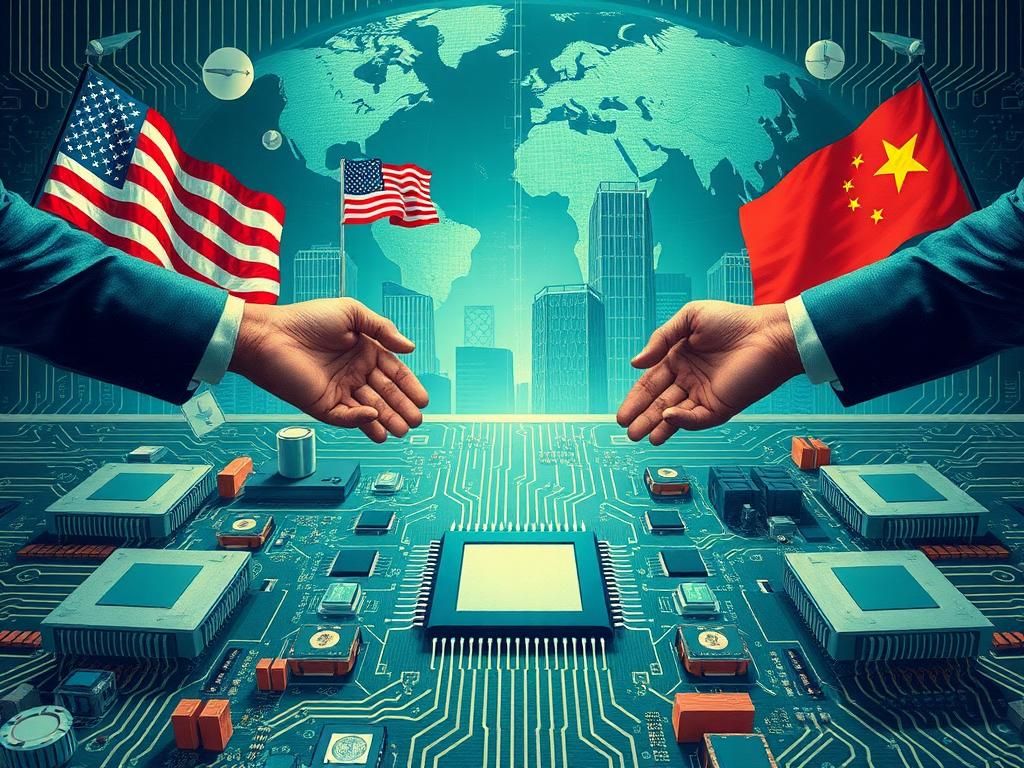
China Escalates Tech War with Dual Semiconductor Probes Ahead of Crucial U.S. Trade Talks
TAIPEI, Taiwan – In a significant escalation of the ongoing technological and trade dispute, China’s Ministry of Commerce announced two investigations targeting the U.S. semiconductor sector on Saturday. This assertive move comes just days before high-stakes trade talks are set to commence in Madrid, Spain, between top U.S. and Chinese economic officials.
Anti-Dumping Probe Targets U.S. Analog IC Chips
The first probe is an anti-dumping investigation into specific analog integrated circuit (IC) chips imported from the United States. These chips include crucial commodity interface IC chips and gate driver IC chips, components vital to a wide array of electronic devices. The investigation specifically mentions U.S. industry giants such as Texas Instruments and ON Semiconductor, indicating a direct challenge to prominent American manufacturers.
Anti-Discrimination Probe Scrutinizes U.S. Restrictions
Simultaneously, Beijing launched an anti-discrimination probe, directly scrutinizing U.S. measures that have been implemented against China’s burgeoning chip industry. A spokesperson for China’s commerce ministry articulated Beijing’s view, stating that U.S. actions – including various export curbs and tariffs – “constitute the containment and suppression of China’s development of high-tech industries” such as advanced computer chips and artificial intelligence.
Heightened Tensions Ahead of Madrid Discussions
These new investigations dramatically heighten tensions as U.S. Treasury Secretary Scott Bessent prepares to meet with Chinese Vice Premier He Lifeng in Madrid. The highly anticipated talks, scheduled to take place between Sunday and Wednesday, are expected to cover a broad agenda, encompassing trade, national security, and even the contentious ownership of the social media platform TikTok.
Context: U.S. Expands “Entity List”
The timing of China’s announcement is particularly noteworthy, following the U.S. Commerce Department’s decision on Friday to add 23 more Chinese companies to its “entity list.” This list imposes severe restrictions on businesses deemed to be acting against U.S. national security and foreign policy interests. Among these newly listed entities are two Chinese firms specifically accused of procuring chipmaking equipment for SMIC, China’s largest semiconductor foundry, further fueling Beijing’s accusations of U.S. attempts to stifle its technological advancement.
A History of Diplomatic Efforts and “Pauses”
The upcoming Madrid discussions represent the latest in a series of critical negotiations aimed at de-escalating the simmering trade conflict and preventing the imposition of even higher reciprocal tariffs. Diplomatic efforts have seen U.S. and Chinese counterparts convene in Geneva in May, London in June, and Stockholm in July. These previous rounds of talks have notably resulted in several “90-day pauses” on increasing tariffs, mechanisms put in place to avert an all-out trade war that could have devastating global economic consequences.
U.S. “De-Risking” Strategy vs. China’s Accusations
During the last round of talks in Stockholm, Treasury Secretary Bessent described the discussions as “very fulsome.” He emphasized the U.S. objective to “de-risk with certain, strategic industries, whether it’s the rare earths, semiconductors, medicines,” highlighting a strategy to secure critical supply chains and reduce reliance on potential adversaries.
The U.S. policy of restricting China’s access to advanced semiconductors and critical chipmaking equipment has been a bipartisan effort, initiated by former President Donald Trump and continued under President Joe Biden. While Washington consistently frames these measures as essential for national security, Beijing vehemently contends that they are merely a thinly veiled strategy to impede China’s economic and technological ascent, particularly in cutting-edge fields like artificial intelligence. The new probes underscore China’s resolve to challenge these restrictions and signal a potentially turbulent path forward for U.S.-China economic relations.