

Mozambique Lights Up: A Nation Electrifying for Economic Transformation
By CHARLES MANGWIRO and Farai Mutsaka
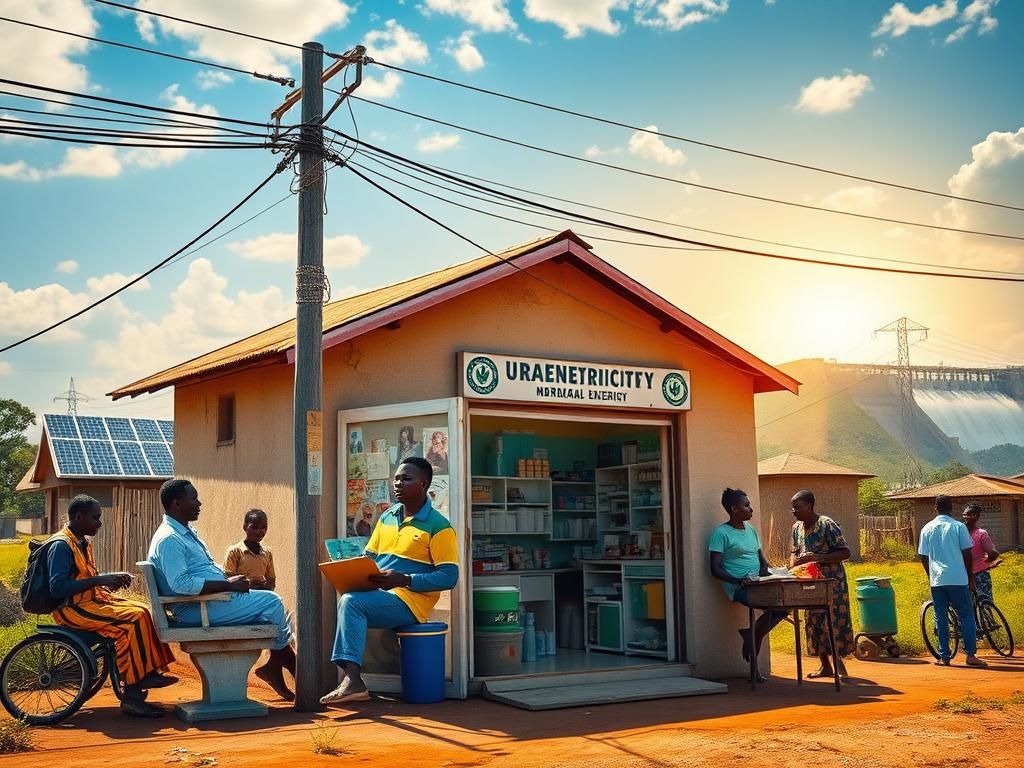
SIDUAVA, Mozambique (AP) — In the bustling village of Siduava, just outside Mozambique’s capital, the transformative power of electricity is vividly on display. For Hermínio Guambe, a 48-year-old barber, the arrival of power meant an end to a tiny barbershop operating in the dark; he now employs modern hair dryers, attracting more clientele and boosting his earnings. This ripple effect extends to the local pharmacy, which can now stock vital refrigerated medicines, and the community at large, where increased trading and improved transport have spurred job creation.
“These are the kinds of businesses that drive economies,” World Bank President Ajay Banga observed during a visit in July, touring electrification projects and meeting entrepreneurs like Guambe. “Electricity isn’t just light, it’s a chance.”
Mozambique, one of the world’s poorest nations by per capita income, has secured crucial World Bank backing for the ambitious $6 billion Mphanda Nkuwa hydroelectric plant. This monumental undertaking is slated to be southern Africa’s largest such project in half a century, underpinning Mozambique’s bold goal to connect all of its 33 million predominantly rural citizens to electricity by 2030, primarily through renewable sources like hydro and solar.
Powering a Continent in Need
The challenge of electrification in Mozambique mirrors that across much of sub-Saharan Africa, a region where a staggering 85% of the global population still lives without access to power, according to the World Bank. Mozambique has made significant strides, nearly doubling its electricity access from 31% in 2018 to an impressive 60% in 2024. The state-run utility, Electricidade de Moçambique (EDM), connected 563,000 homes in 2024 and aims to reach 600,000 this year.
“Mozambique has the resources, gas, hydro, solar, and it’s already the biggest supplier of excess power to southern Africa,” Banga stated, emphasizing the nation’s strategic energy potential.
The Mphanda Nkuwa plant, located 60 kilometers (37 miles) downstream from the existing Cahora Bassa hydroelectric dam along the Zambezi River, is projected to generate 1,500 megawatts upon its operational commencement in 2031. This immense output is critical for a region grappling with a 10,000-megawatt power deficit that leaves millions without reliable electricity.
A New Model for Development Funding
The World Bank’s involvement in Mphanda Nkuwa signifies a strategic shift from traditional direct financing. Instead of an outright loan for the entire project, the bank is providing a comprehensive package of support. This includes concessional funding directed towards addressing legal and environmental issues and developing vital transmission lines, alongside partial risk guarantees and political risk insurance for investors.
This approach aligns with a global trend in development funding, moving away from reliance on direct donor aid, particularly for high-impact infrastructure projects in Africa. As World Bank President Banga noted, “Many shareholders, even in Europe, are reducing their overseas development assistance budgets because they have to divert the money to defense and their own needs. This is the way it is.” This evolving landscape, coupled with shifts like the Trump administration’s dismantling of the U.S. Agency for International Development, has prompted multilateral lenders to increasingly emphasize private sector–led growth.
The Mphanda Nkuwa plant is being developed by a consortium comprising global energy firm TotalEnergies, French utility Électricité de France, and Mozambique’s Hidroeléctrica de Cahora Bassa. Beyond domestic supply, the project also positions Mozambique to earn critical foreign exchange by exporting electricity to power-hungry neighbors like South Africa and Zimbabwe.
Untapped Potential and Lingering Concerns
Despite the rise of new mega-dams like Ethiopia’s $4 billion Grand Renaissance Dam, which will eventually generate over 5,000 megawatts, doubling the nation’s power output, and Congo’s Inga 3 project, hydropower remains largely untapped in Africa. The World Bank and the International Hydropower Association estimate that approximately 90% of the continent’s hydropower capacity is still unutilized.
However, building a mega-dam is only one facet of Mozambique’s energy strategy. Joaquim Ou-Chim, chairman of EDM, acknowledged the challenge posed by the country’s vast size: “Our country is quite big, and it’s not so easy to go everywhere with the national grid.” Consequently, about 10% of current electricity access in Mozambique comes from off-grid solutions, predominantly solar-driven projects, with more being rolled out to reach remote areas.
Amidst this ambitious push, concerns over Mozambique’s growing debt burden persist. Energy consultant Evaristo Cumbane, based in Maputo, highlighted the importance of smaller, localized energy sources, stating, “We are talking about plenty of rivers, plenty of sunshine, plenty of wind, plenty of coastlines. The real Mozambique is in rural, remote areas.” He also urged caution regarding the nation’s public debt, which rose to about $17 billion in the first quarter of 2025, with a record $2.1 billion spent on debt service in 2023. Cumbane emphasized, “The World Bank is not a godfather, it is not god. The guy is here on business. These are not donations.” The final cost of the Mphanda Nkuwa project, estimated between $5 billion and $6 billion, and its specific impact on the national debt, are still being determined.
Mozambique’s path to development has been intricate. Since its independence from Portugal in 1975, the nation has endured civil war, subsequent skirmishes, and an ongoing Islamist insurgency in the northern Cabo Delgado province that forced TotalEnergies to halt a $20 billion gas project, though hopes for restarting operations remain.
Yet, for ordinary Mozambicans, the hum of Guambe’s barbershop and the sight of new power poles in impoverished neighborhoods, like the one where 38-year-old Aurélio Arlindo eagerly awaits power to open his cold drinks stall, stand as tangible proof of a brighter, electrified future finally within reach.