


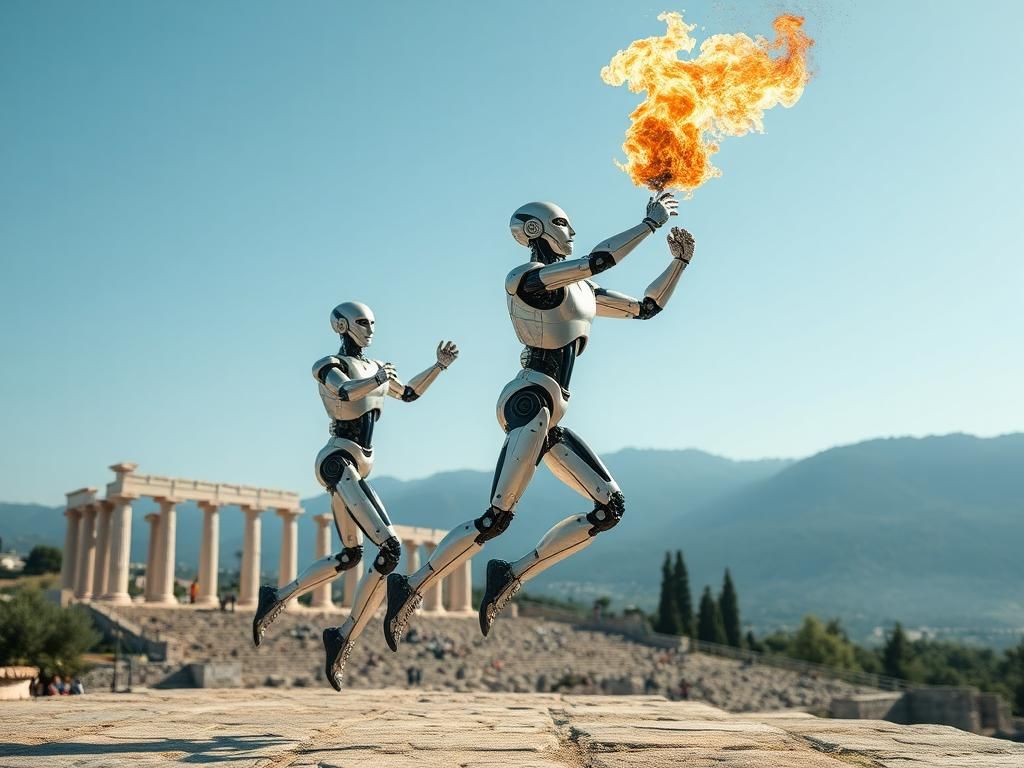
Humanoid Robots Descend on Ancient Olympia: Bridging the Gap Between AI Dreams and Physical Reality
ANCIENT OLYMPIA, Greece — In a unique convergence of ancient tradition and futuristic technology, humanoid robots recently descended upon the hallowed grounds of Ancient Olympia, the birthplace of the Olympic Games. With jerky determination, these mechanical athletes showcased an array of skills, from kicking soccer balls and shadow-boxing to attempting archery, captivating onlookers and igniting a crucial debate among experts: when will these human-like machines truly integrate into our daily lives?
Organized by Greek academic and startup founder Minas Liarokapis, the four-day International Humanoid Olympiad gathered leading experts and developers at the historic site where the Olympic flame is lit every two years for the modern Summer and Winter Games. While the robots impressed with their nascent abilities, their frequent pauses for battery changes underscored a significant challenge facing the field of physical robotics.
The Chasm Between AI and Physical Dexterity
Despite the rapid, “explosive advance” of artificial intelligence in areas like ChatGPT, its physical counterparts – robots designed with human-like forms and capabilities – are currently lagging by years, if not decades. Liarokapis articulated this gap, stating, “I really believe that humanoids will first go to space and then to houses… the house is the final frontier.” He estimates it will take “definitely more than 10 years” for humanoids to perform complex household tasks with genuine dexterity, moving beyond mere companion roles.
The core of this disparity lies in the availability of training data. AI thrives on vast amounts of readily accessible online digital data, such as text and images. In contrast, humanoid robots require real-world action data, which is far slower, more expensive, and inherently more difficult to record. According to an article in the journal Science Robotics, humanlike robots are estimated to be roughly 100,000 years behind AI in terms of learning from data.
To bridge this substantial gap, Ken Goldberg, a professor at the University of California, Berkeley, advocates for moving beyond simulations. He urges developers to combine “old-fashioned engineering” with real-world training, allowing robots to “collect data as they perform useful work, such as driving taxis and sorting packages.” This practical data collection, he argues, is critical for accelerating their learning curve.
Innovations and Collaborations Fueling Progress
The pursuit of more useful data is attracting significant investment and collaboration. Luis Sentis, a professor at The University of Texas at Austin and co-founder of humanoid maker Apptronik, highlights that successful robotics demands synergy between researchers, data companies, and major manufacturers. These partnerships, he notes, are already drawing billions of dollars in funding towards humanoid robot development, suggesting that “these problems [are] being cracked on a day-to-day basis.”
Among the innovators at the Greek event was Aadeel Akhtar, CEO and founder of Psyonic, a company specializing in advanced prosthetics. Akhtar gained international attention after appearing on the U.S. television show “Shark Tank” for his bionic hand, which provides sensory feedback. He sees this technology as a potential accelerant for robot development, explaining, “We’ve built our hand for both humans and robots… So we’re closing that gap by actually using the hand of the prosthetic on humans and then translating that (data) over to robots.” Adding another layer of biological innovation, Hon Weng Chong, CEO of Cortical Labs, discussed his Australian biotech company’s development of a “biological computer” using real brain cells grown on a chip. These cells can learn and respond to information, potentially enabling robots to think and adapt more like humans.
The Olympics of Robotics: A Test of Current Abilities
The International Humanoid Olympiad itself aimed to provide an “honest validation of the progress that has been made,” according to Patrick Jarvis, co-founder of robot maker Acumino, alongside Liarokapis. Organizers carefully limited events to what current humanoids could realistically attempt. Jarvis noted the initial ambitions were higher, stating, “We were trying to get the discus and the javelin, but that’s tough for humanoid robots.” Similarly, high jump competitions were deemed impractical due to the need for specialized leg designs, which are not universal for most humanoid robots.
Thomas Ryden, executive director of MassRobotics, worked to maximize participation, with one company even testing its machine’s capability for the shot put. Despite these efforts, several U.S. roboticists attended primarily to speak, with fewer bringing their robots for demonstration.
Divergent Approaches: China’s Public Displays vs. U.S. Polished Videos
Globally, different philosophies are emerging in how humanoid robot development is showcased. Chinese companies, for instance, are increasingly displaying their machines at public events, such as Beijing’s first Humanoid Robot Games in August. In contrast, U.S. rivals often prefer to release polished videos that, while impressive, can sometimes obscure developmental challenges or failures.
There are notable exceptions that offer a glimpse into the cutting edge. In 2022, Elon Musk revealed Tesla’s Optimus prototype, which walked stiffly onstage, turned, and waved to a cheering crowd. Perhaps more dramatically, Boston Dynamics, known for its agile dog-like Spot robots, had them dance in synchrony to a Queen song on “America’s Got Talent.” During the live performance, one of the five robots unexpectedly broke down mid-routine. Far from a setback, this incident inadvertently highlighted the complex agility and coordination required, leading judge Simon Cowell to remark, “Can I be honest with you? I actually think — I don’t mean this in a cruel way — it was weirdly better that one of them died, because it showed how difficult this was.” This raw, unscripted moment provided a powerful, albeit unintended, validation of the formidable engineering challenges involved in creating truly autonomous and dexterous humanoid machines.