


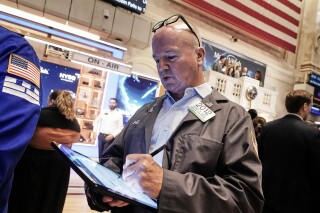
Wall Street Hits New All-Time High Amid Nvidia Earnings, Then Sees After-Hours Dip
NEW YORK — Wall Street celebrated a new milestone Wednesday, with the S&P 500 index notching an all-time high amidst eager anticipation of technology giant Nvidia’s quarterly earnings. However, the enthusiasm was tempered in after-hours trading as Nvidia’s highly scrutinized report, while topping forecasts, revealed a deceleration in its crucial artificial intelligence (AI) chipset sales growth, causing its shares to dip.
The benchmark S&P 500 index rose 0.2%, gaining 15.46 points to close at 6,481.40, surpassing the previous record set just two weeks prior. The Dow Jones Industrial Average also saw gains, climbing 0.3% (147.16 points) to finish at 45,565.23, while the Nasdaq composite advanced 0.2% (45.87 points) to reach 21,590.14. Technology companies were the primary drivers of these gains during regular trading, offsetting declines observed in communication services and other sectors.
Nvidia’s Pivotal Role in the AI Boom
Much of Wednesday’s market activity revolved around Nvidia, a semiconductor behemoth whose chips are indispensable to the burgeoning AI industry. Investors keenly monitor Nvidia’s performance as a critical barometer for the health and trajectory of the broader artificial intelligence boom. Jay Woods, chief global strategist at Freedom Capital Markets, underscored the company’s immense influence, stating, “Saying this is the most important stock in the world is an understatement.” Woods added, “The stock’s average move after an earnings release is plus or minus 7.4%, so just an average move will make an impact on the entire market.”
Following the closing bell, Nvidia announced quarterly earnings and revenue figures that exceeded Wall Street analysts’ expectations. Despite these headline beats, the company noted that the sales growth of its high-demand AI chipsets had slowed more than analysts had projected. This news led to a 3.2% drop in Nvidia’s stock during after-hours trading, after it had already slipped 0.1% during the regular session.
Individual Stock Performance Highlights
- Software Sector Surge: Several prominent software firms, including CrowdStrike Holdings, ServiceNow, Palo Alto Networks, Intuit, and Salesforce, experienced pre-Nvidia earnings rallies. This occurred despite lingering investor concerns that advancements in AI could potentially erode the competitive advantages of established software companies.
- Retail and Tech Boost: Department store chain Kohl’s surged an impressive 24%, while database platform company MongoDB saw its shares leap 38%. Both companies not only delivered better-than-expected quarterly results but also raised their full-year guidance, signaling strong future prospects.
- Dips and Disappointments: J.M. Smucker, the well-known jelly and jam maker, saw its stock slide 4.4% after its latest quarterly report fell short of analyst estimates. Doughnut chain Krispy Kreme also declined 3.5%, and Paramount Skydance registered the steepest drop among S&P 500 companies, falling 6.5%.
- Cracker Barrel’s PR Win: Cracker Barrel shares climbed 8% after the restaurant company rescinded controversial plans to alter its iconic logo. The reversal followed a swift public backlash across social media platforms, even drawing commentary from former President Donald Trump.
Bond Markets and Federal Reserve Dynamics
In the bond market, Treasury yields mostly declined. The yield on the benchmark 10-year Treasury note slipped to 4.24% from 4.26% the previous day, while the two-year Treasury yield, a key indicator of Federal Reserve policy expectations, dropped to 3.62% from 3.68%.
The week has seen an uneven start for Wall Street, following substantial gains last week driven by renewed hopes for interest rate cuts from the Federal Reserve. However, recent political developments have added a layer of uncertainty. Former President Trump has intensified his long-standing feud with the central bank, notably attempting to dismiss Federal Reserve Governor Lisa Cook, whose lawyer has indicated plans to sue to prevent her removal.
Trump’s conflict with the Fed stems from his opposition to what he describes as its cautious interest rate policy. The central bank, having successfully curbed inflation through a series of rate hikes over several years, initiated a benchmark interest rate cut in late 2024. It then paused further cuts in early 2025, largely due to concerns that Trump’s unpredictable tariff policies could reignite inflationary pressures. Despite Trump’s public taunts, including threats to fire Fed Chair Jerome Powell, his individual influence is limited, as he holds only one of 12 votes on interest rate policy.
Despite the political noise, the situation is not expected to significantly alter the Fed’s near-term policy course. Traders remain largely convinced that a rate cut is imminent. According to data from CME Group, there is a 90.3% probability that the Federal Reserve will implement a quarter-percentage-point rate reduction at its upcoming September meeting. “It’s kind of a foregone conclusion from the market that we’re going to get the September interest rate cut,” remarked Jed Ellerbroek, portfolio manager at Argent Capital Management. “The bigger question is probably ‘What’s after that?’ “
The Fed’s strategy of raising rates to combat inflation largely avoided a significant economic downturn, thanks to robust consumer spending and a resilient job market. However, concerns are now deepening over the state of the job market. This week’s economic calendar is relatively light, with market participants awaiting Friday’s release of the U.S. personal consumption expenditures (PCE) index, a crucial inflation gauge. Economists anticipate the index will show year-over-year inflation holding steady at approximately 2.9% in July. Businesses across various sectors have been vocal about increased costs and pricing pressures, attributing them partly to escalating tariffs.
Further complicating the global economic picture, the Trump administration’s stringent tariffs on India, imposed over its purchases of Russian oil, officially came into effect on Wednesday. These new measures bring the combined tariffs on the U.S. ally to a substantial 50%.
As the trading day concluded, crude oil prices registered an uptick, while European markets closed mostly lower, and Asian markets presented a mixed performance overnight.