


US and EU Solidify Landmark Trade Agreement to Boost Economies
WASHINGTON (AP) – The United States and the European Union have formally cemented a comprehensive framework agreement, aiming to bolster their substantial trade and investment relationship and revitalize their economies. This pivotal joint statement, issued Thursday, outlines key commitments designed to stabilize and expand what is already the world’s largest bilateral trade partnership, collectively accounting for 44% of the global economy.
A Turnaround from Past Tensions
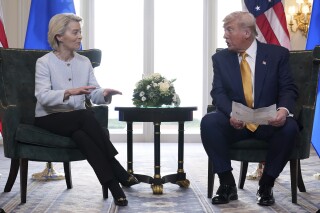
The agreement emerges from a period of notable trade tensions, particularly during the previous U.S. administration. A critical turning point occurred in July 2020, when then-President Donald Trump and European Commission President Ursula von der Leyen held a crucial summit at Trump’s Turnberry golf course in Scotland. This meeting was instrumental in averting a steep escalation of tariffs, as the U.S. had threatened a punitive 30% tariff rate on a broad range of European goods if a new accord wasn’t reached by August 1st of that year. The outcome of that summit was an initial commitment to a new trade deal, setting the stage for the more formalized framework announced this week.
Key Tariff Adjustments and Concessions
Under the terms of this new framework, the U.S. will apply a maximum 15% tariff rate on most European goods, a significant concession from the previously threatened higher levels. Notably, specific tariffs on automobiles will now be conditionally linked to future legislative actions undertaken by the EU. In a reciprocal move, the European Union has committed to eliminating tariffs on a wide array of industrial goods and many agricultural products, with the U.S. agreeing to corresponding tariff reductions.
Ambitious Economic Cooperation and Long-Term Vision
Beyond immediate tariff adjustments, the agreement outlines ambitious economic cooperation, projecting a cumulative $750 billion in energy purchases and $600 billion in EU investments by 2028. These substantial figures underscore the long-term vision for deepening economic integration and mutual growth. Furthermore, the framework extends its scope to address complex non-tariff barriers—such as differing regulatory standards and administrative hurdles that can impede trade flows—and incorporates provisions for digital trade, alongside an emphasis on robust environmental regulations, reflecting modern economic priorities.
A Foundation for Stability and Growth
This framework agreement, building on a robust history of generally low tariff levels in a relationship valued at approximately $2 trillion (around 1.7 trillion euros) in annual trade, represents a strategic effort to foster stability and predictable growth. As articulated in the joint document, the overarching objective is to place the colossal U.S.-EU trade and investment relationship “on a solid footing” and “reinvigorate our economies’ reindustrialization,” promising a more cooperative and prosperous future for both economic blocs.