


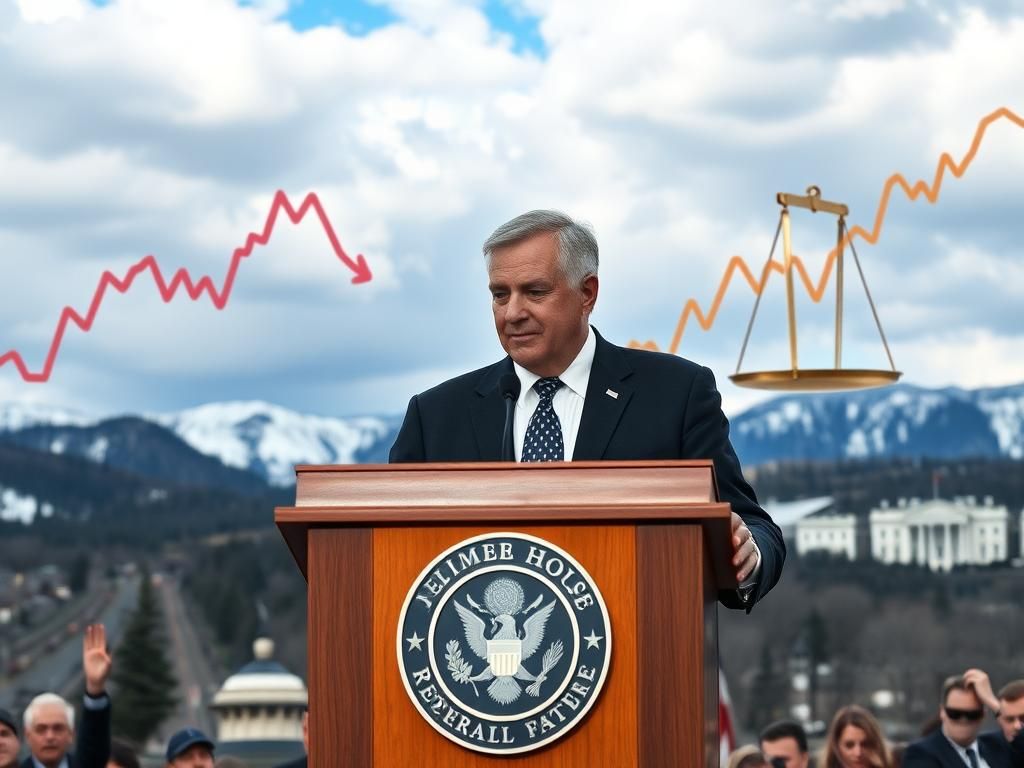
Powell Under Pressure: Navigating Conflicting Economic Signals Ahead of Key Jackson Hole Speech
WASHINGTON (AP) — Federal Reserve Chair Jerome Powell faces a high-stakes moment this Friday as he delivers his highly anticipated speech at the Fed’s annual economic symposium in Jackson Hole, Wyoming. The address comes amidst conflicting economic signals and unprecedented political pressure, leaving both Wall Street and the White House on edge for any indication of the central bank’s next move on interest rates.
The Shifting Sands of the Job Market
Just three weeks ago, following the Federal Reserve’s decision to keep its key interest rate unchanged for a fifth consecutive meeting at 4.3%, Powell offered a confident assessment, describing the job market as “solid.” However, this optimistic outlook was quickly challenged. Two days later, a Labor Department report revealed a significant slowdown in hiring for July, with May and June figures also revised sharply downwards, casting a shadow over the “solid” narrative.
This sudden shift in labor market data has intensified speculation about a potential interest rate cut at the Fed’s upcoming September meeting. A gloomier view from the famously data-dependent Powell could signal a pivot towards easing monetary policy. Yet, the path forward is anything but clear.
Inflation’s Persistent Creep
Adding to the complexity, the latest inflation report, released approximately a week after the surprising jobs figures, showed an unwelcome creep upwards in price growth during July. Core prices, which exclude the volatile food and energy sectors, rose by 3.1% year-over-year, exceeding the Fed’s long-standing 2% target. This stubbornly elevated inflation pushes the central bank in the opposite direction, suggesting that the current 4.3% short-term rate should be maintained, thereby keeping borrowing costs for mortgages, auto loans, and business loans elevated.
The Fed’s Growing Dilemma
“The dilemma that the Fed is in has become, if anything, more intense,” remarked David Wilcox, a former top Fed economist now directing economic research at Bloomberg Economics and a senior fellow at the Peterson Institute. The twin mandates of stable prices and maximum employment now pull the Fed in opposing directions.
Political Crosscurrents: Trump’s Unprecedented Criticism
Powell is also contending with an unprecedented level of public criticism from President Donald Trump, who has openly demanded rate cuts and sought greater influence over the Fed, an institution traditionally revered for its independence. A notable instance of this dynamic occurred last month during Trump’s visit to the Fed’s ongoing office building renovation. What began as a $1.9 billion project had reportedly ballooned to $2.5 billion, leading Trump to falsely claim the cost had surged to an astronomical $3.1 trillion. Powell, with characteristic composure, calmly corrected the President, clarifying that the $3.1 billion figure erroneously included the cost of renovating a third building five years prior.
“That was just such a classic Powell,” observed Diane Swonk, chief economist at KPMG. “He just doesn’t get fazed. He’s got a humility that oftentimes I think is lacking among my colleagues in economics.” Powell’s steady demeanor appeared to at least temporarily assuage the President, who subsequently backed off his threats to fire the Fed chair over the project.
A Tenure Defined by Challenges
Powell’s eight-year tenure has been marked by a series of extraordinary challenges. Appointed in 2018, he initially faced Trump’s ire for gradually raising interest rates from post-2008 recession lows. His leadership then navigated the economic turmoil of the pandemic, followed by the worst inflation spike in four decades, fueled by government stimulus and disrupted supply chains. Despite widespread predictions of a recession during the Fed’s rapid series of rate hikes, the U.S. economy has largely continued its forward momentum.
The political pressures persist. Just this Wednesday, President Trump called for the resignation of Fed governor Lisa Cook, echoing accusations of mortgage fraud made by administration official Bill Pulte, head of the agency regulating Fannie Mae and Freddie Mac. Cook, however, has firmly stated she will not be “bullied” into stepping down and is preparing to address the charges.
The Unclear Path for Interest Rates
The path ahead for interest rates remains shrouded in uncertainty. While Atlanta Fed President Raphael Bostic noted in an interview that businesses surveyed and consulted directly suggest they “still are looking to see the price that they charge their customers increase from where we are today” due to tariffs, other economists point to signs of weakness. Neil Dutta, an economist at Renaissance Macro, highlighted the sharp slowdown in housing due to elevated mortgage rates and modest consumer spending, with growth at a mere 1.2% annual rate in the first half of 2025. “The weakness in the economy isn’t about tariffs,” Dutta asserted, “but instead the Fed’s high rates.”
Most economists anticipate Powell will signal the likelihood of a rate cut this year, without necessarily committing to one in September, a stance that could disappoint Wall Street’s high expectations. As Powell delivers what is understood to be his final Jackson Hole address before his term concludes in May, all eyes will be on whether he tips the balance towards fighting inflation or supporting a potentially faltering job market.