


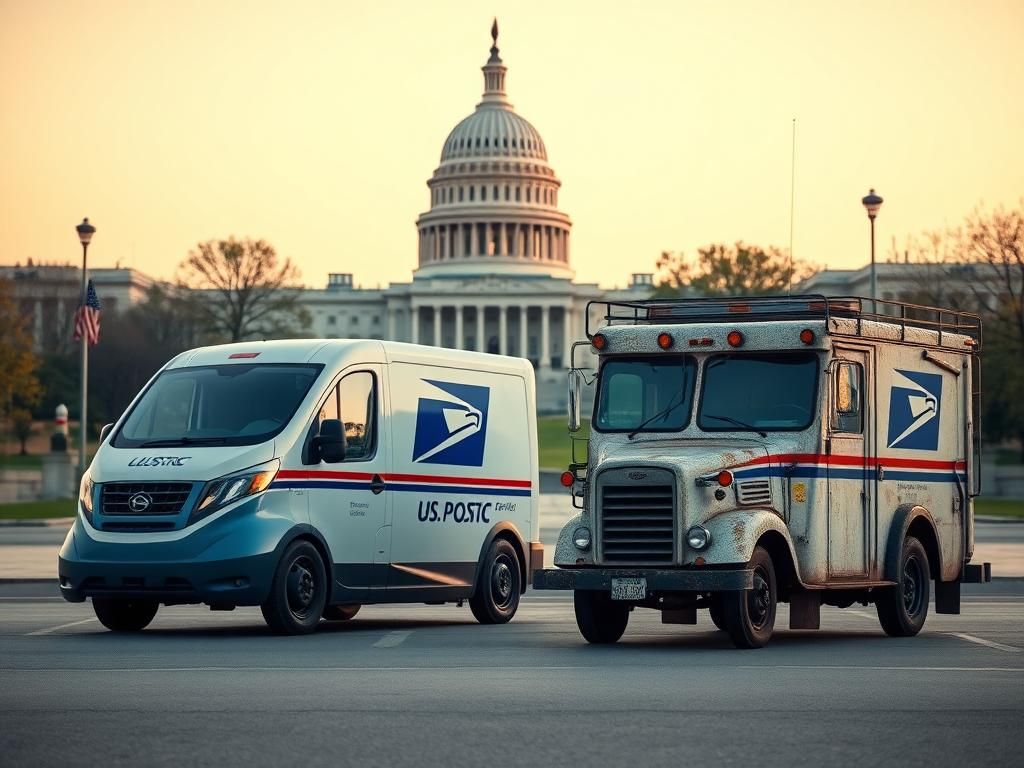
USPS Electric Fleet Faces Congressional Pushback Amid Modernization Drive
WASHINGTON (AP) — The U.S. Postal Service’s ambitious plan to electrify its vast delivery fleet, once lauded as a cornerstone of federal sustainability efforts, is now facing significant congressional headwinds. Just a year after receiving a Presidential Sustainability Award for its commitment to replace thousands of aging, gas-guzzling mail trucks with a mostly electric fleet, the agency is confronting Republican-led attempts to strip billions in allocated federal funding.
This reversal in sentiment comes as the USPS continues its decade-long, $40 billion modernization and financial stabilization initiative, known as “Deliver for America.” A key component of this plan is the overhaul of its ground fleet, primarily the iconic but inefficient Grumman Long Life Vehicle. These trucks, which date back to 1987, average a mere 9 miles per gallon and are well past their projected 24-year lifespan, frequently breaking down and even posing fire risks. “Our mechanics are miracle workers,” remarked Mark Dimondstein, president of the American Postal Workers Union, highlighting the challenges of finding parts for these vintage vehicles.
The Push for Electrification and Republican Resistance
The shift towards electric vehicles (EVs) gained momentum under President Joe Biden, who pledged to transition the entire federal fleet to electric. In 2022, the Postal Service announced its intention to deploy at least 66,000 electric vehicles by 2028, a move that followed years of criticism for its slow pace in reducing emissions.
However, many Republican lawmakers, echoing former President Donald Trump’s skepticism of green energy initiatives, argue that the Postal Service should prioritize mail delivery over environmental mandates. Senator Joni Ernst (R-Iowa) has been a vocal critic, labeling the EV initiative a “boondoggle” and a “textbook example of waste.” She cites concerns over delays, high costs, and potential performance issues in cold weather, and plans to introduce legislation to rescind the remaining $3 billion from the Inflation Reduction Act, which was allocated to assist with the $10 billion overall cost of the new postal vehicles.
Ernst specifically pointed to Wisconsin-based Oshkosh Defense, the contractor producing the Next Generation Delivery Vehicles (NGDVs), claiming they are “so far behind schedule, they will never be able to fulfill that contract.” She advocates for continued reliance on gas-powered vehicles, suggesting the use of corn-based ethanol, a clear nod to Iowa’s agricultural interests. Representative Michael Cloud (R-Texas), a co-sponsor of the rollback effort, echoed these sentiments, stating the project has delivered “nothing but delays, defective trucks, and skyrocketing costs.”
USPS and Scientific Community Defend the Transition
Despite the political pressure, the Postal Service maintains that any production delays for the NGDVs have been “very modest” and anticipated. USPS spokesperson Kim Frum explained that the ramp-up in production was intentionally gradual to allow for the resolution of any initial issues. She emphasized that the planned NGDV purchases were “carefully considered from a business perspective” and are being deployed to routes and facilities where they will demonstrably save money.
Proponents of the electrification plan also highlight the significant environmental and long-term financial benefits. Donald Maston, president of the National Rural Letter Carriers’ Association, warned that canceling the program now would be “shortsighted,” resulting in “a bunch of money on infrastructure that’s been wasted.”
From an environmental standpoint, a 2022 University of Michigan study provided compelling data. Lead author Maxwell Woody and co-director Gregory A. Keoleian of the Center for Sustainable Systems found that the new electric postal vehicles could slash total greenhouse gas emissions by up to 20 million tons over their predicted 20-year cumulative lifetime. While this is a fraction of the more than 6,000 million metric tons emitted annually in the United States, Keoleian stressed the urgency of accelerating decarbonization, noting that current efforts are “falling short of goals for reducing emissions.”
Woody further emphasized that postal routes are uniquely suited for electric vehicles due to their characteristics: low average speeds, a high number of stops and starts that enable regenerative braking, and known routes typically under 30 miles. “It’s the perfect application for an electric vehicle,” he asserted, “and it’s a particularly inefficient application for an internal combustion engine vehicle.”
Progress and Future Outlook
Oshkosh Defense was awarded a contract in 2021 for up to 165,000 battery electric and internal combustion engine NGDVs over a decade. The first of these distinctive, duck-billed trucks began service in Georgia last year. These new vehicles offer significant safety upgrades over the old Grumman trucks, including airbags, blind-spot monitoring, collision sensors, 360-degree cameras, antilock brakes, and notably, air conditioning – a long-awaited comfort for mail carriers. Douglas Lape, special assistant to the president of the National Association of Letter Carriers, praised Oshkosh’s transformation of an old North Carolina warehouse into a fully functioning factory for these vehicles.
To date, the Postal Service has ordered 51,500 NGDVs, with 35,000 designated as battery-powered electric vehicles. They have received 300 battery-powered NGDVs and 1,000 gas-powered models. Additionally, the agency has acquired over 8,200 of the 9,250 Ford E-Transit electric vehicles it ordered. Former Postmaster General Louis DeJoy had set a goal in 2022 for the agency to purchase chiefly zero-emissions delivery vehicles by 2026, though some internal combustion engine vehicles will still be needed for longer routes.
As the debate continues, the Postal Service stands at a critical juncture, balancing its vital role in national commerce with increasingly urgent environmental demands and the shifting tides of political will. The outcome of these congressional efforts will determine not only the future of the USPS fleet but also the pace of the federal government’s broader commitment to a greener future.