


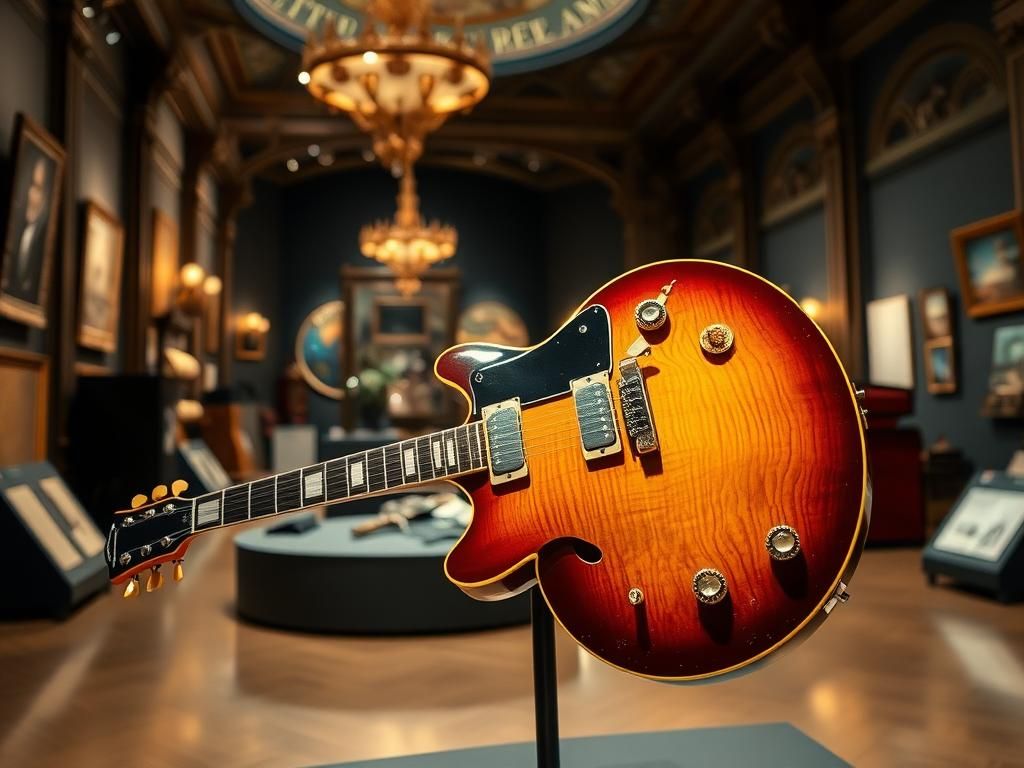
Rock and Roll Rumble: Mick Taylor Claims Iconic ‘Keithburst’ Guitar Stolen from Him, Now at The Met
A prized piece of rock and roll history, a 1959 Gibson Les Paul guitar, has become the focal point of a heated ownership dispute involving a legendary musician and one of the world’s most prestigious art institutions. Mick Taylor, the former guitarist for The Rolling Stones, claims the distinctive “starburst” instrument currently housed at the Metropolitan Museum of Art in New York was stolen from him over half a century ago. The museum, however, stands firm, stating its provenance records show no evidence of Taylor’s ownership.
The “Keithburst”: A Guitar of Legend
Nicknamed the “Keithburst,” this particular 1959 Gibson Les Paul holds a significant place in rock lore. It was originally owned by Rolling Stones co-founder Keith Richards, who famously wielded it during the band’s groundbreaking debut on “The Ed Sullivan Show” in 1964 — an appearance credited with dramatically boosting interest in this iconic guitar model. Beyond Richards, the instrument reportedly passed through the hands of other guitar virtuosos, including Eric Clapton and Jimmy Page, further cementing its legendary status. Taylor asserts that he received the guitar as a gift from Richards in 1967, two years before he officially joined the Rolling Stones, replacing the late Brian Jones.
Mick Taylor’s Account of the Disappearance
Taylor’s recollection dates back to the notoriously tumultuous 1971 recording sessions for the Rolling Stones’ album “Exile on Main St.” at Keith Richards’ rented villa in Nellcôte, located in the south of France. Amidst a backdrop of intense creativity, drug use, and a free-flowing atmosphere, several instruments mysteriously vanished, believed to have been stolen. Taylor’s partner and business manager, Marlies Damming, stated that Taylor’s team now believes this specific Gibson Les Paul has resurfaced, unequivocally linking it to that period. Adding a personal touch to his claim, former long-time manager Jeff Allen corroborated Taylor’s account, recalling that Taylor told him he used the very Les Paul in question for his acclaimed guitar solo on the band’s 1971 track, “Can’t You Hear Me Knocking,” a signature moment in his career.
The Metropolitan Museum of Art’s Provenance
The Metropolitan Museum of Art received the 1959 Gibson Les Paul as part of a monumental donation from billionaire investor and renowned guitar collector, Dirk Ziff. This “landmark gift,” announced in May, comprises more than 500 of what the museum describes as “the finest guitars from the golden age of American guitar making.” Ann Bailis, a spokesperson for the Met, firmly countered Taylor’s claim, asserting that the guitar possesses “a long and well-documented history of ownership” that does not include Mick Taylor. According to the museum’s records, Richards retained ownership of the guitar until 1971, when it was acquired by record producer and manager Adrian Miller, who passed away in 2006.
The Guitar’s Journey to The Met
The “Keithburst” has changed hands multiple times since its alleged departure from Taylor’s possession. After Adrian Miller’s acquisition in 1971, the guitar made a notable public appearance when it was put up for auction by Christie’s in 2004, though it ultimately failed to sell. Dirk Ziff then purchased the instrument in 2016. Its journey to the Met began in 2019 when Ziff loaned it for the “Play it Loud: Instruments of Rock & Roll” exhibition, before it became a permanent part of the museum’s collection through his generous gift in May.
An Unresolved Mystery
As of recent statements, Taylor’s team has urged the Met to allow for an independent examination of the guitar. Marlies Damming emphasized that “An independent guitar expert should be able to ascertain the guitar’s provenance one way or another.” Despite the public statements and the ongoing debate within rock music circles, the Metropolitan Museum of Art indicates it has not yet been directly contacted by Taylor or his representatives regarding this dispute. The museum is currently preparing to open a new gallery specifically dedicated to its expansive collection of American guitars, where this contested instrument is expected to be a highlight. The resolution of this intriguing rock and roll mystery remains uncertain.