


U.S.-India Relationship Hits Rocky Terrain Amid Trade Disputes and Shifting Alliances
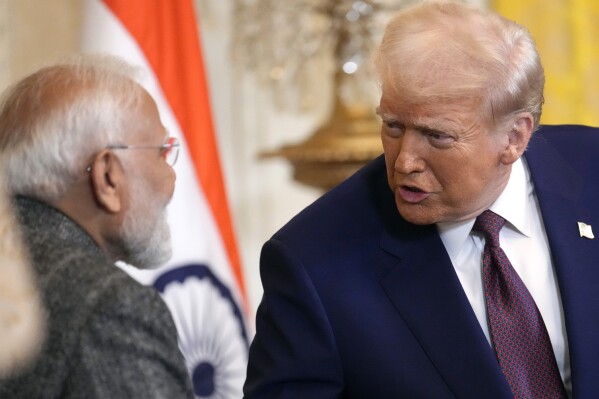
NEW DELHI (AP) — The once-vaunted camaraderie between Indian Prime Minister Narendra Modi and former U.S. President Donald Trump, characterized by public bear hugs and joint stadium rallies, has given way to palpable friction. What was once seen in India as an unparalleled relationship is now navigating increasingly bumpy terrain, challenged by trade disputes, a perceived U.S. tilt toward Pakistan, and India’s continued energy ties with Russia. Policy experts are now openly questioning whether this strategic bilateral relationship, meticulously cultivated over the past two decades, is at risk.
Trade Tensions Escalate with New Tariffs
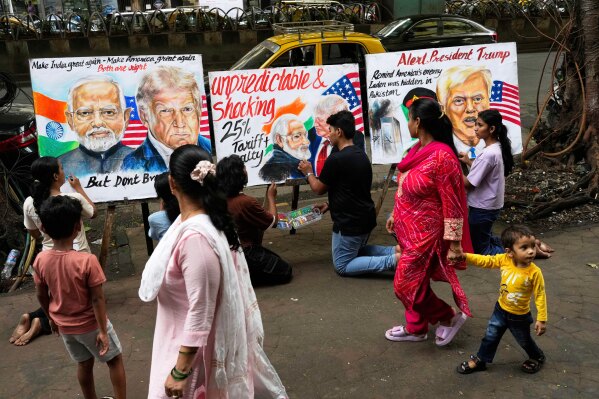
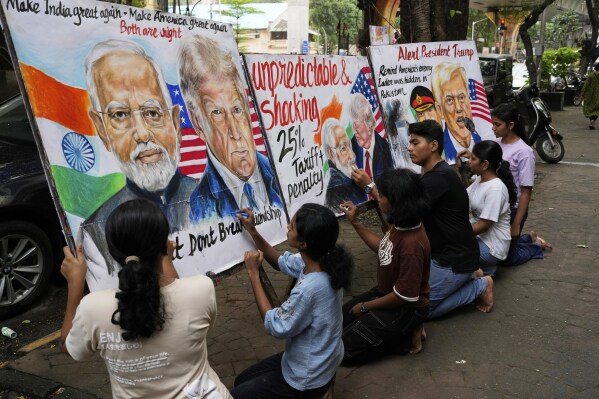
The latest significant hiccup in the relationship emerged last week when Donald Trump, from his social media platform Truth Social, announced a punitive 25% tariff on India, alongside unspecified penalties. This move stems from his frustration with India’s substantial purchases of Russian oil. Adding to the unease in New Delhi, Trump publicly declared India’s economy “dead,” a statement that stung Modi’s administration, which has been vigorously pushing for a comprehensive trade deal with the U.S.
A White House official, speaking anonymously to discuss internal administration thinking, indicated that Trump’s recent statements reflect his impatience with the slow pace of trade talks. The former President has been pressing India to open its protectionist market to more American goods. Ashok Malik, a former policy adviser in India’s Foreign Ministry and head of The Asia Group’s India chapter, noted that the proposed trade deal from the Indian side is “the most expansive in this country’s history,” reportedly including politically sensitive concessions on American agricultural products, an issue that previously triggered a yearlong farmers’ protest in India.
Trump’s Pakistan Tilt Raises Concerns in New Delhi
Beyond trade, a discernible shift in Trump’s stance toward Pakistan, India’s nuclear-armed rival, has further fueled tensions. The unraveling became more evident following a four-day conflict in May between India and Pakistan over a gun massacre in disputed Kashmir, which New Delhi attributed to Islamabad, though Pakistan denied involvement. Global powers intervened to de-escalate the situation, averting a potential nuclear conflagration.
However, it was Trump’s subsequent claims of mediating peace and offering a “solution” for Kashmir – repeated nearly two dozen times – that deeply unsettled Modi’s government. India consistently maintains that Kashmir is an internal matter and vehemently opposes any third-party intervention. Modi, without directly naming Trump, publicly dismissed these claims last week, stating that “no country in the world stopped” the fighting.
Trump has also demonstrably warmed to Pakistan, commending its counterterrorism efforts. Hours after announcing tariffs on India, he touted a “massive” oil exploration deal with Pakistan, remarking that India might one day need to purchase oil from Islamabad. Furthermore, a private lunch hosting one of Pakistan’s top military officials underscored this perceived realignment. Sreeram Sundar Chaulia, an expert at New Delhi’s Jindal School of International Affairs, affirmed that Trump’s “sudden admiration for Pakistan as a great partner in counterterrorism has definitely soured the mood in India.”
Russian Oil Purchases Remain a Point of Contention
India’s continued reliance on Russian oil has become another significant irritant. During the initial months of Russia’s invasion of Ukraine, India faced intense pressure from the Biden administration to curtail its oil imports from Moscow. However, New Delhi significantly increased its purchases, making it the second-biggest buyer of Russian oil after China. While this pressure had somewhat subsided as the U.S. prioritized strategic ties with India as a bulwark against China, Trump’s renewed threats have reignited the issue.
On Sunday, Stephen Miller, former deputy chief of staff at the White House, publicly accused India of “financing Russia’s war in Ukraine” through these oil purchases, labeling it “not acceptable.” Trump echoed this sentiment on Monday, asserting on social media that India is “not only buying massive amounts of Russian Oil, they are then, for much of the Oil purchased, selling it on the Open Market for big profits. They don’t care how many people in Ukraine are being killed by the Russian War Machine.”
India’s Measured Yet Firm Response
Despite Modi’s carefully cultivated image of strength, India’s initial response to Trump’s tariff threats was notably cautious. Commerce Minister Piyush Goyal stated that both countries are working towards a “fair, balanced and mutually beneficial bilateral trade agreement.” While the Foreign Ministry initially downplayed suggestions of strain, it later issued a robust statement on Monday, calling Trump’s criticism “unjustified and unreasonable.”
The statement clarified that India began importing oil from Russia out of “necessity compelled by global market situation” after traditional supplies were diverted to Europe following the Ukraine conflict. It also pointedly remarked, “It is revealing that the very nations criticizing India are themselves indulging in trade with Russia.”
Experts like Chaulia, while acknowledging the current discord, suggest that Trump’s remarks might be tactical pressure. “Given the wild fluctuations in Trump’s policies,” he speculated, “it may return to high fives and hugs again.” Nevertheless, Malik warned that “strenuous, uninterrupted and bipartisan efforts… over the past 25 years are being put at risk by not just the tariffs but by fast and loose statements and social media posts,” highlighting the precariousness of the evolving U.S.-India relationship.