


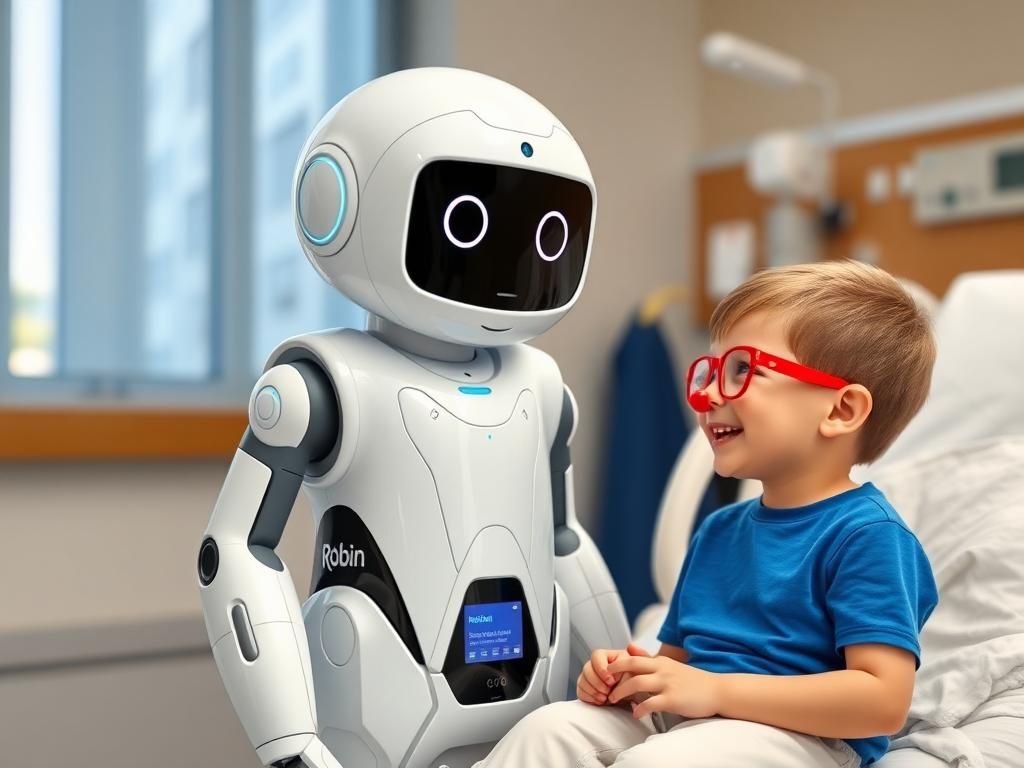
Robin the Robot: A Beacon of Joy and Comfort in Healthcare
WORCESTER, Mass. – In the often sterile and anxious environment of a hospital, a 4-foot-tall, 1.2-meter-tall robot with a disarmingly high-pitched voice resembling a 7-year-old girl is bringing moments of unexpected joy and profound comfort. Named Robin, this innovative artificial intelligence-powered therapeutic robot is swiftly becoming a familiar and cherished face in pediatric units and nursing homes, transforming patient experiences and providing crucial support to overworked medical staff.
For Meagan Brazil-Sheehan and her 6-year-old son, Luca, diagnosed with leukemia, their encounter with Robin at UMass Memorial Children’s Medical Center in June was a beacon of light during a challenging time. “Luca, how are you? It’s been awhile,” Robin greeted the young patient, who had only met the robot once before. Brazil-Sheehan recalls her son’s face lighting up instantly. “It was so special because she remembered him,” she shared, highlighting the robot’s capacity for personalized interaction and emotional connection.
A Growing Presence in Healthcare
Developed by Expper Technologies, Robin the Robot is designed to offer emotional support, combat loneliness, and alleviate the burdens of staffing shortages that plague many healthcare facilities. Five years after its U.S. launch, Robin has established a significant presence, operating in 30 healthcare facilities across California, Massachusetts, New York, and Indiana. This expansion underscores a broader trend of artificial intelligence finding a crucial foothold in medical care, from aiding in note-taking during exams to serving as “electronic nurses.”
Karen Khachikyan, CEO of Expper Technologies, emphasizes the robot’s role as a supplementary caregiver. “Nurses and medical staff are really overworked, under a lot of pressure, and unfortunately, a lot of times they don’t have capacity to provide engagement and connection to patients,” Khachikyan explained. “Robin helps to alleviate that part from them.”
Engaging Patients, Mirroring Emotions
Robin’s impact is vividly demonstrated during its rounds. At HealthBridge Children’s Hospital in Orange County, California, staff members prioritize patients for Robin’s visits, dictating the duration of each interaction. The robot, with its sleek white triangle-shaped frame designed for hugging, rolled into one teenager’s room, playing his favorite song, “No Fear” by DeJ Loaf, prompting him to dance. In the hallway, Robin donned a series of silly glasses and a big red nose, eliciting laughter from a young child. In another room, it engaged a patient in a simplified version of tic-tac-toe.
Samantha da Silva, a speech-language pathologist at HealthBridge, notes the immediate positive response. “Patients light up when Robin comes into their room and not only remembers their names but their favorite music,” she said. “She brings joy to everyone. She walks down the halls, everyone loves to chat with her, say hello.”
Beyond entertainment, Robin mirrors the emotions of those it interacts with. A laughing patient prompts a shared laugh from the robot, while difficult conversations are met with a display of sadness and empathy on its cartoon-like screen. In nursing homes, Robin plays memory games with dementia patients, guides them through breathing exercises, and offers companionship akin to a grandchild. Khachikyan recounted a poignant moment in a Los Angeles facility where Robin calmed a woman experiencing a panic attack by playing Elvis Presley songs and videos of puppies until her distress subsided.
The Technology and Future of Care
Currently, Robin operates with about 30% autonomy, with a team of remote operators providing the remaining control, all under the vigilant supervision of clinical staff. Expper Technologies ensures all data collection complies with the Health Insurance Portability and Accountability Act (HIPAA), continuously gathering information to advance Robin’s independent functioning. “Imagine a pure emotional intelligence like WALL-E. We’re trying to create that,” Khachikyan stated, referencing the beloved animated robot.
As the Association of American Medical Colleges projects a shortage of up to 86,000 physicians in the U.S. within the next 11 years, Robin’s potential goes beyond emotional support. Khachikyan envisions an “next evolution” where Robin measures patients’ vitals, checks on their well-being, and transmits that data to medical teams. Longer-term plans include developing Robin to assist elderly patients with tasks like changing clothes and using the bathroom. Khachikyan clarifies that the goal is not to replace healthcare workers but to seamlessly integrate Robin into the care delivery system, filling critical workforce gaps.
Robin’s collaborative role with human staff is already evident. When Luca at UMass Memorial Children’s needed an IV, a certified child life specialist, Micaela Cotas, brought Robin in. The robot first demonstrated the procedure with an IV on itself via a cartoon, providing a relatable peer-like experience. “It just kind of helps show that Robin has gone through those procedures as well, just like a peer,” Cotas noted.
From Personal Dream to Healthcare Reality
Robin’s genesis traces back to Khachikyan’s own childhood loneliness in a single-parent household in Armenia, inspiring him to create a robot companion. After testing in various industries, an investor’s suggestion led to its application in pediatric hospitals, recognizing the prevalent stress and isolation children face during hospitalization. Following successful pilots in Armenia, Robin made its U.S. debut with a pilot program at UCLA Mattel Children’s Hospital in 2020.
Remarkably, Robin’s personality and character have evolved through direct user interaction. Khachikyan shared an example: while testing responses for “What is your favorite animal,” neither “dog” nor “cat” garnered much reaction. However, “chicken” consistently brought laughter. “We created Robin’s personality by really taking users into the equation,” he explained. “So we often say that Robin was designed by users.” This user-centric approach ensures Robin remains a genuinely engaging and empathetic presence, continually adapting to better serve those in need.