


FAA Rule Set to Propel Drone Delivery into American Mainstream
A landmark FAA rule aims to clear the path for major retailers and tech giants to bring rapid aerial delivery to millions of American households, overcoming years of regulatory stagnation.
Delivery drones boast an impressive speed, capable of zipping a pint of ice cream to a customer’s driveway before it even begins to melt. Yet, despite this inherent efficiency, the long-promised technology has been remarkably slow to take flight in the United States. For more than six years since the Federal Aviation Administration (FAA) first approved commercial home deliveries via drones, the service has largely been confined to a handful of select suburbs and isolated rural areas.
That cautious approach, however, appears to be on the cusp of a dramatic shift. The FAA last week unveiled a pivotal proposed new rule designed to significantly streamline the process for companies to operate drones beyond an operator’s direct line of sight (BVLOS). This critical regulatory update would allow for vastly longer delivery distances, effectively unlocking the true potential of drone logistics. Currently, only a limited number of companies are authorized for BVLOS operations, a status they achieved only after navigating complex waiver applications and obtaining certification as air carriers. The new rule, once finalized, is expected to simplify these procedures, paving the way for authorized retailers and drone companies that have been rigorously testing fulfillment from the sky to expand their drone-based delivery programs to millions more U.S. households.
Retail Giants Take Flight
Walmart Forges Ahead with Drone Expansion
Leading the charge are retail behemoths like Walmart and e-commerce giant Amazon, both eager to capitalize on the burgeoning drone delivery market.
Walmart, in collaboration with Wing (a drone company owned by Google parent Alphabet), currently offers drone deliveries from 18 Walmart stores situated in the sprawling Dallas metropolitan area. By next summer, the partnership anticipates a massive expansion, planning to roll out services to a total of 100 Walmart locations across key U.S. markets including Atlanta, Charlotte (North Carolina), Houston, and Orlando and Tampa in Florida. This ambitious expansion builds on Walmart’s already significant experience, having completed over 150,000 drone deliveries since 2021, proving the viability and demand for such services among its customer base. Walmart also partners with drone maker Zipline in Arkansas and the Dallas-Fort Worth region.
Amazon Prime Air Broadens Horizons
Amazon, through its Prime Air delivery service, initiated drone deliveries in College Station, Texas, in late 2022. Last year, the company secured FAA permission to operate autonomous drones capable of flying beyond a pilot’s line of sight, a significant regulatory milestone. Since then, Amazon has broadened its drone delivery footprint to suburban Phoenix and has announced plans to extend the service to Dallas, San Antonio (Texas), and Kansas City.
Beyond the Hype: The Realities of Aerial Delivery
While the concept of drone delivery might evoke images of futuristic scenarios, the cargo they transport is often surprisingly mundane. Walmart reports that among the top items delivered by its drones are everyday necessities like ice cream (underscoring the speed advantage), eggs, and even popular confections like Reese’s Peanut Butter Cups.
Drone Capabilities and Operations
Unlike traditional delivery models where a single driver might carry a truckload of packages, drones generally handle one small order at a time. Wing’s drones, for instance, are designed to carry packages weighing up to 2.5 pounds and can travel up to 12 miles round trip. Impressively, a single pilot can oversee the operations of up to 32 drones simultaneously. Zipline offers drones with a higher capacity, capable of carrying up to 4 pounds and achieving a remarkable 120-mile round trip. Some drones, including Amazon’s models, are engineered to handle even heavier payloads.
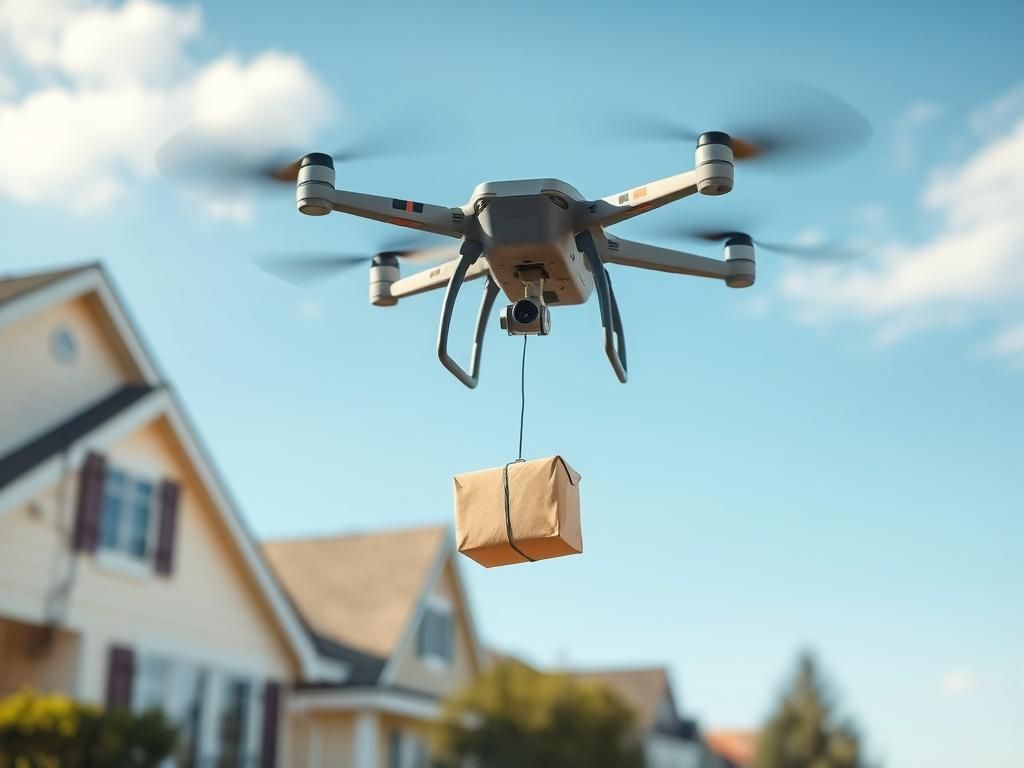
The delivery process is largely automated. Once an order is placed and packaged for flight at a designated launch site, the drone automatically charts an optimal route, meticulously avoiding obstacles. A human pilot maintains oversight, monitoring the aircraft as it navigates to its destination and precisely lowers the cargo to the ground using retractable cords.
Global Pioneers and U.S. ‘Treading Water’
The notion of drone delivery isn’t new; it has seen successful implementation internationally for years. Drone maker Zipline, a partner of Walmart, began delivering critical medical supplies to hospitals in Rwanda as early as 2016, showcasing the technology’s life-saving potential. Similarly, Israel-based Flytrex, which collaborates with DoorDash, launched household drone deliveries in Iceland in 2017. DoorDash itself has been utilizing drone drop-offs in suburban Brisbane, Australia, for several years, where the service has seamlessly integrated into daily life.
Adam Woodworth, CEO of Wing, candidly described the U.S. drone delivery landscape as being in a “treading water mode” for years. This stagnation was largely attributed to the absence of a comprehensive and predictable regulatory framework, deterring service providers from scaling up their operations. “You want to be at the right moment where there’s an overlap between the customer demand, the partner demand, the technical readiness and the regulatory readiness,” Woodworth stated, expressing optimism that “we’re reaching that planetary alignment right now.”
Navigating Risks and Rewards
While the advantages of drone delivery are clear—such as reduced emissions, faster delivery times, and improved access to goods for residents in remote or underserved rural areas—the technology is not without its challenges and concerns.
Cost Considerations
Cost remains a significant hurdle. Shakiba Enayati, an assistant professor of supply chain and analytics at the University of Missouri, St. Louis, highlights the current disparity: it costs approximately $13.50 per delivery to transport a package by drone, a stark contrast to the estimated $2 for a traditional vehicle delivery. Drones also require specialized, well-trained employees for oversight and can be sensitive to adverse weather conditions.
Ensuring Safety
Safety is paramount. Concerns about mid-air collisions or drones falling from the sky are valid, though proponents argue that, much like the accepted risks of road accidents, public acceptance will grow as technology improves and error rates decrease. Woodworth emphasized that U.S. airspace is tightly controlled, and companies must rigorously demonstrate the safety and reliability of their drones to the FAA before receiving clearance to fly. Even under the proposed new rules, stringent requirements will be imposed on drone operators.
Addressing Privacy and Noise
Privacy is another hot-button issue. When the FAA solicited public comments on Amazon’s request to expand deliveries in College Station, Texas, numerous residents voiced concerns that drones equipped with cameras violated their privacy. Amazon maintains that its drones use cameras and sensors primarily for navigation and obstacle avoidance, though they may record overhead videos of people during deliveries. Noise pollution also drew complaints, with one respondent likening the sound to a “giant nagging mosquito” – a concern Amazon has since addressed by releasing a quieter drone model.
Impact on Human Delivery Drivers
Regarding the potential displacement of human delivery drivers, Harrison Shih, who leads DoorDash’s drone program, believes it’s unlikely. He points out that many popular delivery items, such as 24-packs of water, are simply too heavy for current drone capabilities. DoorDash has also observed that in areas where drone delivery is offered, orders requiring human drivers tend to increase overall, suggesting a complementary rather than competitive relationship.
On the Ground: A Glimpse of the Future
For businesses and consumers in active drone delivery zones, the experience is largely positive. John Kim, owner of PurePoke restaurant in Frisco, Texas, signed on with DoorDash for drone deliveries last year. He reports a 15% increase in his overall DoorDash orders this year and has received no complaints from drone delivery customers. “It’s very stable, maybe even better than some of the drivers that toss it in the back with all the other orders,” Kim remarked.
Residents like Janet Toth of Frisco, Texas, who witnessed drone deliveries in Korea years ago, were eager for the service to arrive in the U.S. She now orders via drone a few times a month. Her 9-year-old daughter, Julep, shared her enthusiasm, noting that friends often visit to watch the drone. “I love to go outside, wave at the drone, say ‘Thank you’ and get the food,” Julep Toth cheerfully recounted.
With the FAA’s proposed regulatory changes poised to clear a significant hurdle, the long-anticipated era of widespread drone delivery in the U.S. appears closer than ever, promising to transform the final mile of logistics for consumers and businesses alike.