


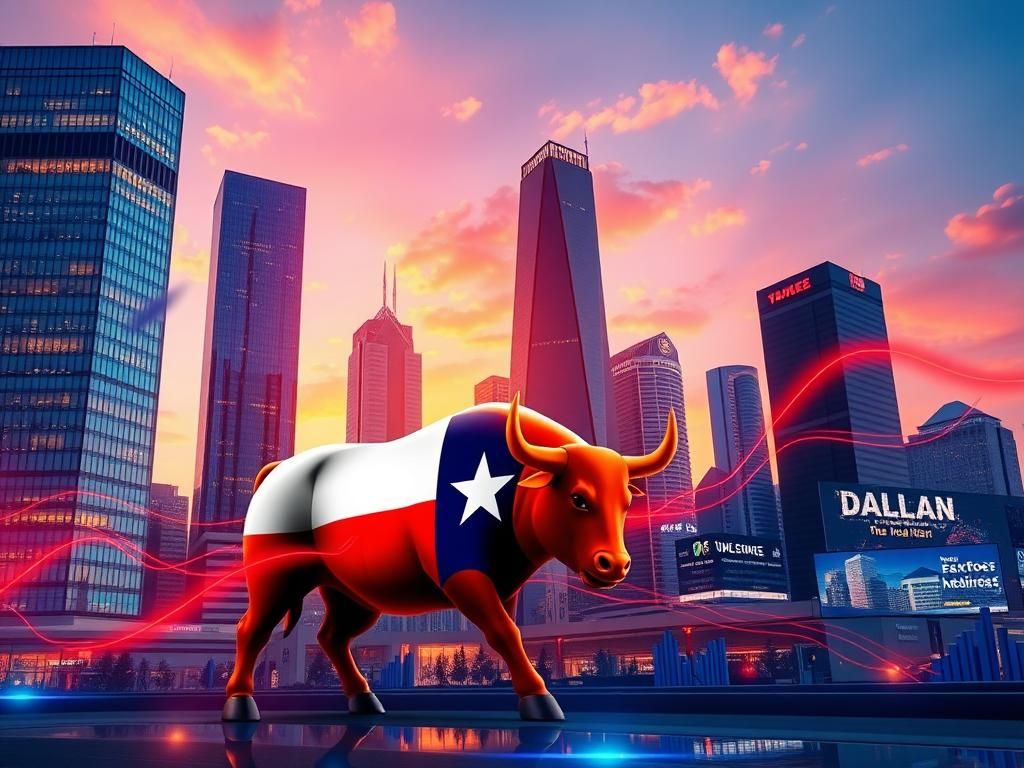
Texas Stock Exchange Approved: A New Era for U.S. Finance?
By PAUL COBLER/The Texas Tribune
Dallas, Texas – The financial landscape of the United States is poised for a significant shift as the Texas Stock Exchange (TXSE), a Dallas-based startup, officially secured approval from the U.S. Securities and Exchange Commission (SEC) on September 30. This landmark decision paves the way for the TXSE to emerge as a direct competitor to the long-standing dominance of the New York Stock Exchange (NYSE) and the Nasdaq.
The announcement was met with fervent enthusiasm from Texas lawmakers, including Governor Greg Abbott, who confidently declared, “Texas is swiftly becoming America’s financial hub.” This sentiment underscores the growing confidence in the state’s economic prowess and its ambition to carve out a larger share of the nation’s financial markets.
A Well-Funded Challenge to the Duopoly
The TXSE’s journey has been closely watched since its June 2024 revelation of plans to launch with a substantial $120 million in backing. This impressive capital injection comes from major investment powerhouses, including BlackRock and Citadel Securities, making it one of the most robustly funded attempts at establishing a new national exchange in decades. This financial muscle is a critical factor, providing the resources needed to build state-of-the-art digital infrastructure and attract crucial initial listings.
TXSE officials assert that the burgeoning strength of the Texas economy made such an ambitious endeavor possible. Texas proudly hosts the headquarters of the second-highest number of Fortune 500 companies in the nation, trailing only California and surpassing New York. Globally, the Texas economy stands as the 7th largest, a compelling statistic highlighted by Nicole Chambers, Global Managing Director of Listings for TXSE. Addressing Dallas business leaders in September, Chambers noted, “Texas is a major player in the U.S. regardless of the exchange landscape, but it ultimately makes sense as the 7th largest economy in the world.” She further emphasized the state’s unique appeal, adding, “We couldn’t do this in Oregon or in Nebraska.”
“Y’all Street” Emerges as a Financial Powerhouse
“Y’all Street” Emerges as a Financial Powerhouse
The TXSE’s impending launch, anticipated for next fall, has already stirred the competitive waters. In a clear response to the Dallas startup’s ambitions, the NYSE announced in February that it would reincorporate its Chicago electronic exchange and relocate it to Dallas, rebranding it as NYSE Texas. Not to be outdone, Nasdaq followed suit in March, revealing plans to establish a regional headquarters in Dallas. Bill Bailey, managing director of market intelligence at TXSE, views these moves as direct reactions to the TXSE’s emergence, solidifying Dallas’ new, unofficial moniker: “Y’all Street.”
Dallas’ evolution into a significant financial services hub is no accident. Historically, its central location within the Sun Belt made it a natural nexus for communication, transportation, and finance as Texas modernized. This trend has accelerated, with top investment banks like JPMorgan Chase and Goldman Sachs significantly expanding their presence. Goldman Sachs, for instance, is currently constructing a $500 million tower in downtown Dallas, slated to house over 5,000 employees – its largest hub outside of New York. Charles Schwab also moved its headquarters from California to Dallas in 2020.
Economic data underscores this shift: over the last two decades, New York saw a 16% growth in investment and securities sector employment, while Texas experienced a remarkable 111% expansion, according to Ray Perryman, president of The Perryman Group, an economic research company. This growth, coupled with a lower cost of living compared to the Northeast, attracts talent. Sasha Stratton, head of risk for Selby Jennings in Dallas, a recruitment firm for financial services, moved from New York five years ago for a better quality of life and housing affordability. She notes, “(Firms) are prioritizing hiring in Dallas over hiring in New York in a lot of instances… It’s actually a smart, strategic decision to take advantage of how booming the economy is.”
TXSE’s Vision: Modernity and Accessibility
TXSE’s Vision: Modernity and Accessibility
Stock exchanges are private institutions facilitating the trade of securities, much like any other market, explains Sriram Villupuram, an associate professor of finance at the University of Texas at Arlington. While iconic bell-ringing ceremonies on the NYSE and Nasdaq floors often grab public attention, modern trading is predominantly digital. Since the NYSE’s acquisition of the American Stock Exchange in 2008, a duopoly has effectively controlled the U.S. market, with many regional exchanges either absorbed or shut down.
TXSE leadership is confident this attempt to create a third national exchange will succeed where others have failed. The exchange will be entirely digital but will maintain a physical presence in Dallas, complete with its own “Texas flair” bell-ringing ceremonies. Key to its strategy are fewer requirements for the makeup of company boards of directors compared to its rivals. Furthermore, TXSE aims to capitalize on what it perceives as growing discontent among companies regarding new rules, rising fees, and stringent share price benchmarks imposed by Nasdaq and NYSE.
The success of TXSE, Villupuram suggests, will heavily depend on the patience of its investors and its ability to rapidly attract its initial cohort of 50 to 100 companies. This early momentum is crucial for creating a “snowball effect” that encourages further listings. The continued robust growth of the Texas economy will also be a vital determinant, as it promises to attract more large corporations and financial firms, providing a fertile ground for TXSE to recruit.
Ultimately, while stock transactions are largely automated, the human element of “courting companies to come get listed” remains paramount, emphasizes Villupuram. The physical proximity to major corporations and a vibrant financial community in Dallas will be essential.
A Changing Landscape
A Changing Landscape
The convergence of TXSE’s launch with the expansion of established exchanges in Dallas is expected to significantly ease access to capital for growing Texas companies, fueling further expansion and job creation – a beneficial feedback loop for both the exchanges and the state’s economy.
As Ray Perryman concludes, “New York will likely remain the primary center of equity markets for the time being, but the landscape is changing.” The rise of the Texas Stock Exchange signals a new era of competition and decentralization in the American financial system, with Dallas firmly establishing itself as a formidable contender on the national stage.