


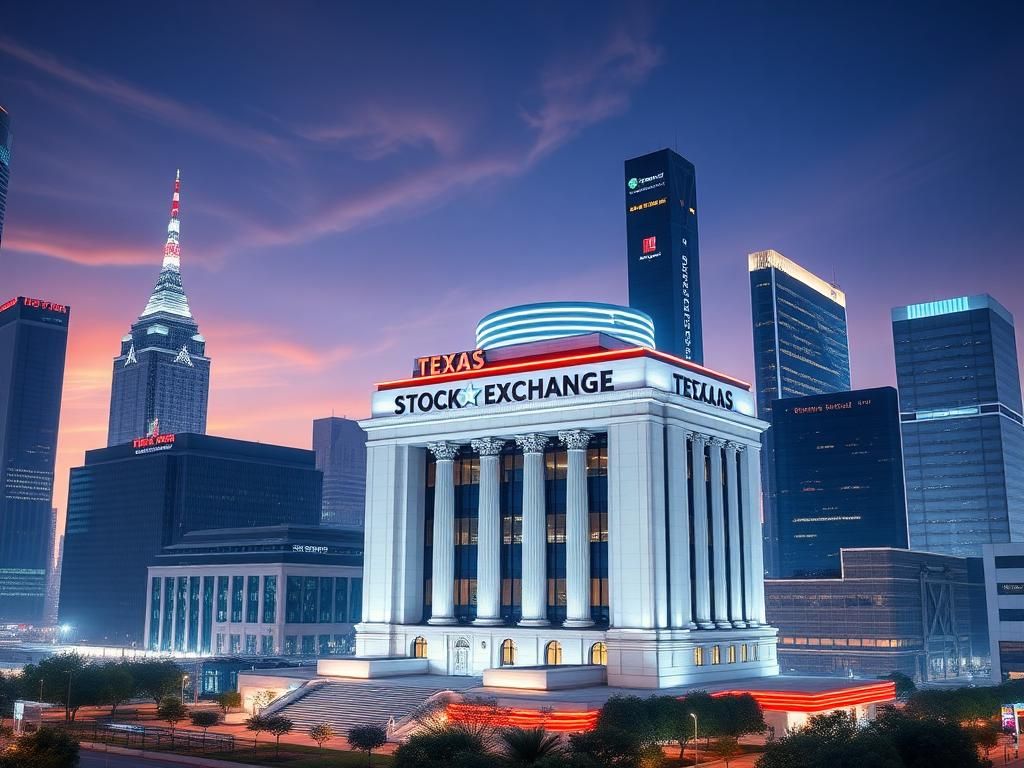
Texas Stock Exchange Approved: A New Challenger to Wall Street’s Dominance
Dallas, Texas – The financial landscape of the United States is poised for a significant shift as the Texas Stock Exchange (TXSE), a Dallas-based startup, has officially secured approval from the U.S. Securities and Exchange Commission (SEC) to operate as a national exchange. Announced on September 30, this milestone marks a pivotal moment in the ambitious bid to challenge the long-standing dominance of the New York Stock Exchange (NYSE) and Nasdaq.
The approval has been met with fervent enthusiasm by Texas officials, including Governor Greg Abbott, who confidently declared, “Texas is swiftly becoming America’s financial hub.” This sentiment underscores the state’s growing economic prowess and its deliberate efforts to attract major businesses and financial institutions.
A Well-Funded Challenger Emerges
The anticipation for TXSE, affectionately pronounced “Tex-ee,” has been building steadily since June 2024, when the exchange first unveiled its intentions to launch with a robust $120 million in backing. This substantial capital comes from an impressive roster of major investment firms, including industry titans like BlackRock and Citadel Securities. Such significant financial endorsement positions TXSE as one of the most well-funded attempts to establish a new national exchange in decades, highlighting serious investor confidence in its potential to disrupt the established order.
TXSE officials attribute this unprecedented move to the formidable strength of the Texas economy. The state has emerged as a magnet for Fortune 500 companies, drawn by what it offers: favorable regulatory environments and attractive taxation policies. Texas now proudly hosts the second-highest number of Fortune 500 company headquarters in the country, a figure that surpasses New York and closely trails only California. Nicole Chambers, Global Managing Director of Listings for TXSE, emphasized this point to Dallas business leaders in September, stating, “Texas is a major player in the U.S. regardless of the exchange landscape, but it ultimately makes sense as the 7th largest economy in the world.” She further noted that 45 countries, each smaller than Texas in economic output, successfully operate their own stock exchanges.
“Y’all Street” — A New Financial Frontier
Dallas’s burgeoning reputation as a financial services hub has earned it the playful moniker “Y’all Street.” This newfound status is not going unnoticed by the incumbents. Following TXSE’s initial announcement, both the NYSE and Nasdaq swiftly reacted. In February, the NYSE announced it would reincorporate its Chicago electronic exchange and relocate it to Dallas, rebranding it as NYSE Texas. Not to be outdone, Nasdaq declared in March its plans to establish a regional headquarters in Dallas. Bill Bailey, TXSE’s managing director of market intelligence, views these strategic moves as direct responses to TXSE’s emergence, underscoring the competitive pressure it has already generated.
Historically, Dallas has served as a critical trading nexus in the Sun Belt, owing to its central location. This geographic advantage, coupled with the expansion of Texas-based corporations and the growth of Dallas-Fort Worth International Airport as a national travel hub, has cemented the city’s role in communications, transportation, and finance, according to Ray Perryman, president of the Waco-based economic research company The Perryman Group.
Indeed, the region has witnessed explosive growth in its financial sector. Top investment banks such as JPMorgan Chase and Goldman Sachs have established significant presences, collectively employing tens of thousands. Goldman Sachs, for instance, is currently constructing a $500 million tower in downtown Dallas, slated to accommodate over 5,000 employees, making it the bank’s largest hub outside of New York. Charles Schwab famously moved its headquarters from California to Dallas in 2020. Over the past two decades, New York has seen a 16% growth in employment within the investment and securities sector, while Texas has experienced a remarkable 111% expansion, according to Perryman.
TXSE’s Competitive Edge and Future Outlook
Since the NYSE’s acquisition of the American Stock Exchange in 2008, a duopoly has effectively existed between the NYSE and Nasdaq. Past attempts to create a formidable third national exchange have largely faltered, with regional exchanges like those in Boston, Philadelphia, and Chicago either absorbed by the dominant players or shuttered. TXSE leadership believes their approach will yield a different outcome.
The TXSE will operate as an entirely digital exchange but will maintain a prominent physical presence in Dallas. It plans to incorporate the traditional pomp and circumstance of bell-ringing ceremonies, albeit with its distinctive “Texas flair.” Crucially, TXSE aims to attract companies by offering fewer stringent requirements for the composition of company boards of directors compared to its rivals. It also seeks to capitalize on a growing discontent among some companies regarding rising fees and evolving share price benchmarks imposed by Nasdaq and NYSE.
University of Texas at Arlington associate professor of finance, Sriram Villupuram, notes that the success of TXSE will heavily depend on the patience of its investors and its ability to rapidly onboard its first 50 to 100 companies. This initial momentum, he explains, will be crucial in demonstrating viability and attracting further listings, creating a snowball effect.
The lower cost of living in Texas compared to the Northeast also plays a significant role in attracting talent, as highlighted by Sasha Stratton, head of risk for Selby Jennings in Dallas. She observes that firms are increasingly prioritizing hiring in Dallas over New York, driven by talent availability, lower operational costs, and abundant real estate. This strategic shift, coupled with TXSE’s arrival, signals a recognition that building in Dallas is a smart, strategic decision that leverages the booming local economy.
Ultimately, the launch of TXSE, alongside the expansion of NYSE and Nasdaq operations in the area, is expected to enhance access to capital for growing Texas companies. This, in turn, is projected to fuel further expansion and job creation, establishing a virtuous cycle that benefits both the burgeoning exchanges and the broader Texas economy. While New York will likely retain its primary status in equity markets for the foreseeable future, as Perryman suggests, “the landscape is changing.” Texas is no longer just a state of ambition; it is rapidly transforming into a formidable financial powerhouse.