


James A. Lovell Jr., Apollo 13 Commander, Dies at 97
CHICAGO (AP) — James A. Lovell Jr., the legendary commander of NASA’s imperiled Apollo 13 mission who masterfully steered his crew through a harrowing crisis to a safe return, has died at the age of 97. NASA confirmed his passing on Thursday in Lake Forest, Illinois.
“Jim’s character and steadfast courage helped our nation reach the Moon and turned a potential tragedy into a success from which we learned an enormous amount,” NASA stated in a tribute. “We mourn his passing even as we celebrate his achievements.”
Lovell was one of the most distinguished astronauts of NASA’s early era, embarking on four spaceflights: Gemini 7, Gemini 12, Apollo 8, and the indelible Apollo 13. His two Apollo missions, in particular, captivated the world, showcasing both monumental exploration and extraordinary resilience.
A Journey to the Moon and Back: Apollo 8’s Historic Voyage
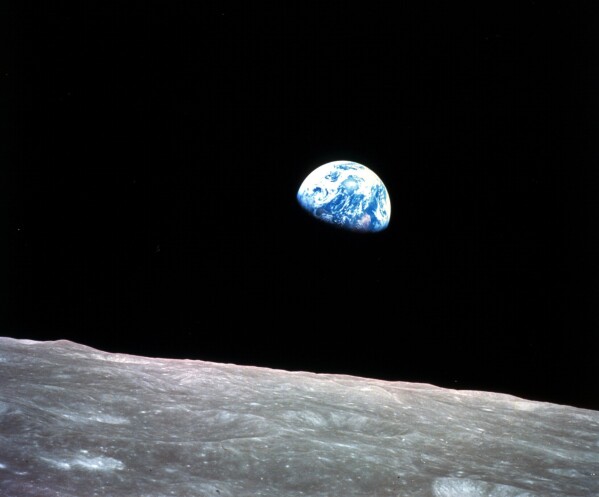
In December 1968, Lovell, alongside fellow astronauts Frank Borman and William Anders, etched their names in history as the crew of Apollo 8. This groundbreaking mission was the first to escape Earth’s orbit and the first to journey to and successfully orbit the Moon. While a lunar landing was not the objective, Apollo 8 delivered a critical triumph, placing the United States definitively ahead of the Soviet Union in the fiercely contested space race.
During this mission, Lovell offered vivid descriptions of Earth’s blue oceans and sprawling landmasses, reflecting, “What I keep imagining, is if I am some lonely traveler from another planet, what I would think about the Earth at this altitude, whether I think it would be inhabited or not.” The iconic “Earthrise” photograph, a world-first image of Earth from lunar orbit, along with the crew’s poignant Christmas Eve reading from the Book of Genesis, profoundly impacted a nation reeling from the tumult of 1968. Smithsonian Institution historian Roger Launius posited that Apollo 8’s significance rivals even the historic Apollo 11 moon landing, as it paved the way for future lunar expeditions.

Apollo 13: A Triumph of Resourcefulness Against Catastrophe

Yet, it was Lovell’s final mission, Apollo 13 in April 1970, that cemented his status as a national hero and an icon of cool under pressure. Originally slated to be the fifth human to walk on the Moon, Lovell’s lunar ambitions were dramatically cut short when, 200,000 miles from Earth, an oxygen tank in the spacecraft’s service module catastrophically exploded. The sudden rupture led to an urgent, desperate struggle for survival.
Lovell’s calm, measured transmission to Mission Control – “Houston, we’ve had a problem” – became one of the most famous phrases in space exploration history, a slight rephrasing of an earlier call from fellow astronaut Jack Swigert. With diminishing oxygen, dwindling water, and severely limited electricity, Lovell, Fred Haise, and Jack Swigert were forced to abandon their primary spacecraft. For four cold and clammy days, they huddled in the cramped lunar module, transforming it into an emergency lifeboat. The spacecraft, instead of landing, swung around the Moon, using its gravity to slingshot back towards Earth.
On the ground, legendary NASA Flight Director Gene Kranz spearheaded a team of hundreds of flight controllers and engineers. They worked tirelessly, improvising solutions in real-time to guide the stricken crew home. Their collaborative ingenuity in the face of insurmountable odds demonstrated the unparalleled capabilities of NASA personnel. As Lovell himself reflected in a 1994 interview, the mission, “in some sense it was very much of a success… Not that we accomplished anything, but a success in that we demonstrated the capability of (NASA) personnel.”
This dramatic saga was immortalized in the 1995 blockbuster film “Apollo 13,” with Tom Hanks portraying Lovell. The movie brought the harrowing journey and the brilliance of the ground team to a new generation, further solidifying Lovell’s place in popular culture. In a subtle nod to his real-life role, Lovell himself made a cameo appearance in the film as a Navy captain, a rank he held before retiring.
A Lifetime of Exploration and Resilience
Throughout his four missions, Lovell amassed a remarkable 715 hours, 4 minutes, and 57 seconds in space, holding the world record for longest cumulative time in space until the Skylab flights of the mid-1970s. Known for his unflappable demeanor, even in the face of profound danger, Lovell embodied a quiet confidence that set him apart. “He was a member of really the first generation of American astronauts and went on to inspire multiple generations of Americans to look at the stars and want to explore,” noted Bruce McClintock, head of the RAND Corp. Space Enterprise Initiative.
Lovell candidly acknowledged the lifelong impact of the Apollo 13 ordeal. “I don’t worry about crises any longer,” he stated in 1999. “Whenever he has a problem, ‘I say, “I could have been gone back in 1970. I’m still here. I’m still breathing.” So, I don’t worry about crises.’ “
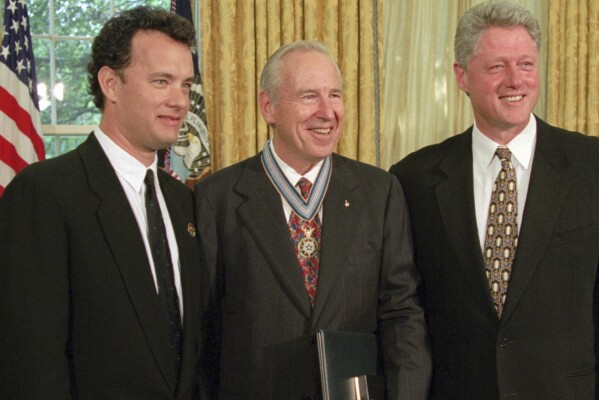
While the inability to walk on the Moon remained his “one regret,” as he shared with The Associated Press in 1995, he took immense satisfaction from the mission’s successful recovery. President Bill Clinton recognized this extraordinary feat, presenting Lovell with the Congressional Space Medal of Honor in 1995. “While you may have lost the moon… you gained something that is far more important perhaps: the abiding respect and gratitude of the American people,” Clinton affirmed.
As Lovell famously summarized in 2004, “Going to the moon, if everything works right, it’s like following a cookbook. It’s not that big a deal. If something goes wrong, that’s what separates the men from the boys.”
Early Life and Legacy
Born on March 25, 1928, in Cleveland, Ohio, James A. Lovell pursued his education at the University of Wisconsin before transferring to the U.S. Naval Academy in Annapolis, Maryland. On his graduation day in 1952, he married his beloved wife, Marilyn, who passed away in 2023. A skilled test pilot at the Navy Test Center in Patuxent River, Maryland, Lovell was selected by NASA as an astronaut in 1962.
He retired from both the Navy and the space program in 1973, transitioning into private business. In 1994, he co-authored “Lost Moon” with Jeff Kluger, a definitive account of the Apollo 13 mission that served as the foundation for the acclaimed film. Lovell and his family also operated Lovell’s of Lake Forest, a restaurant in suburban Chicago that has since closed.
Lovell is survived by his four children. In a heartfelt statement, his family honored him as their “hero,” adding, “We will miss his unshakeable optimism, his sense of humor, and the way he made each of us feel we could do the impossible. He was truly one of a kind.”


