

Trump Targets ‘Debanking’ with Sweeping Executive Order
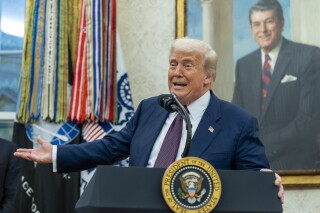
NEW YORK (AP) — President Donald Trump on Thursday signed a sweeping executive order, initiating a federal probe into allegations that banks have systematically discriminated against conservatives and specific industries, including gun manufacturers and cryptocurrency companies. The directive leverages the vast powers of the presidency to address a practice known as “debanking,” where financial institutions close accounts or refuse to do business with certain individuals or entities.
The Executive Order’s Mandate
The order mandates federal bank regulators to ensure that financial institutions do not discriminate based on political or religious beliefs. Critically, it also compels regulators to investigate instances of alleged discrimination and refer these cases to the Department of Justice within 120 days. This could expose banks to significant civil or criminal investigations, substantial fines, or other penalties.
Understanding ‘Debanking’ and Industry Arguments
“Debanking,” in the context of conservative concerns, refers to banks terminating relationships with customers whom they no longer wish to serve. While banks typically assert these decisions are based on risk assessments, such as perceived financial instability or potential for illicit activities, Trump and his allies argue that political or ideological bias is often the underlying motive. The banking industry maintains its constitutional right to select clients, provided it adheres to anti-discrimination laws like the Equal Credit Opportunity Act, which prohibits discrimination based on race, ethnicity, religion, sex, and other protected statuses.
The ‘Reputational Risk’ Factor
A key aspect of the executive order addresses “reputational risk” – a metric previously used by regulators to assess a bank’s safety and soundness. This concept suggests that associating with certain industries, deemed “high risk” due to their historical reputation for legal or ethical issues, could jeopardize a bank’s standing. Under the new order, bank regulators are instructed to remove reputational risk as a factor in their evaluation metrics.
Historical Context: Previous Administrations and Banking Practices
This isn’t the first time the U.S. government has influenced banking relationships with specific sectors. During the Obama administration, the Department of Justice spearheaded “Operation Choke Point,” which informally urged banks to avoid “high-risk” industries such as payday lenders and firearms manufacturers. Similarly, under President Joe Biden, bank regulators expressed public concerns about the cryptocurrency industry, a move perceived by many banks as a signal to distance themselves from crypto firms. This latter period was dubbed “Operation Choke Point 2.0” by Trump and his supporters, solidifying conservative grievances.
Trump’s Personal Experience and Allegations
For President Trump, the issue of debanking is deeply personal. In a recent CNBC interview, he claimed that two banking giants, JPMorgan and Bank of America, had “totally discriminated against” him and his companies after he left office in 2021, and against “many conservatives.” Both JPMorgan and Bank of America have vehemently denied these allegations. A JPMorgan Chase spokeswoman stated, “We don’t close accounts for political reasons, and we agree with President Trump that regulatory change is desperately needed.”
Scrutiny and Industry Reaction
The executive order faces scrutiny from former bank regulators who argue that financial and reputational risks are often intertwined. Graham Steele, a former Treasury Department official and Democratic Congressional staffer on banking issues, noted, “Financial risk, and reputational risk, can be intertwined.” He cited the 2023 failure of Signature Bank, partly due to its significant exposure to cryptocurrency companies during a market downturn, and Credit Suisse’s 2009 half-billion-dollar penalty for laundering money on behalf of Iran, as examples where reputational factors signaled underlying financial vulnerabilities.
Despite these concerns, major banking lobby groups have issued a joint statement, striking a cordial tone with the administration. They expressed support for the order’s goal of ensuring fair treatment for all consumers and businesses. “It’s in banks’ best interest to take deposits, lend to and support as many customers as possible,” their statement read. “Unfortunately, regulatory overreach, supervisory discretion and a maze of obscure rules have stood in the way as the (executive order) makes clear.” The banking industry has already been proactively removing mentions of reputational risk from their internal policies, particularly since Trump’s return to the White House.
Congressional Action
Congressional Republicans are also advancing efforts to curb alleged debanking practices. Senator Tim Scott of South Carolina, who chairs the Senate Banking Committee, has introduced legislation that would formally prevent bank regulators from considering reputational risk when assessing a bank’s health. Senator Scott lauded Trump’s action, stating, “Debanking federally legal businesses and law-abiding citizens is un-American, and President Trump’s Executive Order is a critical step towards protecting Americans’ access to financial services.”
Looking Forward
The executive order marks a significant escalation in the ongoing debate over banking discretion, regulatory oversight, and alleged political bias within the financial system, setting the stage for potential clashes between the administration, regulators, and the banking industry.