

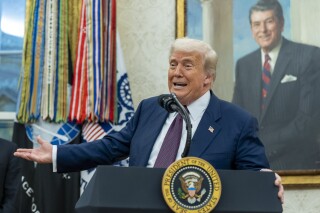
NEW YORK – President Donald Trump on Thursday signed an executive order initiating a federal investigation into allegations of banks discriminating against conservatives and specific industries, including gun manufacturers and cryptocurrency firms. This directive, invoking the executive branch’s broad regulatory authority, targets the practice known as “debanking,” where financial institutions close accounts or decline business for perceived risks. Trump, who has personally accused financial giants JPMorgan and Bank of America of debanking his own companies in the past—claims both banks unequivocally deny—asserts these actions are politically motivated.
President Trump Takes Aim at ‘Debanking’ with New Executive Order
What is “Debanking”?
“Debanking” broadly refers to the termination of financial services by banks for various reasons. While financial institutions typically cite risk assessment, legal compliance, or business decisions as the basis for these actions, conservatives, led by President Trump, contend it has become an insidious tool for ideological discrimination. In a candid interview with CNBC earlier this week, Trump declared, “They totally discriminate against … me maybe even more, but they discriminated against many conservatives.” This executive order directly addresses these profound concerns.
Key Provisions of the Executive Order
Under the sweeping executive order, federal bank regulators are mandated to ensure that banks strictly adhere to principles of non-discrimination based on political or religious beliefs. Crucially, the order also tasks these regulators with thoroughly investigating all reported instances of alleged discrimination and, within 120 days, referring substantiated cases to the Department of Justice. This could unleash severe repercussions for banks found in violation, including the specter of civil or criminal investigations, substantial financial penalties, and other punitive measures.
Banking Industry’s Perspective
The banking industry, however, largely maintains its inherent constitutional right to choose its clientele, provided such decisions do not violate established anti-discrimination statutes like the Equal Credit Opportunity Act. This landmark legislation, a product of the Civil Rights Movement, explicitly bans discrimination based on protected characteristics such as race, ethnicity, religion, and sex. Banks frequently assert that account closures or loan denials are rooted in legitimate financial and operational risk assessments, not political bias or ideological targeting.
Historical Precedent: Operation Choke Point and Reputational Risk
The contentious concept of “debanking” spurred by government influence is not unprecedented in U.S. financial history. During former Democratic President Barack Obama’s administration, the Department of Justice initiated “Operation Choke Point,” an initiative that advised banks to prudently avoid “high-risk” industries, a list that notably included payday lenders and firearms manufacturers. This practice is also widely recognized as managing “reputational risk”—where the perceived or historical reputation of an industry prompts banks to exercise heightened caution in extending services. Historically, such risks were primarily associated with entities involved in illicit activities, like those operating in high-risk countries, conducting large cash transactions, or frequently flagged for anti-money laundering violations. A pivotal aspect of the new executive order is its explicit directive for bank regulators to eliminate “reputational risk” as a factor in their metrics for assessing a bank’s overall safety and soundness.
Industry Reacts with Cautious Cooperation
Major banking lobby groups, which have generally benefited from President Trump’s deregulation agenda and favor simpler regulatory frameworks, have responded with a tone of cautious cooperation. In a joint statement, they articulated, “It’s in banks’ best interest to take deposits, lend to and support as many customers as possible. Unfortunately, regulatory overreach, supervisory discretion and a maze of obscure rules have stood in the way as the [executive order] makes clear.” They further added, “Today’s Executive Order helps ensure all consumers and businesses are treated fairly, a goal the nation’s banks share with the Administration.” Industry insiders note that, recognizing the heightened scrutiny surrounding this issue, the banking sector has reportedly already commenced removing any explicit mention of reputational risk from their internal policies and procedures, particularly since Trump returned to the White House.
Trump’s Personal Experience and Underlying Concerns
President Trump’s claims of being debanked by JPMorgan and Bank of America after leaving office in 2021 have been met with firm denials from both institutions. A spokeswoman for JPMorgan Chase emphatically stated, “We don’t close accounts for political reasons, and we agree with President Trump that regulatory change is desperately needed.” Nevertheless, the issue of financial exclusion based on perceived political alignment resonates deeply with the conservative base.
Expert Insights: The Intertwined Nature of Risk
Former Treasury Department official Graham Steele, who also served as a Democratic Congressional staffer on banking issues, has long cautioned that “financial risk, and reputational risk, can be intertwined.” He pointed to recent, tangible examples that underscore this interconnectedness:
- Signature Bank’s Collapse: Its demise in 2023 was partly attributed to substantial exposure to highly volatile cryptocurrency companies during a significant market downturn.
- Credit Suisse Penalties: In 2009, Credit Suisse was compelled to pay a staggering half a billion dollars to regulators for laundering money on behalf of Iran, starkly illustrating the immense financial penalties tied to severe reputational hazards.
The Road Ahead: Legislative Action and Political Implications
The Obama administration’s “Operation Choke Point” became a foundational rallying cry for conservatives, profoundly influencing industries like cryptocurrency, which largely backed Trump in the 2024 election. Although the Biden administration did not explicitly force banks to debank the crypto industry, their public expressions of concern were widely interpreted by banks as a clear signal to distance themselves from crypto-related businesses—a move swiftly dubbed “Operation Choke Point 2.0” by Trump and his political allies. In parallel, Republicans in Congress are actively pursuing legislative avenues to address alleged debanking practices. Senator Tim Scott of South Carolina, a prominent figure and Chairman of the Senate Banking Committee, has introduced legislation that would specifically prohibit bank regulators from considering reputational risk as a factor in their assessments of a bank’s financial health and risk profile. Scott lauded President Trump’s recent order, affirming, “Debanking federally legal businesses and law-abiding citizens is un-American, and President Trump’s Executive Order is a critical step towards protecting Americans’ access to financial services.”