


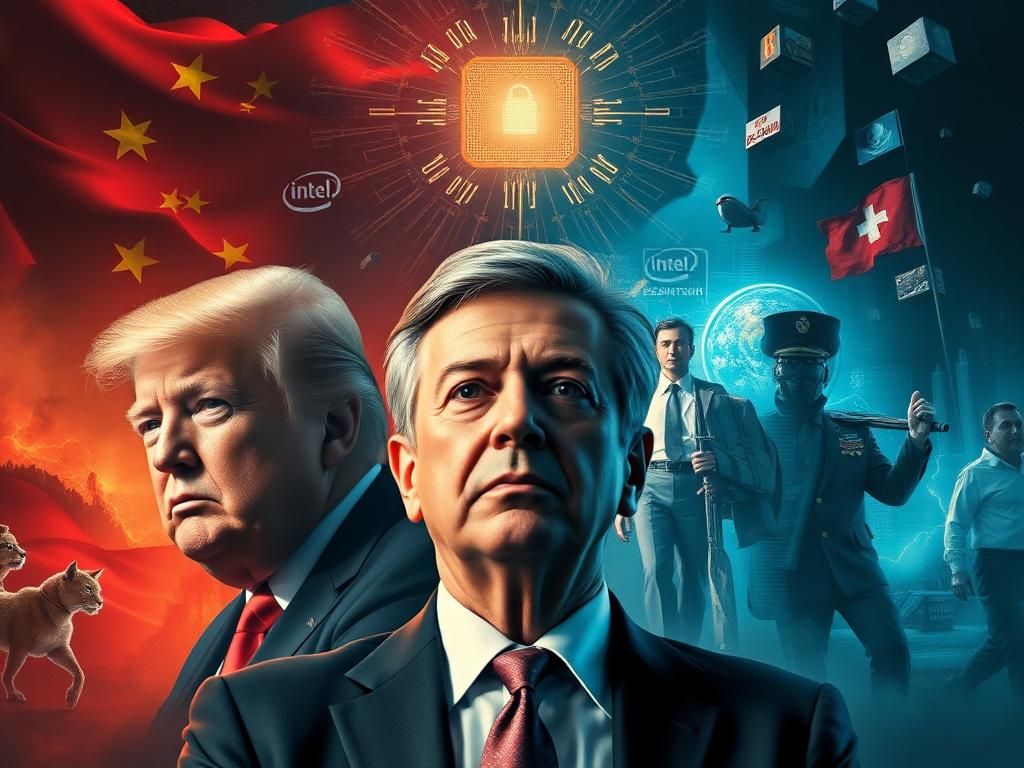
Intel Shares Plunge as Trump Demands CEO’s Resignation Over China Ties
Shares of semiconductor giant Intel experienced a sharp decline on Thursday, August 4, 2025, plummeting 3.5% following an explosive social media post from former President Donald Trump. Trump publicly demanded the immediate resignation of Intel CEO Lip-Bu Tan, accusing him of severe conflicts of interest stemming from his purported investments and deep connections to Chinese semiconductor firms, some allegedly linked to the Chinese Communist Party and the People’s Liberation Army.
“The CEO of Intel is highly CONFLICTED and must resign, immediately,” Trump declared on Truth Social. “There is no other solution to this problem. Thank you for your attention to this problem!” The unexpected declaration sent ripples through the market, contrasting sharply with the broader tech sector’s gains, particularly the Nasdaq.
Senator Cotton’s Alarming Letter Fuels Controversy
The former president’s direct challenge followed a formal letter sent to Intel Chairman Frank Yeary by influential Republican Senator Tom Cotton of Arkansas, a prominent voice on national security. Cotton’s correspondence, dispatched earlier in the week, expressed profound concern over Lip-Bu Tan’s reported extensive financial interests in Chinese advanced-manufacturing and chip companies. The senator cited intelligence reports suggesting Tan “reportedly controls dozens of Chinese companies and has a stake in hundreds of Chinese advanced-manufacturing and chip firms.” More alarmingly, Cotton’s letter claimed that “at least eight of these companies reportedly have ties to the Chinese People’s Liberation Army,” raising critical questions about potential espionage and technological security risks. Intel has yet to issue an official response regarding the allegations or confirm whether Tan has divested these disputed interests.
Who is Lip-Bu Tan? A Profile in Venture Capital and Asian Markets
Lip-Bu Tan, who assumed the helm as Intel’s CEO in March 2025, brings a long history in venture capital, having founded Walden International in 1987 with a strategic focus on funding burgeoning technology startups, particularly in the chip sector. China’s state media has previously lauded Tan for his “actively” devoted engagement in the Chinese and broader Asian markets. His investment portfolio notably includes shares in both Taiwan Semiconductor Manufacturing Company (TSMC) and SMIC, China’s state-owned semiconductor manufacturing international corporation, which is a key player in Beijing’s ambitions to advance its indigenous chipmaking capabilities.
Escalating US-China Tech Rivalry at Play
This escalating controversy unfolds against a backdrop of intensified economic and political rivalry between the United States and China. The competition for global technological dominance, especially in cutting-edge semiconductors, artificial intelligence (AI), and other digital technologies, is increasingly viewed by experts as a defining factor for future economies and potential military conflicts. Intel itself has been a significant beneficiary of the Biden administration’s landmark CHIPS and Science Act, receiving over $8 billion in federal funding earmarked for boosting domestic computer chip manufacturing across the U.S.
Senator Cotton’s Broader Security Push
Senator Cotton’s concerns about foreign influence and espionage extend beyond Intel. As chairman of the Senate Intelligence Committee, he has repeatedly voiced anxieties over Chinese operatives potentially infiltrating U.S. tech companies and defense contractors to steal classified information or embed digital backdoors into critical systems and networks. Just this Thursday, Cotton formally urged Defense Secretary Pete Hegseth to implement a comprehensive ban on all non-U.S. citizens from positions granting them access to Department of Defense networks. He has also called for a thorough investigation into Chinese citizens employed by defense contractors, reiterating previous warnings that “The U.S. government recognizes that China’s cyber capabilities pose one of the most aggressive and dangerous threats to the United States, as evidenced by infiltration of our critical infrastructure, telecommunications networks, and supply chains.” Cotton further emphasized on social platform X that “U.S. companies who receive government grants should be responsible stewards of taxpayer dollars and adhere to strict security regulations.”
Intel’s Tumultuous Turnaround Effort Faces New Headwinds
The current crisis further complicates Intel’s ongoing efforts to revitalize its market position. The company, founded in 1968 at the dawn of the personal computer revolution, notoriously missed the pivotal shift to mobile computing ignited by Apple’s iPhone release in 2007. More recently, Intel has struggled to keep pace with agile competitors like Nvidia, whose specialized chips have become the “hottest commodity” in the booming field of artificial intelligence. Under Tan’s leadership, the company is reportedly shedding thousands of workers and implementing aggressive cost-cutting measures, including some domestic semiconductor manufacturing capabilities, in a bid to reverse its fortunes. The calls for his resignation now add another layer of complexity to an already challenging turnaround.