


Dali Owners Sue Hyundai Heavy Industries Over Baltimore Bridge Collapse, Citing Defective Switchboard
Baltimore, MD – In a significant development following the tragic collapse of the Francis Scott Key Bridge, the owners of the cargo ship Dali have filed a lawsuit against Hyundai Heavy Industries (HHI), the vessel’s builder. Grace Ocean Private and Synergy Marine PTE Ltd, the Singapore-based owners and managers of the Dali, allege that a defectively designed switchboard on the ship was responsible for the critical power outage that led to the devastating collision in March.
Allegations of Defective Manufacturing
Filed last week in the U.S. District Court for the Eastern District of Pennsylvania, the lawsuit claims the switchboard was manufactured with insecure wiring connections, rendering the vessel “unreasonably dangerous” when it left Hyundai Heavy Industries’ control. The complaint states, “HHI’s defective manufacture of the Switchboard and Vessel caused the signal wiring to come loose in normal operation, resulting in the power outage that led to the allision with the Key Bridge.” Hyundai Heavy Industries has not yet publicly responded to these serious allegations, and their legal representatives were not immediately named in court records.
The Catastrophic Incident
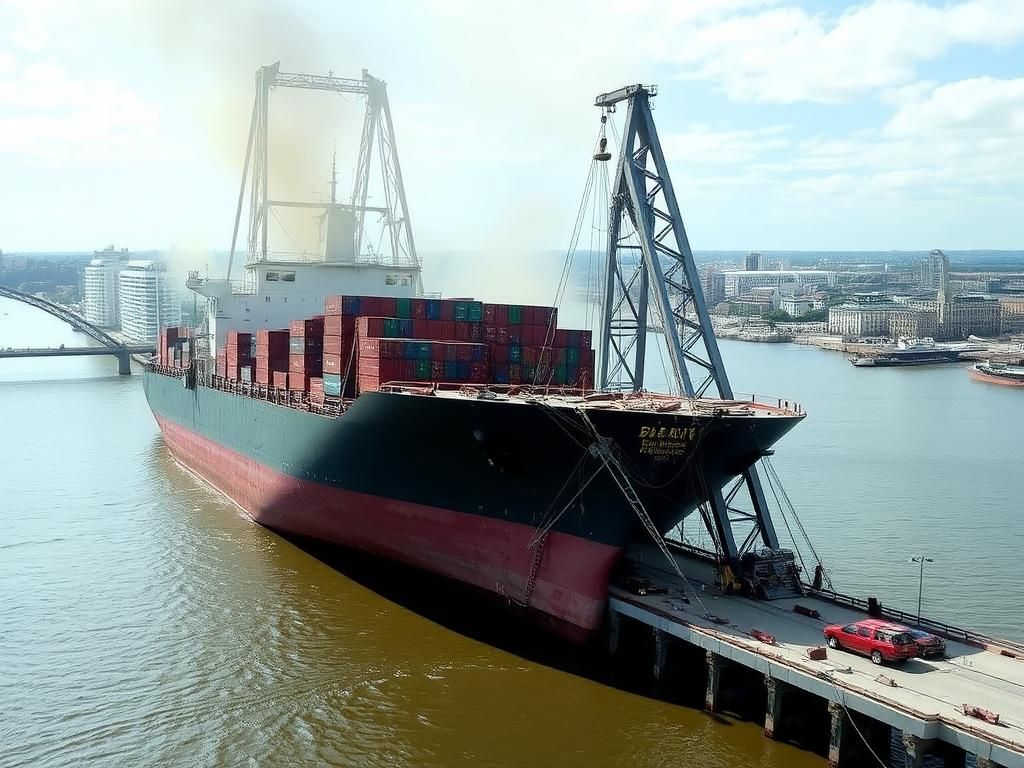
The incident, which occurred on March 26, saw the 984-foot-long Dali lose power and veer off course moments after departing Baltimore’s port en route to Sri Lanka. The unpowered vessel then tragically collided with a critical support pier of the Francis Scott Key Bridge, a vital 1.6-mile span over the Patapsco River, leading to its catastrophic collapse. The disaster resulted in the deaths of six construction workers, who were members of a roadwork crew on the bridge at the time.
Lingering Impact on Baltimore and Global Trade
In the aftermath, the Port of Baltimore, one of the busiest in the United States, was effectively shut down for months, causing significant disruptions to maritime traffic and global supply chains. While the main channel has since been reopened, the region continues to grapple with increased traffic congestion as a direct result of the bridge’s destruction.
Complex Legal Fallout and Previous Findings
This lawsuit marks a new chapter in the complex legal fallout from the collapse. Last year, the Justice Department pursued its own legal action against Grace Ocean Private and Synergy Marine PTE Ltd, seeking to recover over $100 million in federal funds spent on clearing the extensive underwater debris and restoring port operations. In that settlement, the ship’s owner and manager agreed to pay more than $102 million towards cleanup costs. The Justice Department’s earlier lawsuit had accused the Dali’s operators of negligence, alleging they “recklessly cut corners and ignored known electrical problems on the vessel,” specifically pointing to a failure to address “excessive vibrations” that had reportedly caused electrical issues.
Further compounding the narrative, a preliminary report from the National Transportation Safety Board (NTSB) released last year revealed that the Dali had experienced multiple electrical blackouts:
- Two distinct power losses in the hours leading up to its departure from the Port of Baltimore.
- Another blackout just moments before it crashed into the bridge.
The Road to Recovery
Meanwhile, demolition crews continue to work tirelessly at the site, removing large sections of the bridge wreckage using specialized equipment. Maryland officials recently visited the ongoing efforts. The replacement for the Francis Scott Key Bridge is currently projected to be completed and open to traffic by 2028, a testament to the long and arduous road ahead for Baltimore’s recovery.