


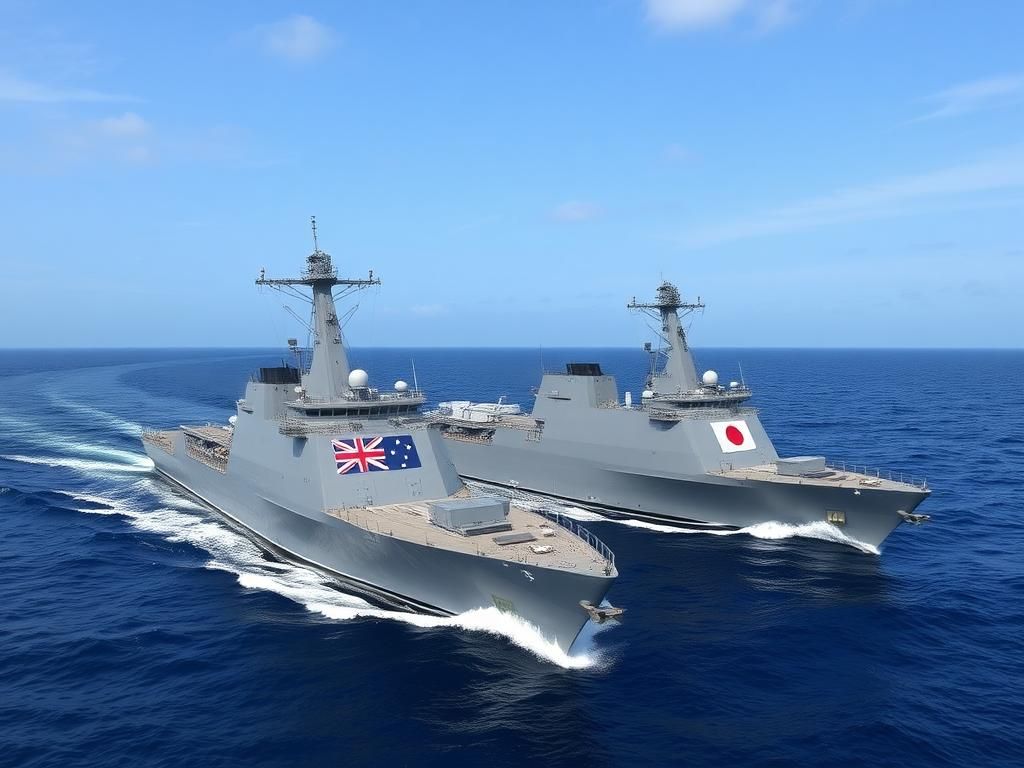
Australia Awards Landmark Naval Contract to Japan’s Mitsubishi Heavy Industries
In a significant strategic move, Australia has awarded a hotly contested multi-billion dollar contract for new naval vessels to Japan’s Mitsubishi Heavy Industries. The agreement, valued at an estimated 10 billion Australian dollars ($6.5 billion), will see the Japanese company’s advanced Mogami-class frigates replace Australia’s aging fleet of ANZAC-class ships.
A Monumental Step in Bilateral Defense Cooperation
The decision, announced Tuesday by Australian Defense Minister Richard Marles, marks a monumental step in bilateral defense cooperation. “This is clearly the biggest defense industry agreement that will ever have been struck between Japan and Australia,” Marles stated, highlighting its unprecedented scale as one of Japan’s largest ever defense exports. This victory comes after Japan’s government intensely lobbied for the deal, particularly keen to secure a major defense contract with Australia following its unsuccessful bid for Australia’s submarine contract in 2016, which was ultimately awarded to a French company.
Mogami-Class Frigate: A “Clear Winner”
Mitsubishi Heavy Industries’ Mogami-class frigate was chosen over Germany’s MEKO A-200, offered by Thyssenkrupp Marine Systems. While Australian news outlets indicated the German bid emphasized a lower price point and greater experience in international ship construction, Australia’s Minister for Defense Industry, Pat Conroy, affirmed the Mogami-class frigate was a “clear winner.” The selection was based on a comprehensive assessment of “cost, capability and meeting our schedule of delivery.”

The Advanced Mogami-Class Fleet
The new fleet will comprise 11 frigates. Three of these cutting-edge vessels are slated for construction in Japan, with the first expected to be operational in Australian waters by 2030. The remaining eight frigates will be built in Australia, fostering local industry and jobs. These modern warships boast impressive specifications:
- A range of up to 10,000 nautical miles (18,520 kilometers)
- 32 vertical launch cells capable of deploying long-range missiles
- Can operate with a significantly smaller crew of just 90 personnel, a notable reduction compared to the 170 required for the current ANZAC-class ships, leading to greater efficiency.
Bolstering Indo-Pacific Security
For Japan, a nation whose only treaty ally is the United States, this contract represents a major boost for its defense industry and a deepening of its security partnership with Australia, which it regards as a “special strategic partner.” Japanese Defense Minister Gen Nakatani emphasized the mutual benefits, stating, “We welcome the decision by the Australian government as a major step to further elevate Japan’s national security cooperation with Australia.” He added that the co-development of these frigates would enhance interoperability and efficiency, allowing both navies to train and operate with shared equipment. This strengthened cooperation comes amid increasing regional tensions, particularly in the disputed South China Sea, underscoring the strategic importance of a robust Australia-Japan defense posture in the Indo-Pacific.
Finalizing the Agreement and Future Investment
Australian officials confirmed that work on a binding commercial contract with Mitsubishi Heavy Industries and the Japanese government would commence immediately, with a finalized agreement anticipated by 2026. While specific costs per ship were not disclosed due to ongoing negotiations, Minister Conroy reiterated that the Australian government has allocated AU$10 billion for this project over the next decade. This investment forms a critical component of the larger AU$55 billion budget Australia has earmarked for its entire surface combatant fleet during the same period.
Associated Press writer Mari Yamaguchi contributed from Tokyo.