


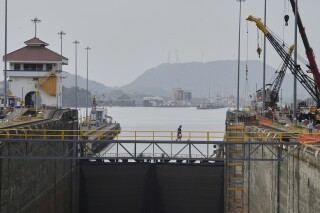
Panama Ports Company Battles Legal Challenges Amid Geopolitical Tensions Over Canal Control
HONG KONG (AP) — Panama Ports Company, a subsidiary of the prominent Hong Kong-based conglomerate CK Hutchison Holdings, issued a robust appeal on Friday for the legal protection of businesses operating in Panama. This plea comes as the company finds itself embroiled in a series of lawsuits challenging the legality of its long-standing contract to operate critical port assets at both ends of the strategic Panama Canal.
The Legal Storm Unleashed
The legal storm erupted on Wednesday when Panama’s Comptroller General formally filed two lawsuits. These legal actions aim to declare the original 1997 concession contract, which granted Panama Ports Company the operational rights to the key ports of Balboa on the Pacific coast and Cristobal on the Atlantic, unconstitutional. Furthermore, the lawsuits seek to nullify its renewal four years ago, in 2021, for an additional 25-year period. The Comptroller General labeled the renewal “abusive” to Panama’s national interests, following an April audit that reportedly uncovered irregularities and alleged failures by the company to pay approximately $1.2 billion to the Central American nation – a claim staunchly denied by Panama Ports Company.
Panama Ports Company Defends Its Operations
In its defense, Panama Ports Company underscored its significant and positive impact on the Panamanian economy. The company asserted that its operations have been instrumental in developing “world-class ports,” directly and indirectly creating “more than 25,000 jobs,” and contributing “billions of balboas” — Panama’s national currency — to the country’s economic prosperity. “Respect for legal protection and the rule of law are essential in order to provide businesses and investors with the certainty that Panama is a safe country to invest in,” the company stated, emphasizing its commitment to collaborating with the Panamanian government for a shared future.
Presidential Backing for Legal Action
Panamanian President José Raúl Mulino publicly backed the Comptroller General’s legal initiatives during his weekly news conference on Thursday. While declining to elaborate on specifics, Mulino stated, “We have all seen what that contract has costed the Panamanian nation over time.” He also hinted at early discussions for a potential public-private partnership for the ports, citing considerable interest from other private entities.
Geopolitical Tensions Entangle Port Assets
The contentious legal battle in Panama unfolds against a complex backdrop of escalating U.S.-China geopolitical tensions, in which CK Hutchison Holdings and its port assets have become unexpectedly entangled. The conglomerate, controlled by the family of Li Ka-shing, Hong Kong’s wealthiest man, had announced in March an ambitious plan to sell its vast global port portfolio – encompassing 43 ports across 23 countries, including its Panamanian operations – to a consortium valued at nearly $23 billion, including $5 billion in debt. This group notably included the U.S. investment firm BlackRock Inc., via its subsidiary Global Infrastructure Partners, and Terminal Investment Limited, a subsidiary of the Mediterranean Shipping Company.
Initially, this proposed sale garnered a favorable reaction from former U.S. President Donald Trump, who has previously voiced allegations of Chinese interference with the Panama Canal. However, the deal subsequently appeared to provoke Beijing, leading to a review by Chinese anti-monopoly authorities. After months of market uncertainty, Hutchison announced on Monday that it might explore the inclusion of a Chinese investor within the consortium of buyers, signaling a potential shift in strategy to navigate the intricate geopolitical landscape.
Dialogue and Sovereign Control
Panama Ports Company reiterated its intention to engage in dialogue with the Panamanian government “at the appropriate time,” affirming its belief that such engagement is “vital to discuss the way forward.” Meanwhile, the Panamanian government consistently maintains that it retains full sovereign control over the Panama Canal, asserting that the operational concessions granted to companies like Hutchison do not translate into Chinese control over the vital waterway.