


U.S. Stock Markets Volatile Amid Economic Concerns and AI Surge
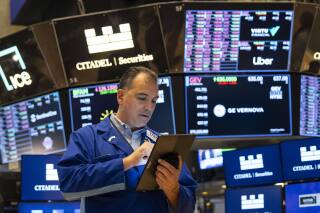
NEW YORK (AP) — U.S. stock markets experienced a volatile trading day on Tuesday, with major indexes slipping as a fresh wave of discouraging economic data heightened concerns about the nation’s financial health. Despite the downturn, resilience emerged from strong corporate earnings reports and growing anticipation of interest rate cuts by the Federal Reserve, preventing a more significant market slide.
Market Performance Overview
The S&P 500, a broad measure of the U.S. market, declined by 0.5%, shedding 30.75 points to close at 6,299.19. This marked a continuation of a whipsaw period, where the index recently swung from its steepest single-day loss since May to its best performance since May. The Dow Jones Industrial Average also saw a modest dip, falling 61.90 points, or 0.1%, to 44,111.74, while the technology-heavy Nasdaq Composite dropped 137.03 points, or 0.7%, finishing at 20,916.55. Despite Tuesday’s retreat, the S&P 500 remains within 1.4% of its all-time record high, underscoring the market’s underlying strength even amid headwinds.
Key Factors Driving Market Movements
Economic Data and Tariff Worries
A key factor driving Tuesday’s decline was a weaker-than-expected report on activity in the U.S. services sector. The Institute for Supply Management (ISM) survey, which tracks businesses in industries ranging from transportation to retail, painted a less optimistic picture of economic expansion. This report intensified worries that President Donald Trump’s tariff policies are beginning to inflict damage on the broader U.S. economy, impacting various business operations.
Offsetting Optimism: Rate Cuts and Earnings
However, these concerns were partially offset by two significant factors. Firstly, hopes are mounting for impending interest rate reductions by the Federal Reserve, with market participants now closely eyeing the September meeting for a potential cut. Lower interest rates typically make stocks more attractive by reducing borrowing costs for companies and making future earnings streams more valuable. Secondly, a steady stream of corporate earnings reports has largely exceeded analysts’ expectations, providing a counterbalance to the economic anxieties.
Individual Company Performance: A Mixed Bag
Companies Feeling the Pinch:
- Edgewell Personal Care: The conglomerate behind well-known brands like Schick razors, Playtex feminine hygiene products, and Banana Boat sunscreens, saw its shares plummet by 18.8%. The company reported lower profit and revenue for the latest quarter than analysts had forecast, with CEO Rod Little citing a “very weak season for sun care in North America” and acknowledging that tariffs were acting as a significant “drag on profits.”
- Tariff Debate Echoes: The ongoing tariff debate echoed across various sectors. In the ISM survey, trade policy emerged as one of the most frequently discussed topics among U.S. services businesses. For instance, a company in the healthcare and social assistance sector reported, “Tariffs are causing additional costs as we continue to purchase equipment and supplies. Though we need to continue with these purchases, the cost is significant enough that we are postponing other projects to accommodate these cost changes.” Conversely, a business in the real estate, rental, and leasing industry offered a more sanguine view, noting that economic “uncertainty remains the dominant theme. However, the tariff talk has turned out to be much more bluster than actual policy, and businesses have seemed to tune out the noise.”
- Yum Brands: The parent company of fast-food giants KFC, Taco Bell, and Pizza Hut, also experienced a downturn, with its stock falling 5.1% after reporting quarterly results that narrowly missed analysts’ projections.
The Power of AI:
- Palantir Technologies: The surge in artificial intelligence (AI) technology, however, appears largely unfazed by broader economic anxieties. Palantir Technologies, a prominent AI-platform provider, saw its stock surge by 7.8%. The company announced a stronger profit than anticipated for its latest quarter and raised its full-year revenue forecast. This impressive performance builds on Palantir’s momentum, with its stock having already doubled year-to-date prior to Tuesday’s jump. CEO Alex Karp enthusiastically stated, “We continue to see the astonishing impact of AI leverage.”
- Axon Enterprise: Similarly, Axon Enterprise, known for supplying Tasers, body cameras, and software to public safety departments, leaped an impressive 16.4%. The company reported a much stronger profit than expected, also attributing its success to growth in its AI offerings, which are proving invaluable for tasks like transcription and other time-saving applications. Axon also raised its revenue forecast for the year, signaling continued confidence in its AI-driven growth.
Broader Market Reactions and Global Outlook
American Eagle Outfitters and Valuation Concerns
American Eagle Outfitters, the clothing retailer, notably dropped 9.5% on Tuesday, ceding some of the substantial 23.6% gain it had achieved the previous day. This volatile movement followed President Trump’s public commentary on the company’s advertisements featuring actor Sydney Sweeney. The ads, which highlighted Sweeney’s “great jeans,” drew criticism for potentially promoting narrow beauty standards. Trump entered the fray with the remark, “WOKE is for losers,” contributing to the stock’s fluctuating fortunes.
The broader market’s surge to multiple records since April has led to criticisms that U.S. stocks have become overvalued. To justify current price levels, companies need to deliver even larger profits, or interest rates must fall to make equities comparatively more attractive. The latter scenario gained significant traction after Friday’s U.S. jobs report came in much weaker than economists had predicted, fueling expectations for an imminent Fed rate cut. While lower rates can stimulate the economy and reduce stock valuation concerns, they also carry the risk of pushing inflation higher.
Bond Market Response
In the bond market, Treasury yields reacted sharply to the weaker jobs data. The yield on the benchmark 10-year Treasury note eased to 4.19% on Tuesday, down from 4.22% late Monday and a more significant drop from 4.39% just before Friday’s jobs report release, indicating a notable shift in investor sentiment towards safer assets.
International Markets
Internationally, stock markets in most of Europe and Asia saw gains, with the exception of India’s Sensex, which dipped 0.4% amid ongoing concerns about escalating trade tensions with the United States. These tensions are primarily driven by the Trump administration’s push for India to curtail its oil purchases from Russia.
The market on Tuesday provided a clear illustration of the complex interplay between economic indicators, corporate performance, government policies, and monetary policy expectations, creating a nuanced landscape for investors.