

Texas Stock Exchange Gets Green Light, Set to Challenge Wall Street’s Dominance
By PAUL COBLER/The Texas Tribune
DALLAS, TX — The U.S. financial landscape is poised for a significant shift as the Texas Stock Exchange (TXSE) officially received approval from the U.S. Securities and Exchange Commission on September 30. This green light marks a crucial milestone for the Dallas-based startup, positioning it as a direct challenger to the long-standing dominance of the New York Stock Exchange (NYSE) and Nasdaq.
The announcement was met with fervent enthusiasm across Texas, with Governor Greg Abbott proclaiming that “Texas is swiftly becoming America’s financial hub.” This sentiment echoes a growing belief that the Lone Star State is ready to carve out a larger piece of the nation’s capital markets.
A Bold Bid Backed by Billions
The TXSE, often pronounced “Tex-ee,” first captured national attention in June 2024 with the revelation of a staggering $120 million in backing from influential investment firms, including BlackRock and Citadel Securities. This substantial financial foundation makes it one of the most robustly funded attempts at launching a new national exchange in decades, signaling serious intent to disrupt the established duopoly.
The strategic decision to launch in Texas is deeply rooted in the state’s robust economic performance. TXSE officials frequently highlight the influx of Fortune 500 companies relocating to Texas, lured by its business-friendly regulatory environment and advantageous taxation policies. Indeed, Texas now hosts the headquarters of the second-highest number of Fortune 500 companies in the nation, trailing only California and surpassing New York. Globally, if Texas were a country, its economy would rank as the world’s seventh-largest.
Nicole Chambers, Global Managing Director of Listings for TXSE, underscored this point at a September gathering of Dallas business leaders. “Texas is a major player in the U.S. regardless of the exchange landscape,” Chambers stated, noting that “45 countries smaller than Texas have their own stock exchanges.” She added, “Texas has really become a leader in where you can do business… We couldn’t do this in Oregon or in Nebraska.”
Wall Street’s Response: A Strategic Migration South
The emergence of TXSE has not gone unnoticed by the traditional giants. In a clear sign of the shifting tides, the New York Stock Exchange announced in February its decision to reincorporate its Chicago electronic exchange and relocate it to Dallas, rebranding it as NYSE Texas. Not to be outdone, Nasdaq followed suit in March, revealing plans to establish a regional headquarters in Dallas.
Bill Bailey, Managing Director of Market Intelligence at TXSE, views these moves as direct reactions to TXSE’s ambitious venture. These strategic expansions by Wall Street incumbents suggest a tacit acknowledgment of Dallas’s burgeoning financial importance and its new, informal moniker: “Y’all Street.”
Challenging the Duopoly: A Digital-First Approach with Texas Flair
For decades, the U.S. stock exchange landscape has been dominated by the NYSE and Nasdaq, a duopoly solidified after the NYSE’s acquisition of the American Stock Exchange in 2008. Historically, regional exchanges like those in Boston, Philadelphia, and Chicago were either absorbed by these larger entities or ceased operations. Attempts to establish a viable third national exchange have largely fallen short, struggling to attract a critical mass of listed companies.
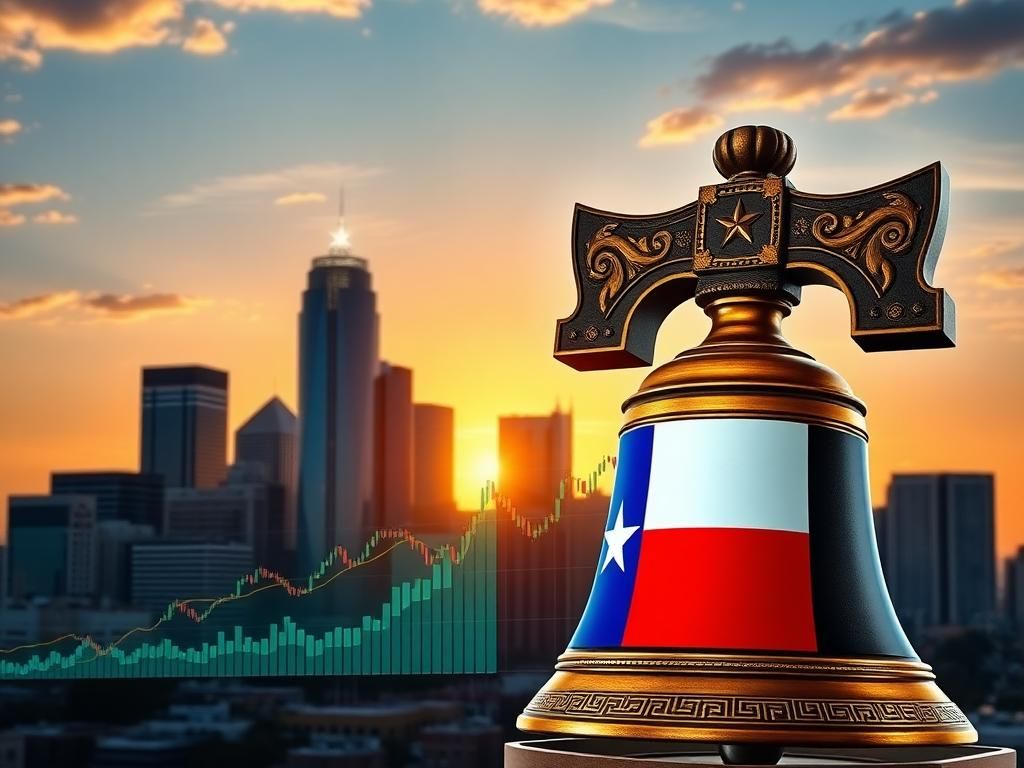
TXSE leadership is confident this time will be different. While the exchange will be entirely digital, reflecting modern trading practices, it plans to maintain a vibrant physical presence in Dallas. This includes incorporating the traditional pomp and circumstance, such as bell-ringing ceremonies, albeit with a distinctive Texas flavor.
Beyond symbolism, TXSE aims to offer a compelling alternative. With its $120 million seed investment, the digital exchange promises state-of-the-art technology. Crucially, TXSE plans to implement fewer stringent requirements for the composition of company boards of directors compared to its rivals. It also hopes to attract companies disaffected by what it describes as rising fees and increasingly challenging share price benchmarks at Nasdaq and NYSE.
The Road Ahead: Patience, Momentum, and Texas’s Economic Engine
Sriram Villupuram, an associate professor of finance at the University of Texas at Arlington, emphasizes that TXSE’s success will hinge on the patience of its investors and its ability to build momentum. Convincing companies to list on a new exchange takes time, but each new listing can create a snowball effect. The speed at which TXSE can onboard its initial 50 to 100 companies will be paramount.
“It gives those that are thinking about listing an idea about what it takes to get on the exchange, and it could snowball from there,” Villupuram noted. TXSE officials concur, asserting that the exchange’s long-term viability is intrinsically linked to the continued health and growth of the Texas economy. As the state continues to attract major corporations and financial services firms, the pool of potential listings for TXSE will expand.
While stock transactions are now predominantly digital, Villupuram highlights the enduring importance of a physical presence near major companies. “With stocks, the demand, the trading has become automated, electronic… but the supply, the courting of companies to come get listed with us, that is still very much human to human,” he explained.
Dallas: A Natural Financial Epicenter
Historically, Dallas has served as a pivotal trading hub in the Sun Belt, becoming a natural nexus for communications, transportation, and finance as Texas modernized. This trend has only accelerated with the growth of Texas-based corporations and the expansion of Dallas-Fort Worth International Airport into a major national travel hub, according to Ray Perryman, president of the Waco-based economic research firm The Perryman Group. “Dallas is the natural location for a financial center to emerge in this region,” Perryman stated.
Indeed, top investment banks like JPMorgan Chase and Goldman Sachs have significantly expanded their presence in the Dallas region, employing tens of thousands. Goldman Sachs is currently constructing a $500 million tower in downtown Dallas, slated to house over 5,000 employees and become its largest hub outside of New York. Charles Schwab famously relocated its headquarters from California to Dallas in 2020.
The numbers paint a clear picture: New York has seen a 16% growth in employment in the investment and securities sector over the past two decades, while Texas has experienced a remarkable 111% expansion during the same period, Perryman reported.
This shift is also driven by quality of life and cost of living. Sasha Stratton, head of risk for Selby Jennings in Dallas, a recruitment firm for financial services, moved from New York five years ago seeking homeownership and a higher quality of life for less money. She observes a distinct trend: “(Firms) are prioritizing hiring in Dallas over hiring in New York in a lot of instances… That’s driven by the availability of talent, the cost of operations, the availability of real estate and with the Texas Stock Exchange and other exchanges following suit, realizing it’s not a compromise to be building out in Dallas, it’s actually a smart, strategic decision.”
The combination of shifting economic activity to the South and the substantial financial backing of TXSE’s investors suggests that the new exchange could indeed become a formidable competitor, Perryman concludes. The launch of TXSE, coupled with the expansion of NYSE and Nasdaq into the region, is expected to create a virtuous cycle, making it easier for growing Texas companies to access capital, fostering further expansion, job creation, and ultimately benefiting the broader Texas economy.
“New York will likely remain the primary center of equity markets for the time being, but the landscape is changing,” Perryman affirmed, hinting at a new era of financial competition on American soil.
This story was originally published by The Texas Tribune and distributed through a partnership with The Associated Press.