Venezuelan Opposition Leader’s Nobel Gesture to Trump Sparks International Controversy and Political Turmoil
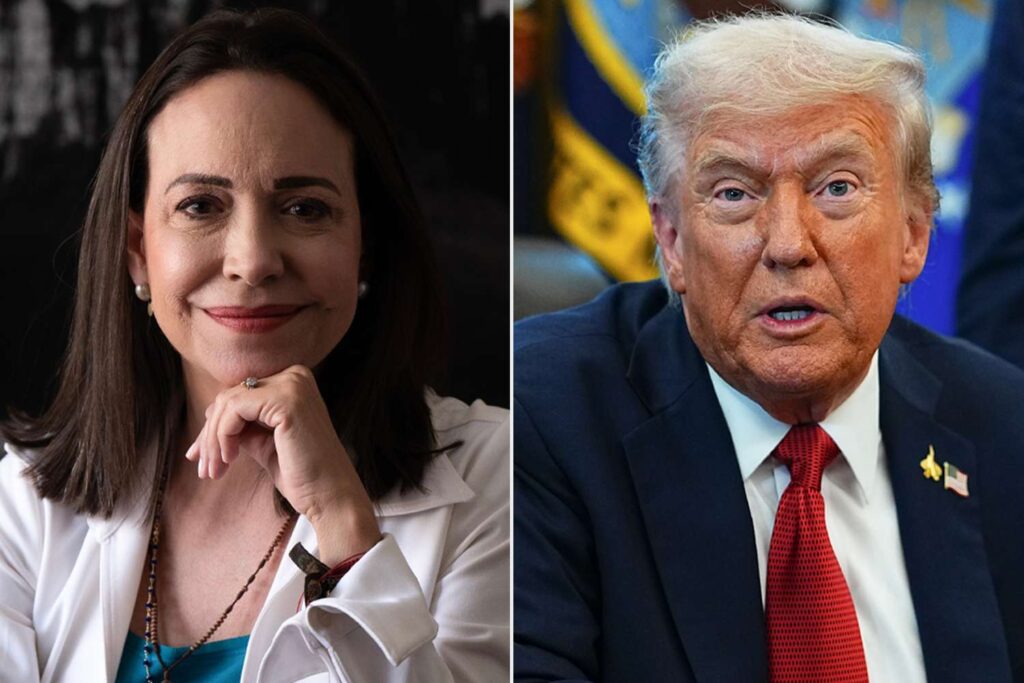
María Corina Machado’s Controversial Nobel Peace Prize Transfer Ignites Global Debate
On Thursday, January 15, 2026, a highly anticipated meeting at the White House between U.S. President Donald Trump and Venezuelan opposition leader María Corina Machado culminated in a stunning claim: Machado, the recent recipient of the 2025 Nobel Peace Prize, announced she had presented her prestigious award to President Trump. This unprecedented act has ignited a firestorm of debate, drawing a swift public rebuke from the Nobel Committee and raising significant questions about Machado’s political future in a post-Maduro Venezuela.
The private meeting in Washington D.C. was shrouded in initial secrecy. While Machado, 58, emerged from the White House without immediate comment, she soon revealed the extraordinary details to Fox News. “I presented the President of the United States the medal, the peace, the Nobel Peace Prize,” Machado stated, emphasizing the gift was “in recognition for his unique commitment with our freedom.” As of press time, the White House has remained silent on whether President Trump, 79, formally accepted the purported transfer of the award.

Nobel Committee Issues Stern Warning
The news of Machado’s intention, however, had already reached the Norwegian Nobel Committee days earlier. On January 9, just six days before the White House encounter, the committee issued a rare and stern public warning, directly addressing the permanence of the Nobel Peace Prize. Their statement clarified, “Once a Nobel Prize is announced, it cannot be revoked, shared, or transferred to others. The decision is final and stands for all time.” This pre-emptive declaration underscored the committee’s commitment to the integrity and immutable nature of its awards, effectively nullifying any attempt to reassign the honor. This warning came shortly after President Trump, during a Fox News interview with Sean Hannity, acknowledged reports of Machado’s desire, stating, “I’ve heard that she wants to do that. That would be a great honor.”
A Prize for Promoting Democracy
María Corina Machado was lauded by the Nobel Committee for her “tireless work promoting democratic rights for the people of Venezuela” and “her struggle to achieve a just and peaceful transition from dictatorship to democracy.” Her receipt of the 2025 Nobel Peace Prize was seen by many as a powerful international endorsement of her decades-long activism against authoritarian rule in Venezuela, a nation grappling with profound political and economic instability. The award recognized her unwavering commitment to democratic principles in the face of significant personal and political risk.
Political Implications and a Miscalculated Move?
The backdrop to this diplomatic drama is the recent seismic shift in Venezuelan politics. In the early hours of January 3, 2026, the Trump administration successfully orchestrated the capture of Venezuela’s long-standing President Nicolás Maduro. This pivotal event created a power vacuum and opened a potential pathway for a democratic transition. However, according to a January 4 report by The Washington Post, sources close to the White House suggested that Machado’s decision to accept, and subsequently attempt to transfer, the Nobel Peace Prize might have inadvertently jeopardized her prospects of becoming Venezuela’s next leader.
When questioned about installing Machado as Venezuela’s new leader following Maduro’s capture, President Trump expressed significant reservations. He claimed “it’d be very tough for her” to lead, asserting she “doesn’t have the support or the respect within the country.” A White House source, speaking to The Washington Post, went further, describing Machado’s initial acceptance of the prize – especially with the implied intent to dedicate or transfer it to Trump – as an “ultimate sin.” The source elaborated on the perceived strategic misstep: “If she had turned it down and said, ‘I can’t accept it because it’s Donald Trump’s,’ she’d be the president of Venezuela today.” This perspective highlights the complex political calculations and the potential for a misread of the domestic and international political landscape by Machado. President Trump himself has frequently asserted his own deservingness of the Nobel Peace Prize, often citing his efforts in negotiating solutions to multiple “unendable wars,” making Machado’s gesture particularly poignant, yet fraught with political peril.
Uncertain Future for Venezuela
The dramatic events of January 2026 have thrust María Corina Machado into an unenviable position. Her attempted presentation of the Nobel Peace Prize to President Trump, while intended as a gesture of profound gratitude and political alliance, has instead entangled her in a dispute with the venerable Nobel Committee and, arguably, complicated her path to leading her nation. As Venezuela stands at a critical juncture, navigating the complexities of a post-Maduro era, the implications of Machado’s controversial decision—and whether it has truly undermined her “tireless work” for Venezuelan democracy—remain to be seen.